Best Healthcare Contract Management Software for Life Sciences

Streamline your document processes with airSlate SignNow's easy-to-use and affordable eSigning solution that enhances efficiency and reduces costs.

Award-winning eSignature solution

What best healthcare contract management software for life sciences does and why it matters

best healthcare contract management software for life sciences centralizes creation, routing, execution, and storage of clinical agreements, vendor contracts, confidentiality agreements, and regulatory documents. For life sciences organizations, this software reduces manual errors, enforces version control, and provides searchable repositories for audit readiness. It typically combines eSignature capability, role-based permissions, secure cloud storage, and detailed audit logs to support compliance with HIPAA and institutional policies while improving collaboration across clinical, legal, procurement, and compliance teams.

Why life sciences teams choose specialized contract management

A purpose-built solution speeds execution, reduces compliance risk, and centralizes records for audits and inspections in the regulated life sciences environment.

Why life sciences teams choose specialized contract management

Common challenges addressed by contract management software

  • Fragmented document storage across departments creates version confusion and audit gaps that delay reviews and approvals.
  • Manual signature and routing processes extend contract cycle times and increase the likelihood of missed renewal or compliance dates.
  • Insufficient access controls risk unauthorized exposure of PHI or proprietary trial data, creating regulatory and IP concerns.
  • Lack of integrated audit trails makes it difficult to demonstrate chain-of-custody and signer intent during inspections.

Representative user profiles

Clinical Trial Manager

A Clinical Trial Manager uses the system to distribute site contracts and investigator agreements, track signatures, and verify execution before study initiation. They rely on template controls and reminders to enforce standardized terms and to reduce trial start delays across multiple sites and sponsors.

Corporate Counsel

Corporate Counsel monitors redlines, approval history, and audit trails to confirm enforceability and regulatory compliance. They use role-based permissions to control access to sensitive clauses and produce evidence of intent and chain-of-custody during audits or dispute resolution.

Primary users in life sciences organizations

  • Clinical operations teams who manage investigator agreements and site contracts with complex approval chains.
  • Legal and compliance teams that require enforceable signatures, redlining history, and retention policies.
  • Procurement and vendor management groups coordinating supplier contracts and renewals across global sites.

Cross-team visibility and standardized workflows reduce bottlenecks and make compliance documentation easier to produce for audits.

Expanded feature set to support enterprise life sciences programs

Beyond core signing and templates, advanced features support scale, security, and process governance across global programs.

Document repository

Centralized, searchable storage with metadata, indexing, and retention controls to keep executed agreements accessible for audits and inspections.


Workflow automation

Conditional routing, parallel approvals, and automated reminders reduce cycle times and keep multi-stakeholder reviews on schedule.

Access controls

Granular role-based permissions and compartmentalization restrict PHI and proprietary content to authorized users only.

Compliance reporting

Prebuilt reports and exportable audit logs help demonstrate ESIGN and HIPAA adherence during internal and external reviews.

API access

REST APIs allow integration with trial systems, CRMs, and document management platforms to automate contract creation and status updates.

Bulk Send

Ability to send identical documents to many recipients at once, useful for investigator agreements and large supplier rollouts.

be ready to get more

Choose a better solution

Four essential features for life sciences contract workflows

Certain capabilities consistently deliver the most value for regulated contracting, including auditability, templates, and integrations that minimize manual work.

eSignature

Legally enforceable electronic signatures with configurable authentication options and detailed timestamps to demonstrate signer intent for clinical agreements and vendor contracts.

Template library

Pre-approved contract templates with locked clauses and placeholders reduce legal review cycles and ensure consistent language across study sites and supplier contracts.

Audit trail

Immutable logs capture user actions, IP addresses, and timestamps so teams can produce evidence for HIPAA-related audits and sponsor inspections.

Integrations

Direct connectors to document repositories, CRMs, and PRA systems streamline document transfer and reduce manual rekeying across trial management tools.
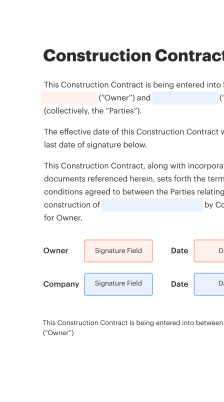
How the signature and approval flow typically operates

An overview of the sequential steps signers and reviewers experience when using the system for life sciences agreements.

  • Initiate: Create a secure envelope or contract package
  • Route: Define signing order and parallel approvals
  • Sign: Signers authenticate and apply signatures
  • Complete: System generates final PDF and audit log
Collect signatures
24x
faster
Reduce costs by
$30
per document
Save up to
40h
per employee / month

Quick setup: getting a contract executed

A concise four-step sequence from document preparation to executed storage for regulated contracts.

  • 01
    Prepare document: Upload template and apply required fields
  • 02
    Configure workflow: Set approvers, routing order, and reminders
  • 03
    Collect signatures: Send to signers via email or Bulk Send
  • 04
    Archive and record: Store executed PDF with audit trail
be ready to get more

Why choose airSlate SignNow

  • Free 7-day trial. Choose the plan you need and try it risk-free.
  • Honest pricing for full-featured plans. airSlate SignNow offers subscription plans with no overages or hidden fees at renewal.
  • Enterprise-grade security. airSlate SignNow helps you comply with global security standards.
illustrations signature

Typical workflow settings and recommended configurations

Default settings and examples that life sciences teams commonly configure to align the platform with study and compliance needs.

Workflow Setting Name Header Row Configuration (default value shown; editable by admins)
Reminder Frequency for Pending Signatures 48 hours; daily reminders to signers
Signature Routing and Approval Order Sequential routing with parallel legal review
Document Retention and Archival Policy 7 years after study closure
Access Expiry for External Users 90 days post-signature
Notification Channels for Status Updates Email and in-app notifications enabled

Supported platforms and system requirements

  • Desktop browsers: Chrome, Edge, Safari supported
  • Mobile support: iOS and Android apps available
  • API compatibility: REST API with OAuth2

Validate browser versions, mobile OS minimums, and firewall rules with your IT team before rollout to ensure smooth integrations and secure access for remote sites and partners.

Core security and protection controls

Encryption at rest: AES-256 level encryption
Encryption in transit: TLS 1.2+ for data transmission
Role-based access: Granular permissions per user
Comprehensive audit logs: Immutable activity records
Multi-factor authentication: Optional MFA for users
HIPAA controls: Business associate agreement support

Industry examples showing practical impact

Two brief case examples illustrate real-world applications of contract management in life sciences settings.

Multi-site trial start-up

A sponsor needed coordinated signature collection across 25 trial sites with different local contracts and timelines.

  • Template enforcement and Bulk Send reduced local edits and standardized language.
  • Centralized tracking shortened turnaround by reducing manual follow-ups and missed signatures.

Resulting in accelerated site activation and improved audit readiness across the program.

Vendor contract consolidation

A manufacturing department consolidated multiple supplier agreements into one governed repository to manage lot-release services and QA terms.

  • Role-based approvals ensured legal and QA signoff before execution.
  • Automated reminders and retention rules reduced expirations and noncompliance exposures.

Leading to clearer supplier SLAs and fewer procurement disputes during inspections.

Best practices for secure and compliant contract management

Practical steps life sciences teams can adopt to improve contract controls, reduce risk, and simplify audits.

Standardize templates and locked clauses
Use legally approved templates with immutable sections for core compliance and IP terms. Locking critical clauses reduces inconsistent language, speeds legal review cycles, and ensures regulatory obligations are consistently captured across sites and vendors.
Enforce role-based approvals and separation of duties
Implement routing that requires independent review from legal, QA, and clinical operations where appropriate. Separation of duties reduces conflicts of interest and strengthens evidence of proper approvals during inspections.
Keep comprehensive, exportable audit records
Regularly export and back up executed bundles with full audit trails. Store these records in an immutable archive to support regulatory requests and legal inquiries without relying on live application access.
Train users and maintain clear SOPs
Provide role-focused training and publish standard operating procedures for contract creation, redlining, and signature workflows. Consistent user behavior reduces errors and ensures defensible document handling.

Frequently asked questions and troubleshooting guidance

Answers to common implementation and usage questions for contract management in regulated life sciences environments.

Feature availability comparison: signNow versus other major providers

A concise availability and capability comparison of core features among three leading eSignature and contract tools used in life sciences.

Feature signNow (Recommended) DocuSign Adobe Acrobat Sign
HIPAA-compliant deployment and option availability
API availability and developer support REST API REST API REST API
Bulk Send capability for mass distribution Bulk Send Bulk Send Bulk Send
Audit trail detail and export formats Extensive Extensive Extensive
be ready to get more

Get legally-binding signatures now!

Regulatory and operational risks of poor contract handling

Regulatory fines: Significant financial penalties
Data breach costs: Direct remediation expenses
Contract disputes: Litigation and settlement risk
Clinical delays: Missed enrollment windows
Reputation damage: Trust erosion with partners
Operational inefficiency: Higher administrative burden

Pricing and plan highlights for common life sciences needs

Representative plan comparisons across providers to help assess budget, support, and compliance features. Pricing and plans vary by contract and organization size.

Plan and Feature Comparison signNow (Recommended) DocuSign Adobe Acrobat Sign OneSpan Sign PandaDoc
Starting price (indicative) From $8/user/month From $10/user/month From $14.99/user/month Enterprise pricing only From $19/user/month
Free trial availability Yes, limited Yes, short trial Yes, limited Contact sales Yes, limited
HIPAA add-on or support BAA available BAA available BAA available BAA on request BAA available
API access in plan Included in business plans Available in developer plans Included in business plans Enterprise only Included in paid plans
Typical target customers Small to mid enterprises and enterprises Large enterprises and regulated orgs Enterprise customers and Adobe customers Large regulated enterprises Sales and document-heavy teams
walmart logo
exonMobil logo
apple logo
comcast logo
facebook logo
FedEx logo
be ready to get more

Get legally-binding signatures now!