Custom Invoice Template for Government

Streamline your billing process with airSlate SignNow's user-friendly tool designed for government needs. Save time and reduce costs while ensuring compliance with every invoice.

Award-winning eSignature solution

What a custom invoice template for government entails

A custom invoice template for government is a standardized digital billing document configured to meet public-sector formatting, accounting, and procurement requirements. It includes required fields such as contract numbers, purchase order references, vendor tax identifiers, line-item harmonization, and state or federal reporting codes. Used consistently, the template reduces manual entry, supports audit readiness, and helps ensure invoices conform to payment terms and agency-specific documentation rules while remaining adaptable for different agencies and contract types.

Why use a tailored government invoice template

A government-specific template enforces required fields and consistent data formats, reducing payment delays and manual corrections while improving traceability for audits and compliance reviews.

Why use a tailored government invoice template

Common challenges when invoicing government entities

  • Missing contract or purchase order numbers cause processing delays and often trigger manual follow-up from accounts payable.
  • Inconsistent line-item descriptions or codes result in rejected invoices and prolonged reconciliation cycles with agency systems.
  • Incorrect vendor registration details or tax identifiers can block payment until registration is corrected in government portals.
  • Failure to include required certifications or attachments leads to noncompliance and potential penalties or withheld funds.

Representative user profiles

Contractor CFO

A finance leader at a small government contractor who needs consistent invoice formats to match multiple agency purchase orders, reduce payment lag, and maintain a clear audit trail for contracts spanning several fiscal years.

Procurement Officer

An agency procurement specialist who validates incoming invoices against contract terms and coding standards, requiring templates that surface required fields and attachments to speed verification and payment processing.

Organizations and roles that commonly use government invoice templates

Typical users include small businesses that contract with federal or state agencies, procurement teams, and accounts receivable specialists tasked with submitting compliant invoices.

  • Small and mid-sized contractors submitting periodic invoices under government contracts.
  • Internal procurement and contract managers ensuring invoice accuracy before submission.
  • Accounts payable teams reconciling payments and responding to agency inquiries.

These stakeholders benefit from templates that reduce errors, accelerate approvals, and provide consistent records for compliance and audit purposes.

Core features for robust government invoice templates

These capabilities support accuracy, compliance, and operational efficiency when preparing invoices for government entities.

Conditional fields

Show or hide fields based on contract type or agency, reducing clutter and ensuring only relevant billing elements are required per invoice submission.


Template library

Maintain multiple templates for different agencies, contract vehicles, or fiscal periods to ensure consistent formatting and compliance across submissions.

Bulk Send

Send batches of invoices populated from a data source, reducing manual sending and supporting periodic or milestone-based billing cycles.

Custom branding

Include standardized vendor identification and compliance notices that agencies may require, while preserving necessary legal and tax information.

Approval routing

Define sequential or parallel approval flows so invoices are reviewed by finance and contract managers before dispatch to agencies.

Audit trail

Capture signer identities, timestamps, and change history to support dispute resolution and meet audit requirements for public-sector contracts.

be ready to get more

Choose a better solution

Integration and template capabilities to support government billing

Select template features should simplify compliance, automate data entry, and integrate with common systems used by vendors and agencies.

Field validation

Enforce formats for contract numbers, tax identifiers, and agency codes so submitted invoices meet portal requirements and minimize manual rework by accounts payable teams.

Data merge

Auto-populate invoices from contract management systems or CRMs to reduce duplicate entry, ensure line-item accuracy, and attach matching purchase order references for reconciliation.

Attachment handling

Include required supporting documents such as certifications, timesheets, and receipts, with validation rules that ensure mandatory attachments are present before submission.

Version control

Maintain template revisions and change history so teams can track updates that affect invoicing rules and retain auditable records for compliance purposes.
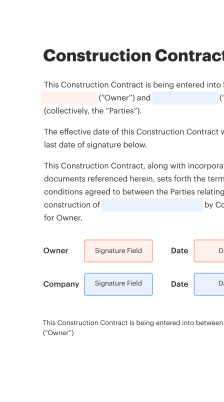
How government invoice templates integrate with document workflows

A template becomes a reusable component in a document workflow, ensuring each invoice follows predefined structure, validation, and approval steps before submission to an agency portal.

  • Create template: Design fields and validations once
  • Populate automatically: Merge contract and PO data
  • Approve internally: Route for manager sign-off
  • Submit or archive: Send to agency or store securely
Collect signatures
24x
faster
Reduce costs by
$30
per document
Save up to
40h
per employee / month

Quick setup: creating a government-ready invoice template

Follow these core steps to create a template that satisfies common government billing requirements and reduces processing friction.

  • 01
    Define fields: List required agency fields and codes
  • 02
    Set validations: Require PO and tax ID formats
  • 03
    Add attachments: Include certified documents and receipts
  • 04
    Test and deploy: Validate with sample submissions

Managing audit trails and records for government invoices

Maintain comprehensive records of who viewed, modified, and signed invoices to support audits and dispute resolution with government payors.

01

Event capture:

Log all significant actions
02

Signer identity:

Record authentication method
03

Timestamping:

Store UTC timestamps
04

Version history:

Preserve prior document states
05

Exportable logs:

Provide downloadable CSV or PDF
06

Retention policy:

Apply statutory retention rules
be ready to get more

Why choose airSlate SignNow

  • Free 7-day trial. Choose the plan you need and try it risk-free.
  • Honest pricing for full-featured plans. airSlate SignNow offers subscription plans with no overages or hidden fees at renewal.
  • Enterprise-grade security. airSlate SignNow helps you comply with global security standards.
illustrations signature

Recommended workflow configuration for government invoices

Configure workflow settings to enforce validations, approvals, and retention policies tailored to public-sector billing practices.

Technical Workflow Setting Name Header Default configuration values used by workflows
Default Email Reminder Frequency Setting 48 hours; three reminders
Default Signing Order Mode Setting Sequential signing
Primary Recipient Authentication Method Setting Email with optional SMS OTP
Document Retention Period Policy Setting 7 years retention
Audit Trail Detail Level Setting Full event and metadata logging

Access and device considerations

Templates and signing workflows should work reliably across desktop and mobile browsers and on native apps where available.

  • Desktop compatibility: Modern browsers supported
  • Mobile and tablet: iOS and Android apps
  • Offline access: Limited offline support

Ensure chosen tools meet agency requirements for secure authentication, provide consistent rendering across devices, and support file types commonly required by government portals when preparing invoices for submission.

Security controls relevant to government invoicing

Transport encryption: TLS 1.2 or higher
At-rest encryption: AES-256 encryption
Access controls: Role-based access
Authentication methods: Multi-factor supported
Audit logging: Comprehensive event logs
Data isolation: Tenant separation options

Use cases: templates applied in real scenarios

Two brief case studies illustrate how a compliant government invoice template improves operations and payment outcomes.

Municipal services contractor

A mid-sized contractor standardized invoices across five municipal contracts to include PO numbers, vendor tax IDs, and labor hour breakdowns.

  • Template fields prevented missing PO references in 98 percent of submissions.
  • The consistent layout reduced agency queries and manual rework.

Resulting in faster payment cycles and clearer records for municipal audits, improving cash flow predictability.

State IT supplier

An IT supplier implemented a template with contract-specific billing codes and required compliance attestations to meet state procurement rules.

  • The template automated line-item mapping to state chart of accounts.
  • Departments received invoices ready for automated matching to purchase orders.

Leading to reduced invoice rejections, streamlined approvals, and fewer manual adjustments during quarterly reconciliations.

Best practices for secure and accurate government invoices

Adopt consistent processes, enforce validations, and document retention practices to minimize errors and maintain compliance for public-sector billing.

Design templates around agency requirements and contract terms
Map each required agency field into the template and include conditional logic for contract-specific variations. Maintain a library of agency-specific templates to avoid one-size-fits-all mistakes and reduce manual adjustments during billing cycles.
Enforce field validation and required attachments
Require purchase order numbers, contract identifiers, and any mandatory certifications or timesheets before allowing submission. Implement file-type and size checks to match agency portal constraints and reduce rejection rates.
Implement approval routing and signer authentication
Route invoices for internal review and require appropriate authentication (MFA, SSO, or verified email) for signers. Document who approved each invoice and retain authentication evidence for audits.
Maintain retention policies and exportable audit logs
Keep signed invoices and related logs for the statutory period, ensure exportability to common archival formats, and document retention schedules to align with contract and regulatory obligations.

FAQs: common questions about government invoice templates

Answers to frequently asked questions address compliance, formatting, authentication, and integration concerns encountered when using templates for government billing.

Feature availability: digital signing providers compared

A concise feature comparison highlights availability and basic technical details across leading U.S.-focused eSignature providers.

Primary Feature and Criteria Header signNow (Recommended) DocuSign Adobe Sign
Legally binding in U.S. contexts
Bulk Send capability availability
Detailed audit trail records Detailed Detailed Detailed
HIPAA compliance options
be ready to get more

Get legally-binding signatures now!

Retention and deadline checkpoints for government invoicing

Apply these timing and retention checkpoints to stay aligned with contract terms and audit requirements.

Invoice submission window requirements:

Submit within contract-defined days

Internal approval turnaround times:

Set 3-5 business day SLAs

Retention period for financial records:

Retain records seven years

Audit preparation review cadence:

Quarterly internal checks recommended

Contract closeout documentation deadline:

Preserve final invoices and attachments

Risks and penalties for noncompliant government invoicing

Payment delays: Late or withheld payments
Contract disputes: Escalated reviews
Fines: Monetary penalties possible
Debarment risk: Contract suspension
Audit exposure: Increased oversight
Reputational harm: Vendor credibility loss

Pricing and plan comparison for common eSignature use cases

Representative plan details and features help assess total cost and fit for government invoicing workflows; values reflect publicly stated entry-level or business-tier offerings.

Pricing Comparison Table Header signNow (Recommended) DocuSign Adobe Sign Dropbox Sign PandaDoc
Plan starting price (monthly) Starts at $8 per user per month Starts at $10 per user per month Starts at $14.99 per user per month Starts at $12 per user per month Starts at $19 per user per month
Per-signature cost (estimate) Volume-based; lower with plans Typically included in plans Included in plans Included in plans Included in plans
Bulk Send included Included on business plans Available on higher tiers Available on enterprise tiers Available on paid plans Available on paid plans
Advanced workflow features Approval routing and templates Workflow builder available Integrations with Adobe ecosystem Basic workflows and templates Proposal and workflow automation
Enterprise support and SLAs Available on enterprise agreements Enterprise SLA options Enterprise support available Enterprise plans offered Enterprise plans and onboarding
Free trial or demo availability Free trial available Free trial available Free trial available Free tier and trial available Free trial available
walmart logo
exonMobil logo
apple logo
comcast logo
facebook logo
FedEx logo
be ready to get more

Get legally-binding signatures now!