Custom Receipt Template for Education

Watch your invoice workflow turn quick and seamless. With just a few clicks, you can execute all the necessary actions on your custom receipt template for Education and other important files from any device with web connection.

Award-winning eSignature solution

What a custom receipt template for education is and why it matters

A custom receipt template for education is a standardized digital document that records payments, donations, fees, or refunds issued by an educational institution and is tailored to institutional branding, data fields, and regulatory needs. It typically captures payer identity, transaction amount, date, purpose, account codes, and authorization signatures or eSign artifacts. Proper templates reduce manual entry errors, ensure consistent recordkeeping across departments, and simplify reporting. When combined with an eSignature-enabled workflow like signNow, templates can auto-populate fields, secure signatures, and provide auditable receipts for parents, students, and auditors.

Core benefits of standardized receipts in education

Standardized custom receipt templates improve accuracy, speed reconciliation, and support regulatory compliance by capturing required metadata consistently across student accounts and institutional transactions.

Core benefits of standardized receipts in education

Common challenges when implementing receipt templates

  • Ensuring FERPA and state privacy rules are met when receipts include student identifiers and payment details.
  • Managing multiple versions and approving updates across departments without creating inconsistent records.
  • Integrating receipt data with finance and student information systems without duplicating work.
  • Providing secure, verifiable signatures while allowing parents and students easy access on mobile devices.

Representative users and roles

Registrar / Finance Officer

A registrar or finance officer configures receipt templates to include required account codes, student or donor identifiers, and signature fields. They ensure templates meet internal audit and reporting needs and coordinate with IT to integrate with student information and accounting systems.

School Administrator

A school administrator uses templates daily to issue receipts for activity fees and donations, verifies payer information, and stores signed receipts in the institution's records, maintaining retention schedules and retrieval procedures for compliance and parent inquiries.

Who typically uses custom receipt templates in education

District finance teams, registrars, campus administrative staff, and development offices often rely on consistent receipts to document payments and donations.

  • K-12 district finance departments reconciling lunch, activity, and fee payments across schools.
  • Higher education bursar offices issuing tuition, housing, and grant disbursement receipts.
  • Development and advancement teams documenting donor gifts with tax-receipt details.

Templates reduce reconciliation time, centralize records for audits, and create a single source of truth for institutional transactions.

Essential tools to include in an effective receipt template

Design templates with features that support accuracy, security, and efficient processing across administrative teams.

Template Builder

A drag-and-drop template builder lets non-technical staff place fields, create repeating line items for multiple payments, and lock sections to prevent accidental edits while maintaining consistent branding.


Conditional Fields

Conditional logic shows or hides fields based on payment type or payer status, reducing clutter and preventing incorrect data capture on receipts issued for different transaction types.

Bulk Send

Bulk Send supports issuing the same receipt template to multiple recipients at once, useful for mass refunds, deposits, or fee acknowledgments while tracking individual sign-offs.

Audit Trail

A cryptographic audit trail records every action on the receipt—views, field edits, authentication events, and signature timestamps—supporting verifiable compliance and dispute resolution.

Role Permissions

Role-based permissions control who can edit templates, who can send receipts, and who can access stored signed documents, limiting exposure of sensitive student or donor information.

Mobile Signing

Mobile-first signing workflows ensure parents and students can review and sign receipts securely from phones or tablets, with responsive templates and inline authentication options.

be ready to get more

Choose a better solution

Integrations that improve receipt workflows

Connect receipt templates to core systems to reduce data entry and keep financial and student records synchronized across platforms.

Google Docs

Two-way integration lets administrators generate receipts from Google Docs templates, auto-populate student and payment fields from form responses, and store signed copies back to Google Drive for centralized access and version control.

CRM Sync

Integration with donor and constituent relationship management systems pushes receipt data and signature metadata into donor profiles, ensuring contributions are recorded for tax reporting and stewardship workflows while avoiding duplicate entries.

Dropbox

Direct save of signed receipts to Dropbox or Dropbox Sign storage ensures copies are kept in secure folders with defined retention policies and easy sharing for auditors or parents when necessary.

SIS Connector

Student information system connectors allow receipts to pull student identifiers and class or account codes, ensuring financial records align with enrollment and billing modules without manual reconciliations.
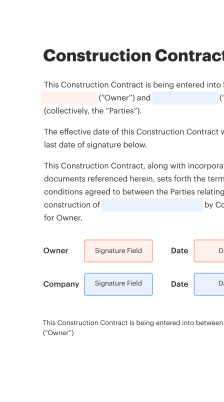
How a template-based receipt workflow operates

A template-driven workflow standardizes data capture, enforces approvals, and automates delivery of signed receipts to payers and institutional records.

  • Upload base document: Start with an existing receipt PDF
  • Customize fields: Map student and payment fields
  • Authenticate signer: Apply chosen authentication method
  • Deliver and archive: Email receipt and store copy
Collect signatures
24x
faster
Reduce costs by
$30
per document
Save up to
40h
per employee / month

Quick setup steps for a custom receipt template

Follow these concise steps to create a functional receipt template that captures required data and supports an auditable signature workflow.

  • 01
    Create template: Upload base receipt and set layout
  • 02
    Add fields: Insert data, date, and signature fields
  • 03
    Set permissions: Assign editors and signers
  • 04
    Publish: Save template and test with sample transactions

How to manage audit trails and signed receipt records

Implementing audit trail practices ensures every receipt has verifiable evidence of signing, delivery, and storage for compliance and dispute resolution.

01

Enable audit logging:

Turn on comprehensive event capture
02

Capture signer IP:

Record IP and timestamp
03

Store signed PDF:

Archive final signed copy
04

Record authentication method:

Log method used
05

Exportable audit reports:

Generate CSV or PDF logs
06

Retention tagging:

Apply retention labels
be ready to get more

Why choose airSlate SignNow

  • Free 7-day trial. Choose the plan you need and try it risk-free.
  • Honest pricing for full-featured plans. airSlate SignNow offers subscription plans with no overages or hidden fees at renewal.
  • Enterprise-grade security. airSlate SignNow helps you comply with global security standards.
illustrations signature

Recommended workflow settings for educational receipts

These settings balance security, usability, and operational needs for recurring receipt workflows in educational institutions.

Setting Name and Description Header Configuration
Default Reminder Frequency in Hours 48 hours
Default Expiration Period in Days 30 days
Signing Order Mode for Workflows Sequential
Default User Authentication Method Type Email verification
Document Storage Location and Path Google Drive folder

Supported devices and platform requirements

Templates and signatures must work consistently across desktop browsers and mobile devices to meet parent and student expectations.

  • Desktop: Recent Chrome, Edge, Firefox
  • Mobile: iOS 13+ and Android 8+
  • Tablet: Responsive UI support

Ensure device compatibility testing and mobile-responsive template design so receipts render correctly, authentication flows complete reliably, and signed copies are captured and archived regardless of device used.

Security controls typically applied to receipt templates

Encryption at rest: AES-256 encrypted storage
Encryption in transit: TLS 1.2+ secure transport
Access controls: Role-based permissions
Multi-factor authentication: Optional two-factor login
Audit logging: Detailed access and signature logs
Data isolation: Tenant and folder segregation

Real-world examples of receipt templates in education

Two concise case examples showing how templates streamline transactions and recordkeeping for different educational settings.

K-12 Lunch Program Receipts

A suburban school district implemented a standardized receipt template to capture student ID, meal type, and payment method.

  • Template automatically populated student and account data from SIS for each transaction.
  • Parents could receive signed receipts by email and view payment history online for transparency.

Resulting in faster reconciliations, fewer manual corrections, and clearer audit trails for state funding reviews.

University Donation Receipts

A university advancement office used a branded receipt template to record donor name, gift designation, and tax language for charitable contributions.

  • Integration with the donor CRM populated contact and campaign codes to the receipt.
  • Receipts included an authenticated eSignature and email delivery to donors for tax documentation.

Leading to higher donor satisfaction, reduced manual processing, and consistent records for annual audits.

Best practices for secure and accurate receipt templates

Follow these practical guidelines to reduce errors, protect privacy, and ensure receipts meet institutional and legal requirements.

Design templates with required fields only
Include only necessary payer identifiers, transaction codes, and signature blocks. Avoid printing full student records or unnecessary personal data on receipts. Use field-level masking where possible and map fields directly from authoritative source systems to prevent manual entry errors.
Apply role-based access and approvals
Limit who can edit templates and who can send receipts. Require approvals for template changes and maintain change logs. Enforce separation of duties between finance staff who issue receipts and those who reconcile accounts to reduce risk.
Document authentication and retention policies
Record the authentication method used for each signed receipt, tag documents with retention metadata, and follow institutional and state retention schedules. Ensure exported audit logs are stored with signed PDFs for future validation.
Test integrations and run reconciliation checks
Before rolling out to production, validate data mapping to SIS and accounting systems, perform end-to-end tests with sample transactions, and schedule periodic reconciliations to catch mapping or duplicate-record issues early.

FAQs about custom receipt templates for education

Common questions and clear answers about template setup, compliance, mobile signing, and integrations used by educational organizations.

Feature availability comparison for receipt-template workflows

Quick comparison of core capabilities across leading eSignature providers relevant to educational receipt templates.

Criteria and Vendor Column Headers signNow (Featured) DocuSign Adobe Sign
ESIGN / UETA validity
FERPA-specific controls Role-based access Limited Limited
Bulk Send capability
API and webhook access
be ready to get more

Get legally-binding signatures now!

Typical retention and compliance timelines to plan for

Common timelines institutions use for retaining financial receipts and audit records, subject to local regulations and institutional policy.

Short-term dispute window:

30 to 90 days retention for immediate dispute follow-up

Standard financial retention:

Seven years for most finance records

Student account records:

Retention aligned with FERPA and state rules

Tax-related donation receipts:

Keep for at least seven years for IRS purposes

Permanent archival:

Select records archived per institutional policy

Risks and penalties for poor receipt handling

FERPA breach: Student privacy fines
Audit failure: Financial penalties
Identity fraud: Reputational harm
Data breach: Regulatory sanctions
Retention noncompliance: Legal exposure
Contract penalties: Vendor termination risks

Pricing and support comparison for common plan features

Representative pricing and feature availability across providers to help institutions compare baseline costs and enterprise support options.

Pricing and Plan Comparison signNow (Recommended) DocuSign Adobe Sign PandaDoc Dropbox Sign
Base price (per user per month) From $8 per user per month From $10 per user per month From $9.99 per user per month From $19 per user per month From $15 per user per month
Free tier availability Limited free trial Developer free tier Trial available Free trial only Free basic trial
Bulk send included Included in business tiers Add-on or higher tier Included in many plans Included in business tiers Included in paid plans
API access Included with developer keys Paid plans or add-on Included with enterprise Available via API Available with business plans
HIPAA support option Available via BAA and settings Available via BAA Available via BAA Limited support Requires enterprise agreement
Enterprise onboarding service Included as add-on service Professional services available Enterprise advisory services Paid onboarding services Enterprise onboarding available
walmart logo
exonMobil logo
apple logo
comcast logo
facebook logo
FedEx logo
be ready to get more

Get legally-binding signatures now!