E Invoice Template Free for Product Management

E Invoice Template Free for Product Management provides a secure and compliant solution for efficient documentation. Streamline your processes with signNow's reliable eSignature platform.

Award-winning eSignature solution

What an e invoice template free for product management is and why it matters

An e invoice template free for product management is a reusable digital invoice layout tailored to product teams that standardizes line items, pricing logic, SKU references, tax handling, and payment terms. It reduces manual entry, ensures consistent formatting across customers and channels, and supports integrations with inventory, billing, and CRM systems. For U.S. businesses, using a compliant electronic invoice template helps preserve legal enforceability under ESIGN and UETA while providing machine-readable fields for automation, reporting, and audit trails across the product lifecycle.

Why standardizing invoices helps product management

Standardized e invoice templates reduce errors, speed reconciliation, and align billing with product catalog updates, helping teams maintain accurate revenue reporting and faster customer resolution.

Why standardizing invoices helps product management

Common hurdles when adopting e invoice templates

  • Mapping product SKUs across legacy systems can create inconsistent line items and pricing mismatches during automation.
  • Ensuring tax treatment for multi-state sales requires up-to-date jurisdiction rules and automated calculations.
  • Keeping templates synchronized with product updates and promotions adds overhead for product and finance teams.
  • Meeting regulatory and audit requirements takes additional configuration and consistent retention policies across vendors.

Representative user profiles for e invoice templates

Product Manager

A product manager uses e invoice templates to ensure SKU definitions, bundle pricing, and promotion rules appear correctly on invoices. They coordinate with finance to update templates when product configurations or price lists change, reducing customer confusion and support tickets.

Billing Specialist

A billing specialist configures templates for tax calculation, payment terms, and dunning workflows. They validate field mappings to ERP systems and confirm audit trails are recorded for each electronic invoice to support month-end close and compliance requirements.

Teams that benefit from e invoice templates for product management

Product managers, billing teams, and operations groups use standardized e invoice templates to link product definitions with billing outputs and customer records.

  • Product managers ensuring SKU accuracy and package definitions across sales channels.
  • Finance and accounts receivable teams streamlining reconciliation and collections.
  • Customer success and sales teams using clear, consistent invoices to reduce disputes.

When teams align on a single template standard, the result is fewer disputes, faster payments, and clearer product revenue analytics.

Advanced features to consider for product invoices

Beyond basic templates, advanced capabilities support scaling, automation, and compliance across product catalogs and customer segments.

Bulk Send

Send batches of invoices with per-recipient data merged from CSV or API to speed mass billing cycles and maintain per-customer customization.


Conditional logic

Automate field visibility and value defaults based on product type, customer location, or order size to reduce manual edits.

Calculated fields

Support discount tiers, volume pricing, tax exemptions, and prorations computed at invoice generation time.

Template permissions

Control who can edit, publish, or use templates to avoid unauthorized changes and maintain governance.

Embedded payments

Include payment links or gateways on invoices to accelerate collections and reconcile payments automatically.

Version history

Preserve historical template definitions and change logs for auditability and dispute resolution.

be ready to get more

Choose a better solution

Core template features for product-focused invoicing

Key template capabilities enable accurate, automatable invoices: field mapping, conditional logic, calculations, and integrations with product data sources.

Custom fields

Create and name fields for SKU, serial number, batch, or warranty code that map directly to your product database and ensure invoice lines are machine-readable for reconciliation.

Calculation rules

Embed arithmetic rules to compute line totals, discounts, taxes, and shipping automatically so invoice amounts remain consistent with price lists and promotional rules.

Conditional visibility

Show or hide sections such as discounts, shipping, or warranty details based on product type, customer segment, or jurisdiction to keep invoices concise and relevant.

Integration hooks

Connect templates to inventory, ERP, and CRM systems so invoices pull live product prices, availability, and customer billing terms for accurate statements.
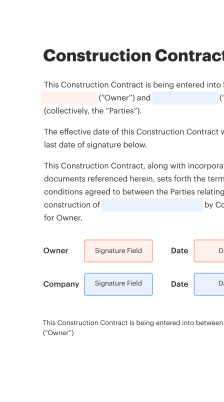
How to create and apply your e invoice template online

Creating and applying an e invoice template online typically involves uploading a base document, adding structured fields, and mapping product catalog values to those fields.

  • Upload base file: Start with PDF or DOCX template
  • Add fields: Insert SKU, quantity, tax, and total fields
  • Map data: Link fields to inventory or CRM values
  • Save template: Publish for team use and automation
Collect signatures
24x
faster
Reduce costs by
$30
per document
Save up to
40h
per employee / month

Quick setup steps for an e invoice template free for product management

Follow these concise steps to create a reusable e invoice template that ties product data to billable line items and payment terms.

  • 01
    Define fields: List SKUs, descriptions, taxes, and totals
  • 02
    Design layout: Arrange header, item grid, and totals
  • 03
    Map data: Connect template fields to product catalog
  • 04
    Test output: Generate sample invoices and validate calculations

Steps to maintain audit trails for e invoice templates

A reliable audit trail links template versions, invoice generation events, and signer actions for each transaction.

01

Enable logging:

Record all template edits
02

Capture generation events:

Log every invoice output
03

Record signer actions:

Keep signature timestamps
04

Store version history:

Preserve template snapshots
05

Exportable audit reports:

Provide CSV or PDF logs
06

Retention policies:

Apply legal retention rules
be ready to get more

Why choose airSlate SignNow

  • Free 7-day trial. Choose the plan you need and try it risk-free.
  • Honest pricing for full-featured plans. airSlate SignNow offers subscription plans with no overages or hidden fees at renewal.
  • Enterprise-grade security. airSlate SignNow helps you comply with global security standards.
illustrations signature

Example workflow settings for automating e invoice templates

These configuration settings illustrate common workflow defaults and options to automate invoice generation and distribution for product teams.

Standard Workflow Setting Name Header Configuration
Reminder Frequency and Notification Window 48 hours; two reminders
Signer Sequence and Routing Order Sequential routing
Default Template and Field Mapping Product catalog mapping
Approval Steps and Parallel Routing Single approver by default
Retention Period and Archival Policy 7 years archival

Device and platform considerations for using e invoice templates

Validate that users have compatible browsers, OS versions, and mobile capabilities before rolling out template tools.

  • Supported browsers: Chrome, Edge, Safari
  • Operating systems: Windows, macOS, iOS, Android
  • Mobile app availability: Native iOS and Android apps

For organizations with strict IT controls, ensure SSO compatibility, up-to-date TLS support, and mobile app policies to maintain security and user access across desktop and mobile environments.

Security controls relevant to e invoice templates

Encryption at rest: AES-256 encryption
Transport security: TLS 1.2+ encryption
Access controls: Role-based permissions
Authentication options: Email OTP, SSO
Audit logging: Immutable event records
Data segregation: Tenant isolation

Industry examples using e invoice templates in product workflows

Two practical examples show how standardized e invoice templates reduce friction between product updates and billing for common U.S. use cases.

SaaS subscription billing

A software vendor standardizes invoice templates to include plan SKUs, prorations, and usage metrics for monthly billing

  • Template maps SKU to subscription tiers and usage lines
  • Finance reduces reconciliation time and customer questions

Resulting in faster collections and clearer revenue recognition for month-end close.

Hardware distribution orders

A distributor aligns product part numbers, warranty codes, and freight charges in a single invoice template

  • The template auto-calculates taxes and shipping per state rules
  • Customer support can verify order details quickly and reduce returns processing

Leading to fewer disputes and improved inventory reconciliation across systems.

Best practices for secure, accurate e invoice templates

Apply standards and controls to reduce disputes and maintain compliance when using e invoice templates across product teams.

Standardize SKU and description formats across systems
Use consistent SKU naming, truncated descriptions for UI, and full descriptions in templates to avoid misinterpretation; maintain a canonical product catalog as the single source of truth and schedule regular reconciliations.
Use field-level validation and required fields
Enforce numeric formats, tax IDs, and mandatory payment terms within the template so invoices generate only when critical billing data is present, minimizing downstream corrections and disputes.
Keep tax rules and rates current
Apply automated tax calculations or integrate a tax engine; document jurisdiction rules inside template notes and run periodic validations against recent tax tables to avoid liability.
Retain clear audit trails for every invoice
Ensure every generated invoice links to an immutable audit record including template version, user action logs, and signature events to support accounting audits and legal compliance.

FAQs About e invoice template free for product management

Answers to common questions about creating, using, and securing e invoice templates for product-focused billing workflows in U.S. environments.

Feature and compliance comparison: signNow (Recommended) vs DocuSign

A concise comparison of common compliance and capability criteria relevant to e invoice templates and electronic signing in U.S. product workflows.

Feature and Compliance Criteria List signNow (Recommended) DocuSign
ESIGN and UETA legal compliance
HIPAA support and BAA Available Available
REST API for integrations
Bulk Send capability
be ready to get more

Get legally-binding signatures now!

Typical invoice lifecycle stages for product billing

An invoice lifecycle from creation to archival includes discrete stages; align systems to automate each step for consistency and compliance.

01

Order confirmation

Trigger invoice draft creation

02

Template population

Merge product and customer data

03

Validation checks

Validate totals and tax

04

Approval routing

Route for finance approval

05

Final issuance

Send to customer via email

06

Payment processing

Accept via gateway or ACH

07

Reconciliation

Match payments to invoices

08

Archival

Store per retention policy

Key timing and retention considerations

Define schedules for invoice issuance, payment terms, and retention to maintain compliance and predictable cash flow.

01

Invoice issuance cadence

Generate on invoice cycle or on delivery

02

Standard payment terms

Net 30, Net 45, or custom terms

03

Late fee application

Apply after specified grace period

04

Document retention period

Maintain records per policy

Suggested invoice schedule and archival timeline

A typical schedule balances operational needs and legal retention requirements for U.S. businesses handling product invoicing.

Monthly billing cadence for subscriptions:

Issue invoices on billing cycle date

Net terms and due dates:

Specify payment due date on invoice

30- to 90-day collections window:

Follow dunning schedule within this window

Seven-year archival recommended:

Retain invoice records for tax and audit

Template versioning schedule:

Record template changes with effective dates

Risks and compliance considerations

Noncompliant storage: Regulatory fines
Incorrect tax handling: Penalties
Unauthorized access: Data breaches
Incomplete audit trail: Disallowed claims
Invalid signatures: Contract disputes
Retention lapses: Regulatory exposure

Plan and feature overview: signNow (Recommended) and peers

High-level comparison of plan positioning and common capabilities across signNow and several major eSignature providers to inform platform selection based on product billing needs.

Plan and Pricing Comparison Table signNow (Recommended) DocuSign Adobe Sign HelloSign PandaDoc
Free or trial offering Free trial available Free trial available Trial with Acrobat Limited free plan Free eSign plan
Entry-level plan positioning Small business oriented Broad personal and business tiers Enterprise and Acrobat bundle Developer and starter tiers Document workflow starter
API and developer access REST API included REST API available REST API available REST API available REST API available
Bulk send and mass billing Bulk Send supported Bulk send supported Bulk send supported Limited bulk Bulk via higher tiers
Enterprise governance features Role controls and SSO Enterprise controls Enterprise controls Team admin features Enterprise packages available
walmart logo
exonMobil logo
apple logo
comcast logo
facebook logo
FedEx logo
be ready to get more

Get legally-binding signatures now!