Manual Bill Format for Quality Assurance

Manual bill format for quality assurance ensures compliance and accuracy in documentation. Explore how signNow's secure eSignature solution supports your quality assurance processes.

Award-winning eSignature solution

What manual bill format for quality assurance means

A manual bill format for quality assurance is a standardized document layout and verification process used to validate billing accuracy before invoices are issued. It specifies required fields, calculation methods, approval checkpoints, and annotation areas for auditors and reviewers. The format supports consistent review of line items, discounts, tax calculations, and service codes, enabling teams to detect discrepancies and prevent billing errors. When combined with electronic workflows and tracked signatures, the manual bill format becomes a repeatable control that documents reviewer decisions and preserves an evidentiary trail for compliance and downstream dispute resolution.

Why adopt a manual bill format for quality assurance

Standardizing manual bill formats reduces processing errors, improves auditability, and ensures consistent reviewer checks across billing cycles, supporting accurate revenue recognition and customer trust.

Why adopt a manual bill format for quality assurance

Common challenges when using manual bill formats

  • Inconsistent field placement across templates leads to missed checks and longer review times.
  • Manual calculations increase the risk of arithmetic errors and misapplied taxes or discounts.
  • Lack of version control causes reviewers to use outdated templates and invalidate audit trails.
  • Paper-based approvals create delays, storage overhead, and difficulty proving the chain of custody.

Representative roles using manual bill formats

Quality Manager

A Quality Manager establishes the bill format, defines review checkpoints, and sets acceptance criteria. They coordinate training for reviewers, maintain the master template, and analyze exception trends to refine validation rules and reduce recurrence of billing errors.

Billing Specialist

A Billing Specialist applies the manual bill format during invoice preparation, performs line-by-line checks, annotates discrepancies, and routes documents for approval. They escalate unresolved issues and document corrective actions for audit records and management reporting.

Who typically uses manual bill formats for quality assurance

Finance, billing operations, internal audit, and compliance teams commonly rely on defined manual bill formats to verify invoices before issuance.

  • Billing operations teams verifying rate application and line-item accuracy before invoice release.
  • Internal audit groups sampling invoices to confirm adherence to company billing policies.
  • Revenue accounting staff ensuring invoices align to revenue recognition and contract terms.

Smaller accounting teams and enterprise billing centers alike use the format to reduce disputes and document approval decisions for internal and external audits.

Key tools for an effective manual bill format for quality assurance

A robust QA format relies on a combination of template controls, validation checks, tracked approvals, and integration capabilities that prevent errors and document review outcomes.

Template locking

Lock critical fields to prevent accidental edits and ensure that reviewers only modify designated comment or exception fields, maintaining template integrity across billing cycles.


Field validation

Use built-in checks for numeric totals, tax calculations, and mandatory fields to automatically flag mismatches or missing information during the review process.

Approval routing

Define sequential or parallel reviewer paths with required sign-offs, enabling structured approvals and clear accountability for each stage of invoice validation.

Audit trail

Maintain an immutable record of who viewed, edited, and signed the manual bill format, with timestamps that support internal controls and external audits.

Version control

Track template revisions and retain prior formats so auditors can reconstruct historical billing rules and reviewer criteria used at the time of invoicing.

Integration APIs

Connect billing systems, ERPs, and CRMs so invoice data populates directly into templates and review outcomes can trigger downstream posting or dispute workflows.

be ready to get more

Choose a better solution

Integrations and templates that support billing QA

Linking templates to common document sources and CRMs keeps billing data consistent and reduces manual rekeying across systems.

Google Docs integration

Synchronize master billing templates stored in Google Docs to generate invoices that maintain consistent field placement, enabling reviewers to rely on a stable format and reducing template drift across teams and departments.

CRM connectivity

Connect billing templates to CRM records so customer and contract data populate invoice fields automatically, minimizing manual entry errors and ensuring that billed items match agreed terms tracked in the CRM.

Cloud storage sync

Automatic saving of completed bill checks and signed approvals to cloud folders like Dropbox preserves version history and centralizes records for future audits or dispute resolution.

Document templates

Create reusable manual bill templates with locked fields and conditional sections to enforce consistent reviewer workflows and capture all required billing metadata for compliance and reporting purposes.
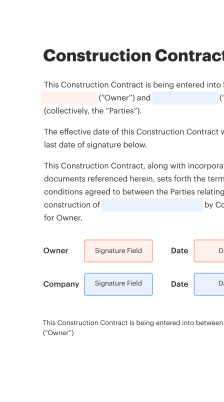
How to create and use your manual bill format online

Convert your paper checklist into a reusable online template and integrate it into approval workflows to speed reviews and capture an auditable record.

  • Upload template: Import PDF or document as base.
  • Add fields: Place signature, text, and numeric fields.
  • Set validation: Require totals and field checks.
  • Route for review: Define reviewer order and reminders.
Collect signatures
24x
faster
Reduce costs by
$30
per document
Save up to
40h
per employee / month

Step-by-step: Implementing a manual bill format for quality assurance

Follow these core steps to create and operate a manual bill format that supports accurate reviews and documented approvals.

  • 01
    Design template: Map required fields and calculated totals.
  • 02
    Define checkpoints: Specify reviewer tasks and acceptance criteria.
  • 03
    Assign roles: Set reviewers, approvers, and escalation paths.
  • 04
    Record approvals: Capture signatures and timestamps for auditability.
be ready to get more

Why choose airSlate SignNow

  • Free 7-day trial. Choose the plan you need and try it risk-free.
  • Honest pricing for full-featured plans. airSlate SignNow offers subscription plans with no overages or hidden fees at renewal.
  • Enterprise-grade security. airSlate SignNow helps you comply with global security standards.
illustrations signature

Typical workflow settings for billing QA templates

Configure these workflow settings to automate reviewer assignments, reminders, and retention for manual bill format approval processes.

Setting Name Configuration
Reminder Frequency 48 hours
Approval Routing Sequential
Field Validation Rules Totals required
Retention Period 7 years
Notification Template Standardized email

Supported devices and technical requirements

Manual bill formats for quality assurance should be accessible on common desktop and mobile platforms to accommodate reviewers across roles and locations.

  • Desktop browsers: Chrome, Edge, Safari supported
  • Mobile OS: iOS 14+, Android 10+
  • Network: HTTPS with TLS required

Confirm browser compatibility, minimum OS versions, and network security controls for mobile access; ensure reviewers have accounts with appropriate permissions and that any integrations use secure, authenticated connections to protect billing data.

Security controls relevant to billing QA documents

Encryption at rest: AES-256 encrypted storage
Encryption in transit: TLS 1.2+ for data transfer
Access controls: Role-based permissions
Audit logs: Immutable activity records
Multi-factor authentication: Optional MFA for users
Data segmentation: Tenant-level separation

Practical use cases for a manual bill format

Real-world scenarios highlight how a manual bill format streamlines review and preserves evidence for audits.

Healthcare billing QA

A hospital billing team uses a manual bill format to verify CPT codes and payer adjustments before claims submission

  • standard field checklist for patient, service, and modifier validation
  • reduces rejected claims and coding disputes

Resulting in fewer resubmissions and faster reimbursements to the organization.

Education institution invoicing

A university finance office applies a manual bill format to confirm tuition charges, scholarship offsets, and residency rates

  • required signature fields for departmental approvers
  • helps catch misapplied discounts and misposted ledger entries

Leading to cleaner monthly reconciliations and clearer audit trails for compliance reviews.

Best practices for secure and accurate manual bill formats

Apply consistent controls, clear responsibilities, and supportive technology to make the manual bill format reliable and defensible.

Standardize template layout and mandatory fields
Ensure all billing templates use the same field locations and validation rules so reviewers can perform checks efficiently and consistently across accounts and billing cycles.
Enforce approval sequencing and accountability
Require clearly assigned reviewers and approvers with documented sign-offs to provide an auditable chain of custody for billing decisions and corrections.
Preserve immutable audit logs and version history
Retain signed copies and template revisions in secure storage to support compliance requests, internal audits, and dispute resolution with complete historical context.
Train reviewers and monitor exception trends
Provide role-specific training on common billing errors, review procedures, and escalation criteria while tracking exceptions to prioritize process improvements and reduce repeat issues.

FAQs About manual bill format for quality assurance

Answers to common questions about creating, validating, and storing manual bill formats for QA, with notes on electronic signature considerations and compliance.

Feature comparison: manual bill format support across eSignature providers

Compare core capabilities that affect how easily you can implement and enforce a manual bill format for quality assurance across different eSignature platforms.

Provider signNow (Recommended) DocuSign Adobe Sign
ESIGN/UETA compliance
Bulk Send
API availability REST API REST API REST API
Native mobile apps iOS/Android iOS/Android iOS/Android
be ready to get more

Get legally-binding signatures now!

Risks and penalties from weak billing QA

Regulatory fines: Monetary penalties
Customer refunds: Return and credit costs
Reputation harm: Lost trust
Contract disputes: Legal exposure
Audit failures: Noncompliance findings
Operational waste: Repeat corrections

Pricing snapshot for platforms that support billing QA workflows

Estimated entry-level pricing and common commercial features for providers that can host manual bill formats and support review workflows.

Provider header signNow (Recommended) DocuSign Adobe Sign Dropbox Sign PandaDoc
Starting price (est.) From $8/user/mo From $25/user/mo From $14.99/user/mo From $15/user/mo From $19/user/mo
Free trial available Yes Yes Yes Yes Yes
API included Yes Yes Yes Yes Yes
Bulk sending Yes Yes Yes Yes Yes
Mobile apps iOS/Android iOS/Android iOS/Android iOS/Android iOS/Android
walmart logo
exonMobil logo
apple logo
comcast logo
facebook logo
FedEx logo
be ready to get more

Get legally-binding signatures now!