Générateur De Factures Médicales Pour Les Soins De Santé

Watch your invoicing process become quick and seamless. With just a few clicks, you can execute all the required actions on your medical bill generator for Healthcare and other important files from any device with web connection.

Award-winning eSignature solution

What a medical bill generator for healthcare does

A medical bill generator for healthcare is a software tool that assembles itemized charges, patient demographics, insurer details, and payment instructions into a standardized billing statement suitable for electronic delivery or printing. It automates code mapping, co-pay and deductible calculations, and can attach encounter notes or remittance advice. For organizations using an eSignature-enabled workflow, the generator can populate documents that require patient acknowledgement or guarantor signatures while preserving audit metadata and integrating with practice management systems and electronic health records.

Why use an electronic medical bill generator

A digital medical bill generator reduces manual errors, standardizes invoices, and accelerates patient collections while maintaining consistent data fields for claims reconciliation and audit readiness.

Why use an electronic medical bill generator

Common challenges addressed by a bill generator

  • Inconsistent charge formatting across departments causing claim rejections and delayed reimbursements.
  • Manual entry of CPT/ICD codes increases transcription errors and coding mismatches.
  • Delayed patient notifications and paper statements that increase days sales outstanding.
  • Difficulty attaching required consents and signatures while preserving a verifiable audit trail.

Representative users and their roles

Billing Manager

Oversees statement templates, ensures correct fee schedules, configures automated reminders, and supervises denials management. This role reviews aggregated reporting to reduce days in accounts receivable and works with IT to maintain integrations with EHR and practice management systems.

Patient Financial Counselor

Explains itemized charges and payment plan options to patients, generates adjusted statements and consent forms, and obtains electronic signatures for payment agreements while documenting conversations in the patient account.

Typical users and teams that benefit

Revenue cycle teams, medical billing vendors, and clinic administrators commonly operate the generator to standardize invoices and speed collections.

  • Revenue cycle management teams responsible for claims and patient balances.
  • Small to mid-size physician practices handling self-billing and patient statements.
  • Third-party billing services that process high-volume invoices for multiple clients.

Integration with practice management systems and secure signature workflows helps these users maintain compliance and faster reconciliation.

Advanced tools for enterprise billing operations

Advanced bill generators include features that scale to enterprise needs while maintaining compliance with healthcare regulations and payer requirements.

Bulk Send

Bulk Send capabilities enable secure distribution of thousands of patient statements with individualized fields, reducing manual send time and enabling batch processing tied to specific billing cycles.


API integrations

Comprehensive REST APIs allow two-way data exchange with EHRs, practice management systems, and CRMs to pull claim statuses, update patient accounts, and trigger follow-up actions programmatically.

BAA support

Vendor-supplied Business Associate Agreements facilitate HIPAA-compliant data handling and clarify responsibilities around PHI processing for covered entities and their partners.

Role permissions

Granular roles and permissions enable administrators to restrict access to billing templates, PHI fields, and signature actions based on job function and least privilege.

Template versioning

Template version control preserves historical invoice formats and enables rollback, supporting audit requirements and dispute resolution with a complete change history.

Conditional logic

Conditional fields and business rules permit dynamic line-item inclusion based on insurance type, encounter codes, or patient status, reducing manual edits for edge cases.

be ready to get more

Choose a better solution

Core features to look for in a medical bill generator

Select features that support billing complexity, security, and integration with existing clinical and administrative systems for faster, auditable workflows.

Template builder

A flexible template builder allows finance teams to design itemized statements with conditional fields, embedded payment links, and signature blocks tailored to payer and patient types, reducing manual reformatting and ensuring consistent presentation across encounters.

Code mapping

Automated mapping between encounter diagnoses and procedural CPT/ICD codes simplifies line-item generation, supports bundled billing rules, and reduces coding mismatches that commonly lead to denials and delayed reimbursements.

Payment integration

Built-in payment link support and tokenized payment capture streamline patient payments on the statement, allow partial payments and payment plans, and reconcile transactions automatically with the patient account ledger.

Audit & reporting

Comprehensive audit logs track who generated, viewed, and signed invoices; reporting features summarize outstanding balances, adjustments, and collection performance for revenue cycle oversight.
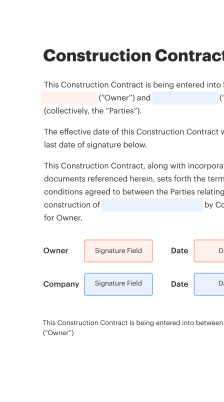
How the generator integrates into billing workflows

A typical flow imports encounter data, applies pricing logic, composes the invoice, and routes it for signature or delivery using secure channels.

  • Data import: Pull patient and charge data from EHR or PMS.
  • Calculation layer: Apply insurance adjustments, copays, and discounts.
  • Document assembly: Populate template fields and attach supporting files.
  • Delivery: Send statements via secure email or eSignature.
Collect signatures
24x
faster
Reduce costs by
$30
per document
Save up to
40h
per employee / month

Quick setup: generate your first medical bill

Follow these core steps to configure templates, map codes, and produce a compliant, signable medical invoice.

  • 01
    Configure template: Define header, itemization, and signature fields.
  • 02
    Map codes: Link CPT/ICD codes to billing line items.
  • 03
    Attach documentation: Include encounter notes or authorizations.
  • 04
    Generate and review: Produce preview, verify totals, and save.
be ready to get more

Why choose airSlate SignNow

  • Free 7-day trial. Choose the plan you need and try it risk-free.
  • Honest pricing for full-featured plans. airSlate SignNow offers subscription plans with no overages or hidden fees at renewal.
  • Enterprise-grade security. airSlate SignNow helps you comply with global security standards.
illustrations signature

Typical workflow configuration for automated billing

Use these recommended settings to align automated billing workflows with common revenue cycle practices while preserving compliance and traceability.

Setting Value
Automated Payment Reminder Frequency Setting Send reminders 48 hours before due date
Statement Generation Trigger Event Completed encounter saved to EHR
Default Payment Terms for Patients Net 30 with installment offer
Signature Required for Guarantor Agreements On file for payment plans
Retention of Signed Statements 7 years for audit purposes

Supported platforms and device requirements

Ensure your environment supports modern browsers, mobile platforms, and secure APIs to run a medical bill generator reliably and securely.

  • Desktop browsers: Chrome, Edge, Safari, Firefox
  • Mobile platforms: iOS and Android supported
  • Integration interfaces: Standard REST APIs

For secure deployments, verify TLS support, enable SSO where possible, and validate mobile signing flows on representative devices to confirm layout, accessibility, and authentication behavior before production roll-out.

Security features for protected billing data

Encryption in transit: TLS 1.2+ enforced
Encryption at rest: AES-256 storage
Access controls: Role-based access
Audit logging: Immutable event trail
Data isolation: Tenant separation
Authentication methods: Multi-factor available

Practical use cases from healthcare settings

Two representative examples show how a medical bill generator streamlines billing, reduces errors, and supports patient communications across different provider settings.

Large outpatient clinic

A high-volume outpatient clinic used the bill generator to consolidate encounter charges and payer rules for each visit into a single standardized invoice

  • Template-driven field mapping for CPT, ICD, and modifiers reduced manual edits
  • Automated insurance adjudication notes and patient balance calculations reduced follow-up work

Resulting in faster claim reconciliation, fewer re-bills, and improved cash flow for clinic operations.

Specialty practice

A specialty practice integrated the generator with its EHR to attach procedure notes and prior authorizations to invoices

  • Role-based templates produced patient-friendly statements and guarantor agreements
  • Integrated secure signing captured electronic patient acknowledgment and payment plans in a single workflow

Leading to higher patient payment rates at time of service and clearer audit records for payor inquiries.

Best practices for accurate and secure medical billing

Adopt policies and controls that reduce errors, protect PHI, and maintain an auditable trail for every generated medical bill.

Standardize templates and field mappings
Use centrally managed templates with enforced field validation to reduce manual edits. Standardization ensures consistent presentation of charges, reduces re-billing, and simplifies staff training. Maintain a version history and require approvals for template changes to preserve auditability and avoid unintended billing format changes.
Enable least-privilege access and role separation
Limit template editing and PHI access to designated roles. Enforce role separation between billing personnel and administrators to minimize accidental data exposure. Regularly review permission assignments and revoke access promptly for departing staff to preserve system security.
Document authentication and consent procedures
Record how signatures are obtained, including authentication steps, device metadata, and consenting language. Store consent records alongside the signed statement so regulatory reviews can verify that electronic signatures met ESIGN/UETA requirements and patient intent was captured.
Test integrations and retention workflows
Periodically validate EHR and PMS integrations, verify data mapping accuracy, and confirm archival restores. Test retention and deletion rules against legal schedules to ensure records are retained and purged correctly while maintaining business continuity and compliance readiness.

FAQs About medical bill generator for healthcare

Common questions focus on compliance, signature validity, integration points, and handling of protected health information when generating and sending medical invoices.

Feature comparison: secure billing capabilities

A concise comparison across common eSignature providers highlights availability of healthcare-oriented features relevant to a medical bill generator.

Criteria for Signing and Integration signNow (Recommended) DocuSign Adobe Acrobat Sign
Protected Health Information Handling and Storage AES-256 encryption AES-256 encryption AES-256 encryption
HIPAA compliance and BAA availability Yes (BAA) Yes (BAA) Yes (BAA)
Bulk Send and mass billing support Yes, high volume Yes, high volume Limited
API access and developer resources REST API available REST API available REST API available
be ready to get more

Get legally-binding signatures now!

Compliance risks and potential penalties

HIPAA fines: Civil and monetary penalties
Data breach costs: Notification and remediation expenses
Claim denials: Revenue loss from rejected claims
Regulatory audits: Operational disruption risk
Contract breaches: Third-party liability exposure
Reputation damage: Patient trust erosion

Pricing snapshot across signature providers

Pricing varies by plan, user count, and included features such as API access and HIPAA support. The table below summarizes starting points and key enterprise considerations.

Plan signNow (Recommended) DocuSign Adobe Acrobat Sign Dropbox Sign OneSpan Sign
Starting monthly price Starts $8/user/mo billed annually Starts $25/user/mo Starts $14.99/user/mo Starts $15/user/mo Contact sales
API availability Included with business plans Available on advanced plans Included with enterprise Included with higher tiers Included with enterprise
HIPAA / BAA support Optional BAA available BAA available BAA available BAA available BAA available
Bulk Send capability High-volume supported High-volume supported Limited bulk sends Limited bulk sends Enterprise-level support
Trial and onboarding Free trial available and onboarding options Limited trial and paid onboarding Free trial with guided setup Free trial with setup guides Contact for trial and onboarding
walmart logo
exonMobil logo
apple logo
comcast logo
facebook logo
FedEx logo
be ready to get more

Get legally-binding signatures now!