Outstanding Invoice Letter for Accounting

Outstanding invoice letter for accounting provides a clear template to ensure timely payments. Use signNow's secure eSignature solution for efficient invoicing.

Award-winning eSignature solution

Why digitize outstanding invoice letters in accounting

Digital outstanding invoice letters reduce turnaround time, improve tracking and recordkeeping, and support consistent communication while lowering manual workload for accounting teams.

Why digitize outstanding invoice letters in accounting

Typical users involved in outstanding invoice letter processes

Accounts Receivable Manager

Manages invoicing and collections workflows, configures outstanding invoice letter templates, sets reminder schedules, and reviews audit logs to ensure accurate records for reconciliation and reporting.

Client/Payor

Receives the outstanding invoice letter, reviews charges, and completes any required acknowledgment or signature; their timely action updates accounting systems and triggers reconciliation of payments.

Key tools that improve outstanding invoice letter for accounting workflows

The right feature set reduces manual follow-up, strengthens auditability, and speeds collections while keeping records secure and compliant.

Templates

Customizable outstanding invoice letter templates let accounting teams maintain consistent wording, embed invoice line items, and include dynamic fields that populate from accounting systems to reduce manual entry and errors.


Bulk Send

Bulk Send enables sending a single outstanding invoice letter template to many recipients with individualized fields and tracking, streamlining collections for recurring statements or batch invoicing cycles.

Automated Reminders

Automated Reminders trigger follow-ups at configured intervals when invoices remain unpaid, reducing manual outreach and maintaining a consistent communication cadence for overdue balances.

Audit Trail

A detailed Audit Trail captures timestamps, IP addresses, and recipient actions to document delivery, opens, and signature events for internal control and external review.

Integrations

Prebuilt connectors to accounting and CRM systems populate invoice fields and update payment status, eliminating duplicate data entry and improving reconciliation efficiency for accounting teams.

Document Security

Encryption, access controls, and tamper-evident seals protect outstanding invoice letter content and ensure integrity from sending through archival storage.

be ready to get more

Choose a better solution

Integration features that support outstanding invoice letter processes

Connectors and document tools reduce manual work by syncing invoice data, storing records, and enabling in-document approvals.

Google Docs

Create and edit outstanding invoice letter templates directly in Google Docs, then push the final document to the eSignature workflow to preserve formatting and version control while reducing copy-paste errors across systems.

CRM sync

Sync recipient contact and account data from CRM systems to auto-populate outstanding invoice letters, attach billing history, and log correspondence to the customer record for a complete audit trail of collections activity.

Dropbox storage

Automatically save signed outstanding invoice letters to Dropbox for centralized archival, applying folder rules and retention settings to match accounting recordkeeping policies and simplify retrieval during audits.

Accounting systems

Integrate with accounting platforms to update invoice status on signature or payment, generate reconciliations, and trigger follow-up actions without manual ledger entry.
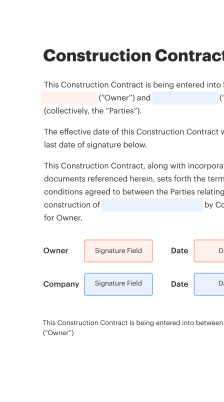
How online outstanding invoice letters for accounting work

An online outstanding invoice letter combines an editable template, delivery options, and signature capture so accounting teams can send, track, and document payment requests efficiently.

  • Template: Use a standardized outstanding invoice letter template for consistency.
  • Delivery: Send via email or secure link with access controls.
  • Signature: Capture electronic acceptance or acknowledgment when required.
  • Tracking: Monitor opens, reminders, and signed timestamps for reconciliation.
Collect signatures
24x
faster
Reduce costs by
$30
per document
Save up to
40h
per employee / month

Quick setup: preparing an outstanding invoice letter for accounting

Create a clear, professional outstanding invoice letter for accounting by gathering invoice details, defining payment terms, and deciding on delivery and signature methods before sending.

  • 01
    Gather details: Confirm invoice number, amount, due date, and client contact information.
  • 02
    Draft letter: State the overdue amount, original due date, and a concise payment request.
  • 03
    Select method: Choose email delivery, digital signature, or a combined document and reminder flow.
  • 04
    Track response: Enable reminders and audit logging to record delivery and client actions.

Managing audit trails for outstanding invoice letter transactions

An auditable record is essential for accounting integrity; follow these steps to capture and review evidence of delivery and acceptance.

01

Enable logging:

Turn on detailed event logging for document events.
02

Capture metadata:

Record IP, timestamp, and user agent data.
03

Store copies:

Save signed PDF and original template versions.
04

Verify integrity:

Use tamper-evident seals to detect changes.
05

Export reports:

Generate CSV or PDF activity summaries.
06

Review regularly:

Include audit checks in month-end procedures.
be ready to get more

Why choose airSlate SignNow

  • Free 7-day trial. Choose the plan you need and try it risk-free.
  • Honest pricing for full-featured plans. airSlate SignNow offers subscription plans with no overages or hidden fees at renewal.
  • Enterprise-grade security. airSlate SignNow helps you comply with global security standards.
illustrations signature

Workflow settings for outstanding invoice letter automation

Configure these workflow settings to automate delivery, reminders, and status updates for outstanding invoice letters in accounting systems.

Setting Name Configuration
Reminder Frequency 7 days
Escalation Path Account manager
Auto-Archive Days 365 days
Signature Required Optional
Payment Link Included Yes

Device and platform requirements for sending and signing

Most outstanding invoice letter for accounting workflows work across modern browsers and supported mobile apps, with minimal local requirements for senders and recipients.

  • Desktop browsers: Chrome, Edge, Safari compatibility
  • Mobile apps: iOS and Android supported
  • Connectivity: Stable internet connection recommended

Confirm browser updates, enable JavaScript, and use the provider's app for offline capabilities; ensure recipients know they can sign on tablet or mobile for faster turnaround.

Security and compliance controls relevant to outstanding invoice letters

US eSignature laws: ESIGN and UETA compliant
Health data safeguards: HIPAA considerations available
Education records: FERPA-aware handling options
Encryption standards: AES-256 encryption supported
Authentication options: Email, SMS, and knowledge-based
Tamper protection: Tamper-evident audit logs

Industry examples: using outstanding invoice letters in practice

Two representative scenarios show how accounting teams use outstanding invoice letters to collect overdue payments while preserving records.

Small Business Collections

A local services firm sends a digitally signed outstanding invoice letter that includes line-item charges and payment links

  • Prepopulated invoice fields reduce input errors
  • Automated reminders are scheduled at 7 and 14 days past due

Resulting in faster reconciliations and clearer client communication for month-end accounting.

Professional Services Firm

An accounting practice issues an outstanding invoice letter to corporate clients with attached timesheets

  • The letter requires an authorized signatory acknowledgment
  • Integration updates the firm’s ledger automatically upon client confirmation

Leading to auditable payment records and reduced manual ledger updates.

Best practices for secure and accurate outstanding invoice letters

Follow consistent standards for content, delivery, and recordkeeping to reduce disputes and improve collection rates while keeping records compliant and searchable.

Use standardized templates with dynamic fields
Maintain a single outstanding invoice letter template that pulls invoice number, due date, and amount automatically from your accounting system. This reduces manual errors, ensures consistent language across communications, and speeds document creation for high-volume billing cycles.
Require appropriate authentication based on risk
For high-value invoices, enable stronger authentication such as SMS verification or knowledge-based checks. For routine communications, email verification may suffice. Tailor authentication to the transaction risk and applicable compliance requirements to balance security and convenience.
Enable automated reminders and escalation
Configure reminder schedules and escalation rules that align with company collections policies. Automated reminders reduce manual outreach, and predefined escalation preserves a clear record of all steps taken prior to further action.
Retain tamper-evident signed copies
Store signed outstanding invoice letters with tamper-evident seals and complete audit trails. Implement retention policies that meet accounting and legal requirements and ensure documents are readily available for reconciliation or dispute resolution.

FAQs and troubleshooting for outstanding invoice letter workflows

Answers to common questions and solutions to typical issues encountered when sending, signing, and tracking outstanding invoice letters.

Digital vs. paper: feature comparison for outstanding invoice letter workflows

Compare common capabilities across eSignature providers to decide which platform fits your accounting needs for outstanding invoice letters.

Criteria signNow (Recommended) DocuSign Adobe Sign
US legal validity status ESIGN/UETA ESIGN/UETA ESIGN/UETA
Bulk Send availability
Native accounting integrations QuickBooks connector Yes, via app Yes, via app
Audit trail detail level High detail High detail High detail
be ready to get more

Get legally-binding signatures now!

Retention and timing guidelines for outstanding invoice letters

Set clear deadlines and retention rules so outstanding invoice letters support accounting cycles and compliance obligations.

Initial payment reminder timeline:

7 days after due date

Secondary reminder schedule:

14 days after due date

Escalation to collections:

30 to 60 days overdue

Document retention duration:

7 years recommended

Archival review frequency:

Annual review

walmart logo
exonMobil logo
apple logo
comcast logo
facebook logo
FedEx logo
be ready to get more

Get legally-binding signatures now!