Project Proposal Software for Government

Effortlessly create, send, and eSign essential documents. Discover a cost-effective solution that boosts productivity and simplifies approvals.

Award-winning eSignature solution

What project proposal software for government does and why it matters

Project proposal software for government centralizes creation, routing, review, and execution of procurement and project approval documents in a secure, auditable platform. It typically includes document templates, role-based routing, eSignatures, access controls, and an immutable audit trail to meet procurement timelines and transparency requirements. For government organizations the software reduces manual handling, standardizes proposal format and approvals, and preserves chain-of-custody for records subject to public records and retention policies. Effective solutions integrate with existing document stores and identity solutions to streamline handoffs between procurement, legal, and program teams.

Legal validity and compliance considerations in the U.S.

Digital proposal approvals rely on ESIGN and UETA for signature validity in U.S. jurisdictions, and agencies must also evaluate HIPAA and FERPA when proposals contain protected health or education data, plus procurement-specific records retention and audit requirements.

Legal validity and compliance considerations in the U.S.

Common challenges when managing government proposals

  • Fragmented review cycles across departments cause delays and inconsistent feedback that extend procurement timelines.
  • Manual signatures and paper routing create audit and retention gaps and increase the risk of lost records.
  • Inadequate access controls can expose sensitive bid pricing or personal data to unauthorized reviewers.
  • Lack of template governance leads to nonstandard proposals that complicate evaluation and compliance checks.

Representative user roles

Procurement Officer

Responsible for issuing solicitations, validating vendor eligibility, and coordinating evaluation panels. Uses templates and routing rules to ensure each proposal follows procurement policy and mandatory disclosure requirements during the lifecycle.

Program Manager

Manages technical review and approves scope and budget elements. Tracks deliverable milestones within proposals and relies on configurable notifications and dashboards to ensure timely decisions and documentation continuity.

Typical users and teams involved

Agencies and vendors use project proposal software for government to coordinate document preparation, approvals, and recordkeeping across functional teams.

  • Procurement officers managing solicitation issuance and award documentation.
  • Program managers tracking proposal submission status and conditional approvals.
  • Legal and compliance teams verifying contract terms and retention obligations.

Common users include procurement officers, program managers, legal reviewers, and external vendors who require a clear, auditable approval path.

Key features to evaluate in project proposal software for government

When selecting software, prioritize features that support standardized documents, secure approvals, auditability, and integrations with existing agency systems.

Template library

Centralized, versioned templates with mandatory fields and conditional sections reduce formatting errors and ensure every proposal includes required procurement disclosures and attachments.


Conditional routing

Rules-driven workflows automatically route proposals to the right reviewers based on value thresholds, program area, or compliance flags to accelerate decision making.

Advanced authentication

Options for SMS, email, multi-factor, and knowledge-based authentication let agencies align signer identity assurance with transaction risk and regulatory requirements.

Bulk Send

Ability to distribute identical documents to many recipients concurrently supports mass vendor notifications, applicant acknowledgements, and uniform award letters with unique tracking.

Audit trail

Comprehensive, tamper-evident logs capture events, IPs, and timestamps for every action to support internal audits and public records requests.

Retention controls

Policy-based retention and legal hold mechanisms automate archival and deletion schedules in accordance with agency records management rules.

be ready to get more

Choose a better solution

Integrations that streamline proposal workflows

Integration with common document editors, cloud storage, and procurement or CRM systems reduces manual uploads and preserves metadata across systems.

Google Workspace

Two-way integration lets users import proposal drafts from Google Docs, place form fields, and push signed PDFs back to Drive while retaining original metadata and version history for compliance.

CRM and procurement systems

Connectors to CRMs or procurement platforms synchronize vendor records and proposal status so contract information and award decisions update automatically across systems and reporting dashboards.

Cloud storage

Native sync with Dropbox, OneDrive, or agency file stores ensures signed proposals are archived to designated folders with retention tags and access controls applied consistently.

Identity providers

SAML/SCIM and directory integration streamline user provisioning and enforce agency authentication policies for user management and access logging.
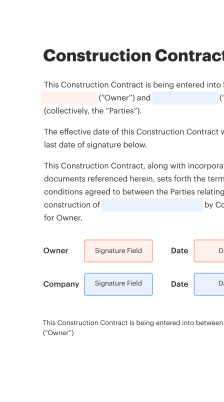
How online proposal creation and approval typically works

A typical online lifecycle moves from template drafting through staged reviews to final signature and archival, with automated notifications at each handoff.

  • Drafting: Start from an agency-approved template.
  • Internal review: Route to subject matter experts.
  • Signature: Collect eSignatures from authorized signers.
  • Archival: Store with retention metadata.
Collect signatures
24x
faster
Reduce costs by
$30
per document
Save up to
40h
per employee / month

Quick setup checklist for a project proposal workflow

Follow these initial steps to configure a proposal approval flow focused on governance and auditability.

  • 01
    Define template: Create a standard proposal template.
  • 02
    Assign roles: Map approvers and reviewers.
  • 03
    Set routing: Configure sequential or parallel flows.
  • 04
    Enable audit: Turn on detailed logging.

Audit trail checklist for each signed proposal

Ensure every signed proposal includes the essential audit records to support legal and procurement reviews.

01

Event timestamp:

Record date and time
02

Signer identity:

Capture user ID or credential
03

IP address:

Log network source
04

Action type:

Sign, view, edit
05

Document version:

Preserve version hash
06

Retention tag:

Attach legal hold status
be ready to get more

Why choose airSlate SignNow

  • Free 7-day trial. Choose the plan you need and try it risk-free.
  • Honest pricing for full-featured plans. airSlate SignNow offers subscription plans with no overages or hidden fees at renewal.
  • Enterprise-grade security. airSlate SignNow helps you comply with global security standards.
illustrations signature

Recommended workflow settings for government proposal approvals

Use these baseline configuration values to balance speed, traceability, and compliance for most public-sector proposal workflows.

Setting Name Configuration
Approval Sequence Sequential
Reminder Frequency 48 hours
Maximum Approval Time 30 days
Signature Authentication Level MFA required
Retention Tagging Records retention

Supported platforms and device guidance

Proposal workflows must support desktop and mobile access while preserving security controls and consistent document rendering.

  • Desktop browsers: Chrome, Edge, Firefox
  • Mobile platforms: iOS and Android
  • Native apps: Optional mobile apps

Test templates on each platform to ensure fields render correctly, verify authentication flows work with agency SSO on mobile, and confirm PDFs preserve signatures and audit metadata across devices and storage exports.

Core security controls for government proposals

Encryption in transit: TLS 1.2+ required
Encryption at rest: AES-256 storage
Role-based access: Granular RBAC
Multi-factor authentication: MFA options available
Audit logging: Immutable trails
Data residency: US-based storage

Real-world government scenarios

Two concise case examples illustrate how proposal software addresses common procurement and interagency approval workflows.

Municipal capital projects

A city procurement office standardized RFP templates and routing to reduce review cycles by enforcing consistent fields and approvers

  • Integrated eSignatures for award documents
  • Retained full audit records for public records requests

Leading to faster contract execution and clear evidence for audits, ensuring compliance and transparency.

State grant awards

A state agency consolidated multiple grant application forms into a single template library to reduce applicant errors

  • Automated eligibility checks for required attachments
  • Notification workflows kept reviewers aligned across departments

Resulting in improved turnaround times and traceable approvals that support grant oversight and financial audits.

Best practices for secure and accurate proposal processes

Adopt consistent governance and configuration practices to maintain control over proposal content, approvals, and records while preserving efficiency for reviewers and bidders.

Maintain a governed template library with version control
Centralize approved proposal templates and document versions to prevent unauthorized edits, ensure consistent disclosures, and simplify audits by keeping a single source of truth for solicitation language and scoring criteria.
Enforce role-based routing and least-privilege access
Configure workflows so users only see sections relevant to their role, minimizing unnecessary exposure of pricing or confidential attachments while ensuring necessary approvers can complete reviews promptly.
Use multi-factor authentication and strong identity checks for signers
Implement MFA and configurable authentication strength based on transaction risk to reduce impersonation risk, particularly for high-value contracts or where legal certainty of signer identity is required.
Document retention and legal hold procedures
Apply retention policies and legal holds at the time of signature to comply with public records laws and procurement retention schedules, and ensure exports for audits are reproducible and complete.

FAQs and troubleshooting for common issues

This FAQ section addresses frequent questions and practical troubleshooting steps encountered when deploying project proposal software for government.

Feature availability: signNow compared with leading providers

A focused feature comparison across common security and workflow capabilities helps clarify fit for government use cases.

Feature / Provider signNow (Recommended) DocuSign Adobe Acrobat Sign
Audit Trail
Advanced Authentication Options MFA & SMS MFA & KBA MFA & KBA
Bulk Send Limited
US Data Residency
be ready to get more

Get legally-binding signatures now!

Typical timeline milestones for proposal processing

Common deadline milestones help set expectations for applicants and internal reviewers while preserving auditability of elapsed time between steps.

Solicitation published:

Day 0

Questions and clarifications period:

7–14 days

Submission deadline:

Specified date/time

Initial compliance review:

3–5 business days

Final award and signature:

Dependent on panel review

Risks and potential penalties for noncompliance

Record retention failures: Fines, legal exposure
Unauthorized disclosure: Privacy breach penalties
Invalid signatures: Contract disputes
Procurement audit findings: Remedial actions
Data integrity loss: Contract voiding
Access control lapses: Accountability issues

Typical pricing and plan comparisons for government buyers

Price structures vary by feature inclusion, user seats, and enterprise integrations. The table summarizes representative entry to enterprise-level plan differences.

Plan signNow (Recommended) DocuSign Adobe Acrobat Sign PandaDoc HelloSign
Entry-level Starts at $8/user/month billed annually, basic eSignature and templates Starts at $10/user/month, eSign only Starts at $14.99/user/month, eSign and cloud integration Starts at $19/user/month, document creation focus Starts at $15/user/month, eSignature focus
Business tier Includes advanced templates, Bulk Send, and integrations with SSO Adds advanced workflow and API access Adds enterprise connectors and advanced authentication Adds CRM integrations and analytics Adds team features and SSO
Enterprise level Custom pricing, SAML, dedicated support, contract lifecycle features Custom enterprise pricing, SOC2, advanced admin Enterprise bundles with Adobe Document Cloud licensing Custom enterprise plans with advanced document automation Enterprise SSO and admin controls
API access Available with developer-friendly REST API and predictable quotas Robust API with broad ecosystem tools Extensive API and SDK support API available with rate limits API available with business plans
Compliance support ESIGN/UETA validation, HIPAA-ready options, US-based hosting available ESIGN/UETA, enterprise compliance modules ESIGN/UETA, FedRAMP options for select plans ESIGN/UETA, business compliance features ESIGN/UETA, SOC2 and security features
walmart logo
exonMobil logo
apple logo
comcast logo
facebook logo
FedEx logo
be ready to get more

Get legally-binding signatures now!