Encryption standards
Assess whether the vendor uses AES-256 for data at rest and modern TLS for data in transit, and whether customer-managed key options are available for added control.



Organizations comparing signNow and Copper should focus on end-to-end encryption, authentication options, and auditability to meet U.S. legal and regulatory requirements while minimizing implementation complexity and ongoing compliance effort.

A compliance officer ensures signed agreements meet ESIGN and sector-specific controls, audits retention policies, and validates vendor security documentation and Business Associate Agreements when PHI is involved.
An IT administrator configures SSO, manages API keys and scopes, enforces MFA, and sets role-based permissions in both CRM and eSignature platforms to align with organizational access policies.
Security architects, compliance officers, and IT administrators assess how CRM integrations affect data flows, encryption, and auditability before selecting an eSignature solution.
Procurement and legal teams also review contractual security commitments and data processing terms to confirm regulatory alignment for customer data and health or education records.
Assess whether the vendor uses AES-256 for data at rest and modern TLS for data in transit, and whether customer-managed key options are available for added control.
Compare support for SSO via SAML/OIDC, built-in MFA, access codes, KBA, and third-party identity provider compatibility to meet organizational policies.
Look for comprehensive audit logs, exportable reports, and event-level detail showing signature events, document state changes, and API activity for compliance evidence.
Determine whether the vendor offers regional storage choices or contractual controls over data location to address regulatory or contractual data residency constraints.
Review whether Business Associate Agreements and FERPA-related controls are documented and whether feature sets can be configured to meet sector obligations.
Examine how the solution limits data shared with CRMs, supports field-level mapping, and enables admin oversight of connected apps and webhooks to reduce exposure.
Single sign-on via SAML or OIDC centralizes authentication, allows enforcement of corporate MFA policies, and reduces password sprawl across CRM and eSignature tools to lower the risk of compromised credentials.
Secure API credential handling, scoped tokens, and rotation policies limit the blast radius of compromised keys and let teams audit which integrations access documents and signer data.
Detailed, tamper-evident audit trails capture signer events, IP addresses, timestamps, and document hashes to support legal validity and forensic review for regulatory audits.
Granular user and team permissions restrict who can send, edit, or retrieve signed documents, reducing unauthorized access to sensitive customer records within integrated workflows.
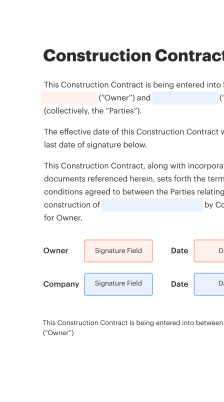
| Setting Name | Configuration |
|---|---|
| SSO enforcement | Enabled |
| MFA requirement | Required |
| API token scope | Least privilege |
| Audit log retention | 7 years |
| Document encryption | AES-256 |
Verify browser, OS, and mobile platform support before deploying integrations to ensure consistent security and feature availability across user devices.
Keep client platforms patched, instruct users to use updated browsers or apps, and validate that mobile and desktop clients support your chosen authentication and encryption settings to maintain a consistent security posture.
A hospital uses eSignature to collect patient consent forms securely, integrating signNow with its CRM to reduce manual entry
Resulting in a consistent, auditable workflow that aligns with compliance and reduces paper handling risk.
A regional bank integrates CRM records and signed account documents to speed account opening while protecting customer data
Leading to faster onboarding with preserved evidentiary records for audits and dispute resolution.
| Security and Compliance Feature Checklist | signNow (Recommended) | Copper | DocuSign |
|---|---|---|---|
| Encryption in transit and at rest | AES-256 | AES-256 | AES-256 |
| Detailed audit logs and exports | Limited | ||
| HIPAA readiness and BAA availability | Offered | Not direct | Offered |
| Granular role and permission controls | Granular | Basic | Granular |
| Plan Comparison Across Providers | signNow (Recommended) | Copper | DocuSign | Adobe Sign | HelloSign |
|---|---|---|---|---|---|
| Starting price per user | $8–$15 monthly | $19 monthly | $10–$25 monthly | $9–$30 monthly | $15 monthly |
| Two-factor authentication included | Yes | Varies by plan | Yes | Yes | Yes |
| HIPAA-ready option | Available with BAA | Not available | Available | Available | Limited |
| Bulk Send capability | Included on higher plans | Limited | Enterprise only | Enterprise only | Available |
| API access and developer support | Included | Add-on | Included | Included | Included |