Establishing secure connection…Loading editor…Preparing document…

Guam Wage and Tax Statement 2014

This template is fully customizable. Edit the text, fill out the fields, and send it for signature. Give it a try!
Guam Wage and Tax Statement 2014

What the Guam Wage and Tax Statement 2014 Is

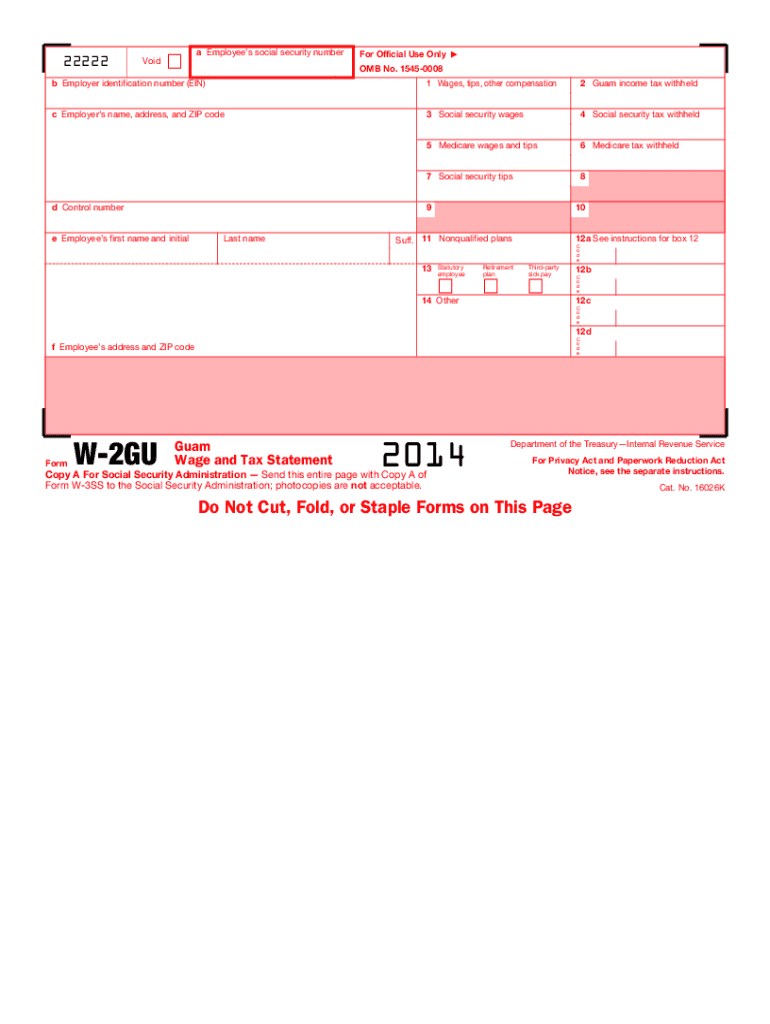
The Guam Wage and Tax Statement 2014 is a payroll reporting document used to record wages paid, taxes withheld, and related employer and employee information for tax year 2014 in the Territory of Guam. It functions like a territorial wage statement that employers issue to employees and to territorial and federal tax authorities for income reporting and withholding reconciliation. Employers use the form to document gross pay, social security and Medicare contributions, Guam income tax withheld where applicable, and other statutory deductions necessary for accurate year-end reporting and tax compliance.

Why this form matters for payroll and tax compliance

Accurate completion of the Guam Wage and Tax Statement 2014 ensures correct employee year-end records, supports payroll tax remittance, and helps avoid information-reporting penalties. It provides the primary record employees use for preparing personal returns and for verifying withholding amounts with territorial and federal agencies.

Why this form matters for payroll and tax compliance

Who prepares and receives the Guam Wage and Tax Statement 2014

Employers, payroll administrators, and human resources teams typically prepare the form; employees receive it for individual tax filing and verification.

  • Employers and payroll providers responsible for wage reporting and withholding reconciliation.
  • Employees who need year-end wage and withholding information for tax returns.
  • Tax preparers and accountants using the statement to reconcile Guam and federal filings.

The form also supports auditing and recordkeeping obligations for employers and provides documentation necessary for resolving withholding or tax-reporting disputes.

Key components of a professional Guam Wage and Tax Statement 2014

A compliant statement includes employer and employee identifiers, itemized wage and tax amounts, specific withholding lines, and a clear signature or verification block. Accurate labeling, consistent numeric formatting, and a retained audit trail improve defensibility and reduce downstream corrections.

Employer ID

Enter the employer name and federal Employer Identification Number (EIN) or Guam tax ID exactly as registered with tax authorities to link the return to the correct filer.
Employee ID

Provide the employee's full legal name and taxpayer identification (SSN or ITIN) to avoid backup withholding or misapplied credits.

Wages

Report total taxable wages for the year in clear dollar amounts; separate boxes for federal, Guam, and other taxable wage categories where required.

Withholding

List federal income tax, social security, Medicare, and Guam income tax withheld in distinct fields to aid reconciliation with remittance records.

Year Labels

Mark the tax year clearly as 2014; consistent date formats prevent misfiling across tax years and support audit trails.

Signature Block

Include preparer name, title, signature or electronic signature attribution, and date to establish accountability and authorization.

Step-by-step: completing the Guam Wage and Tax Statement 2014

Follow this order to prepare, verify, and deliver the statement with minimal rework and legal exposure.

  • 01
    Prepare: Gather payroll records and employee identification documents.
  • 02
    Enter Data: Populate employer, employee, wage, and withholding fields accurately.
  • 03
    Verify: Cross-check totals against payroll register and remittance receipts.
  • 04
    Distribute: Provide copies to employees and retain an employer copy per retention rules.

Configuring an online workflow for this statement

Set up a repeatable digital workflow to collect, verify, and store Guam Wage and Tax Statement 2014 records while maintaining an audit trail.

Field Configuration
Employer Details Required, locked after submission
Employee TIN Masked display, required verification
Wage Lines Numeric validation and auto-totals
Signature eSignature field with timestamp

Where to file, send, and store completed forms

Understand the routing steps so forms reach employees and the correct territorial or federal reporting systems without delay.

  • Employee Copy: Deliver to employee by the statutory distribution method.
  • Employer Records: Retain employer copy per retention rules.
  • Territorial Filing: Submit required copies to Guam tax authority as instructed.
  • Federal Reporting: File federal information returns when applicable to IRS requirements.

Digital signing and eSubmission considerations

Choose a platform that provides secure eSign, audit trails, and exportable PDF records compatible with tax recordkeeping requirements.

  • File Formats: PDF and DOCX supported
  • Integrations: Connects to payroll and storage systems
  • Authentication: Email, SMS, or stronger MFA

Ensure your chosen solution supports ESIGN and UETA legal standards, enables reproducible audit trails, and provides secure storage that meets IRS and territorial record requirements.

Key deadlines and time expectations for wage statements

Adhere to distribution and filing timelines to avoid penalties and to ensure employees can meet their tax obligations.

Employee Distribution:

Provide year-end wage statements by the date required by territorial guidance; align with Jan 31 recipient deadlines for comparable federal forms.

Territorial Filing:

Follow Guam Department of Revenue schedules for any employer remittance and information filing.

Federal Correspondence:

Where federal reporting applies, match federal filing dates such as Jan 31 for information returns to recipients.

Record Retention:

Retain employer copies for at least the applicable statutory period; see retention timeline below.

Corrections:

Submit corrected statements promptly upon discovering errors to minimize penalties.

Milestones from preparation to archival

A sequential milestone view helps teams coordinate payroll close, employee delivery, and record retention.

01

Payroll Close

Finalize payroll journal entries and verify year-to-date totals before statement generation.

02

Statement Generation

Create statements from validated payroll data and prepare distribution files.

03

Employee Delivery

Distribute to employees and capture delivery or signature confirmation.

04

Archive

Store signed statements and audit trails in secure records for the required retention period.

Common mistakes that delay processing

  • Using an incorrect or mistyped SSN/TIN that triggers backup withholding or causes misapplied payments.
  • Mismatched employer name or EIN between the statement and filed returns, causing reconciliation failures.
  • Rounding or subtotal math errors that create discrepancies during tax authority audits.
  • Failing to obtain or retain a signature/audit trail that demonstrates employee receipt and acknowledgment.

Penalties and risks of incorrect or late statements

Information Return Penalties: IRC §6721 penalties apply for incorrect or late information returns; amounts increase with lateness and intent.
Backup Withholding: Incorrect TINs can trigger mandatory 24% backup withholding and downstream reconciliation.
Payroll Liability: Underreported wages may create employer tax and liability exposure including interest and penalties.
I-9/Employment Penalties: Related employment record errors can trigger DHS fines under 8 CFR §274a.2.
State Penalties: Territorial or state-level fines may apply for late or incorrect filings; amounts vary by jurisdiction.
Reputational Risk: Persistent reporting errors increase audit likelihood and damage employee trust.

Real-world examples: using eSignature for payroll forms

Organizations have used electronic signing platforms to reduce turnaround time and ensure compliant records for payroll and tax statements.

Optica Ventures — Practical Simplicity

Many small finance teams adopted digital signing to return statements quickly to employees for tax-season reconciliation.

  • This reduced paper handling across remote staff.
  • Brian Fitzgibbons, COO of Optica Ventures LLC, said the interface is simple and easy-to-use for teams and their customers, improving the speed and accuracy of document returns.

Martin Properties — Remote Execution

Real-estate payroll often requires signatures across distributed locations to meet year-end timelines.

  • Mobile signing enabled on-site or remote completion.
  • Tim Martin, Founder of Martin Properties, noted he can process and execute documents online with compliance and built-in security across mobile and offline use cases.

Comparing eSignature vendor pricing for wage statement workflows

Pricing and feature differences can affect cost and compliance for high-volume payroll workflows; signNow is listed first for direct comparison.

signNow DocuSign Adobe Sign PandaDoc HelloSign
Starting Price $8/user/mo $15/user/mo $14/user/mo $19/user/mo $15/user/mo
Free Trial 7-day free trial Varies by vendor Varies by vendor Varies by vendor Varies by vendor
Bulk Send Yes Yes Yes Yes No
Audit Trail Yes Yes Yes Yes Yes
HIPAA Compliant Yes Yes Yes No No

Frequently asked questions about Guam Wage and Tax Statement 2014

Answers to common questions that arise when preparing, correcting, or submitting the Guam Wage and Tax Statement 2014.


Need help? Contact support

be ready to get more
Join over 28 million airSlate SignNow users