Establishing secure connection…Loading editor…Preparing document…

Peregrine Falcon Monitoring Form

This template is fully customizable. Edit the text, fill out the fields, and send it for signature. Give it a try!
Peregrine Falcon Monitoring Form

What the Peregrine Falcon Monitoring Form Is

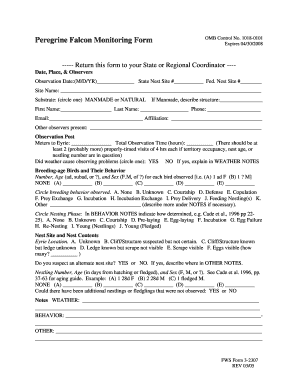
The Peregrine Falcon Monitoring Form is a structured field record used to document observations of peregrine falcons, their nests, and related habitat conditions. It captures standardized data such as observer identity, date and time, GPS coordinates, species and nest status, number of fledglings, and permit or project identifiers. The form supports consistent data collection for research, conservation, regulatory reporting, and facility management. It is commonly distributed as a printable PDF, a fillable PDF or Word document, and may be completed and retained electronically with an audit trail for legal and research integrity.

Why a Standardized Monitoring Form Matters

Using a single, well‑structured monitoring form improves data quality, ensures comparability across observers and sites, and simplifies reporting to agencies and permit holders.

Why a Standardized Monitoring Form Matters

Who Typically Completes This Form

The form is used by government biologists, university researchers, permitted consultants, facility managers, and trained volunteer observers.

Observers should follow any permit or institutional protocols when completing the form and retain records per regulatory or funding requirements.

Field Examples and Practical Uses

Two brief scenarios illustrate how the Peregrine Falcon Monitoring Form is used in practice and why consistent entries matter.

University Research Project

A university team uses the form each breeding season to record nesting success and prey deliveries

  • Standardized fields allow year-to-year comparisons across colonies
  • The resulting dataset supports peer-reviewed analysis and fulfills grant reporting requirements to agencies and funders.

Urban Nest Management

A city facility manager documents rooftop nests observed during maintenance rounds

  • Entries include time, exact rooftop coordinates, and disturbance events
  • Records are shared with the state wildlife office to demonstrate permit compliance and to coordinate any required mitigation.

Essential Sections to Include

A professional monitoring form groups information for clarity, auditability, and regulatory use; each section supports a specific reporting need.

Observer

Name, affiliation, contact, and permit number where applicable. Identifies data provenance and permits attribution in datasets and reports.
Date & Time

Use MM/DD/YYYY and 24‑hour or AM/PM convention. Precise timing is critical for behavior and activity pattern analyses.

Location

Provide GPS coordinates (decimal degrees preferred), site name, and a brief location description to enable mapping and repeat visits.

Species & Count

Record species confirmation, number of adults, juveniles, and fledglings. Note uncertain identifications and supporting evidence.

Nest Condition

Document nest status, substrate, apparent activity, visible eggs or chicks, and any signs of disturbance or damage.

Notes & Attachments

Space for behavioral notes, disturbance observations, photo file names, and permit-related comments or follow-up actions.

Step-by-Step: Completing the Form in the Field

Follow these steps during or immediately after observations to capture reliable data and reduce transcription errors.

  • 01
    Prepare: Confirm you have permit details and GPS device functioning before fieldwork.
  • 02
    Record: Fill observer, date/time, location, and species fields on site.
  • 03
    Detail: Complete nest condition and count fields with specific observations.
  • 04
    Attach: Add photo references and sign the form; note any follow-up required.

Customizing an Online Workflow

Configure an online version of the form to streamline collection, validation, and routing for review and archiving.

Field Configuration
Observer and Permit Fields Required fields with validation and dropdowns for affiliation.
GPS Coordinate Field Validation for decimal degrees and auto-formatting.
Photo Attachment Field Allow image uploads and store filenames in metadata.
Reviewer Routing Conditional routing to agency reviewer when permit number present.

Where to Send or File Completed Forms

Determine the recipient based on project scope, permit terms, or institutional policy before submitting completed forms.

  • Permit Holder: Send the completed form to the permit holder identified on the permit.
  • State Wildlife Agency: Submit copies when required by state permit or agency reporting rules.
  • Research Repository: Upload validated records to institutional or project databases for analysis.
  • Facility Records: Retain a copy with building or site maintenance logs when nests are on structures.

Sharing Formats and Technical Compatibility

Choose file formats and integrations that match your recipients' systems and data policies.

  • File Types: PDF, DOCX, or CSV exports for spreadsheets.
  • Integrations: Connectors for Google Workspace and cloud storage help automate uploads.
  • eSignature: Supports audit trails and signer attribution for electronic completion.

Confirm that chosen formats preserve metadata (timestamps, GPS) and that recipients accept electronic records for compliance.

Reporting Windows and Timelines

Timely submission depends on permit terms and project reporting schedules; know each reporting deadline before fieldwork begins.

Immediate Incident Reports:

Report nest disturbances or mortality within 24–72 hours per many permits.

Seasonal Summaries:

Submit breeding season summaries by the deadline specified in the permit.

Annual Agency Reports:

Many state agencies require annual data submissions for population assessments.

Grant Deliverables:

Follow funding agreements for interim and final dataset delivery dates.

Data Publication:

Allow time for QC and reviewer sign-off before public release.

Common Errors to Avoid

  • Incomplete location data: missing or imprecise GPS coordinates make site relocation and mapping impossible for follow-up.
  • Unclear time entries: inconsistent date/time formats impede temporal analysis and can invalidate comparisons across observers.
  • Missing permit information: failing to record permit IDs may cause noncompliance findings and delay regulatory review.
  • Poor photo reference: unlabeled images or missing filenames prevent verification of species or nest condition during review.

Risks and Potential Consequences

Permit Violation: Fines or permit suspension possible
Data Rejection: Incomplete forms may be excluded from official analyses
Species Harm: Disturbance could injure birds and trigger enforcement
Legal Exposure: Noncompliance may lead to administrative action
Privacy Breach: Improper PHI handling risks HIPAA consequences
Research Impact: Weak records reduce study credibility

Required Data Elements at a Glance

Observer ID: Name and contact
Permit: Permit number if applicable
Date/Time: MM/DD/YYYY and time
Coordinates: Decimal degrees
Species Count: Adults, juveniles, fledglings
Nest Status: Active, failed, unknown

Typical eSignature Pricing and Feature Snapshot

Compare representative starting prices and core feature availability for eSignature providers; signNow is listed first for reference.

signNow DocuSign Adobe Sign PandaDoc HelloSign
Starting Price $8/user/mo $15/user/mo $14/user/mo $19/user/mo $15/user/mo
Free Trial 7-day free trial Varies by plan Varies by plan Varies by plan Varies by plan
Bulk Send Yes Yes Yes Yes Yes
Audit Trail Yes Yes Yes Yes Yes
HIPAA Compliant Yes Yes Yes No No
Envelope Cap No cap 100 envelopes/user/year Varies Varies Varies

FAQs and Troubleshooting

Answers to common questions about completing, signing, and filing the Peregrine Falcon Monitoring Form.


Need help? Contact support

be ready to get more
Join over 28 million airSlate SignNow users