Establishing secure connection…Loading editor…Preparing document…

Acknowledgment by Debtor of Correctness of Account Stated

This template is fully customizable. Edit the text, fill out the fields, and send it for signature. Give it a try!
Acknowledgment by Debtor of Correctness of Account Stated

What the Acknowledgment by Debtor of Correctness of Account Stated Is

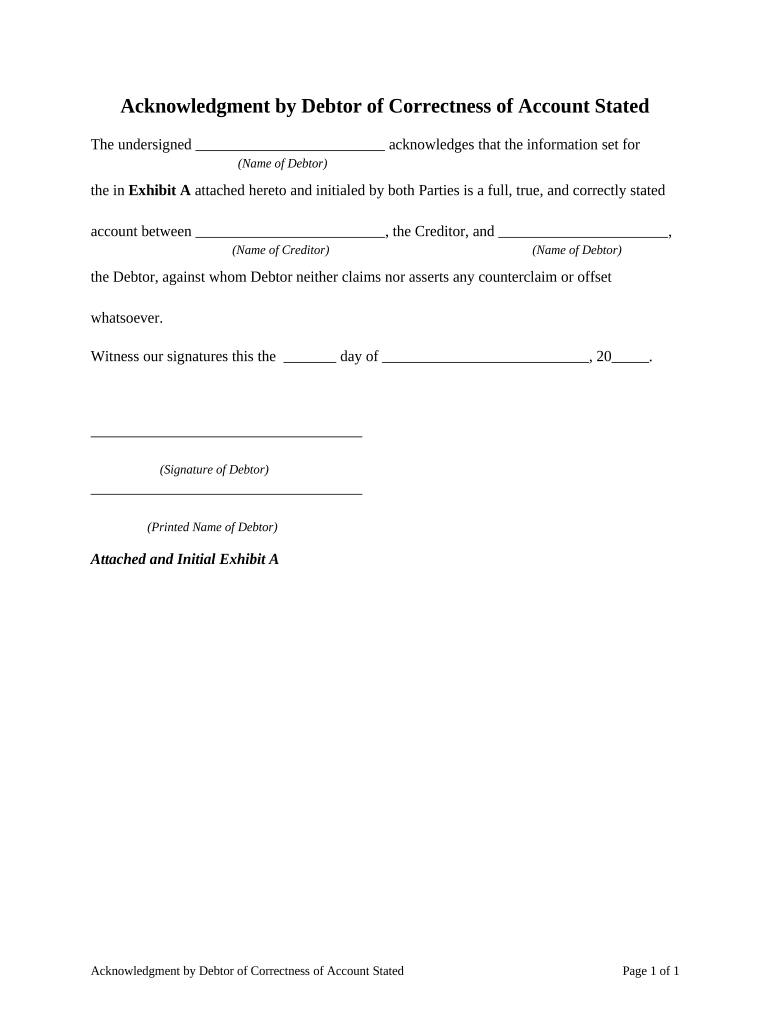
An Acknowledgment by Debtor of Correctness of Account Stated is a signed written confirmation from a debtor acknowledging that a presented account balance, statement, or invoice is accurate and agreed. The document typically identifies the parties, the account period, the outstanding balance, any agreed payment terms, and a signature block where the debtor affirms the correctness of the charges. It is used in commercial collections, account reconciliations, and as a foundation for expedited remedies or judgment in some collection workflows when supported by other documentation and legal process.

Why this acknowledgment matters for creditors and debtors

The acknowledgment creates clear written evidence that the debtor reviewed and accepted the account figures, which can reduce disputes, speed resolution, and simplify bookkeeping. It helps establish a record of consent to amounts invoiced and any agreed repayment terms.

Why this acknowledgment matters for creditors and debtors

Who commonly prepares and signs this acknowledgment

Use by these groups helps shorten dispute cycles and creates a clearer evidentiary trail if further legal steps become necessary.

  • Creditors and billing departments responsible for accounts receivable and dispute resolution.
  • Collection agencies and outside counsel collecting on business debts or reconciling disputed balances.
  • Debtors — business owners or authorized representatives who confirm account accuracy to resolve disputes.

Core elements every professional acknowledgment should include

A complete Acknowledgment by Debtor of Correctness of Account Stated should be clear, dated, and signed, and include references to the original invoice or statement to avoid ambiguity about which charges are confirmed.

Parties

Full legal names and contact information for creditor and debtor so the document identifies who is acknowledging the account.
Account Reference

Invoice or account number, statement date range, and descriptions that tie the acknowledgment to specific billings or services rendered.

Total Balance

The precise amount the debtor acknowledges as correct, including any interest, fees, or credits applied.

Payment Terms

Any agreed payment schedule, due date, installments, or conditions tied to the acknowledgment.

Acknowledgment Language

A clear statement such as 'I acknowledge that the account stated above is correct and due' to show intent and assent.

Signature Block

Signature, printed name, title if signing for an entity, date, and notarization or witness lines if required by law or policy.

Required informational fields and security markers

Debtor Name: Full legal name
Creditor Name: Full legal name
Account ID: Invoice or account number
Amount Owed: Numeric balance
Signature Date: MM/DD/YYYY
Authentication: Notary or e-sign audit trail

Step-by-step: completing an acknowledgment form

Follow these sequential steps to complete the acknowledgment correctly and keep a defensible record.

  • 01
    Review Documents: Compare the statement to invoices and payments before acknowledging accuracy.
  • 02
    Fill Identifiers: Enter names, account number, statement period, and the exact balance acknowledged.
  • 03
    Confirm Authority: If signing for a company, verify the signer’s authority and include the title.
  • 04
    Sign and Authenticate: Sign, date, and if required obtain notarization or capture an e-sign audit trail.

Where to send or file the signed acknowledgment

After signing, route copies to the appropriate internal owners and preserve the record for collections or audit purposes.

  • Send to Creditor: Return the signed copy to the billing contact identified on the statement.
  • Accounting Record: Attach the acknowledgment to the creditor's accounting record or AR ledger entry.
  • Legal Retention: If a dispute may lead to litigation, retain a notarized or e-signed original in legal files.
  • Share with Collections: Provide a copy to any collection agency or counsel handling recovery efforts.

Digital signing and platform considerations

Store signed records in a secure system with access controls and backup copies to support future disputes and compliance reviews.

  • Authentication: Email, SMS code, or stronger methods
  • Audit Trail: IP, timestamp, and action log
  • File Formats: PDF/A or locked PDF

Configuring an online acknowledgment workflow

Set up the digital workflow to reduce errors and ensure each signed acknowledgment is captured and archived automatically.

Field Configuration
Signer Authentication Email link + SMS code or higher
Required Fields Make name, account ID, amount, and date mandatory
Notary / Witness Enable RON or add witness fields where required
Storage Archive signed PDF with audit trail

Common risks and legal consequences of a flawed acknowledgment

Enforceability Risk: Invalid format can undermine collectible evidence
Dispute Exposure: Ambiguous amounts increase litigation risk
Identity Issues: Mismatched signer names complicate proof
Notary Defects: Absent or incorrect notarization reduces weight
Record Retention: Poor storage risks loss during audits
Regulatory Concerns: Consumer-finance rules may impose disclosure obligations

Common eSignature vendor comparison for acknowledgments and authenticated signatures

Platform capabilities and pricing vary; signNow is shown first for comparison. Choose a plan that meets your authentication, notarization, and retention requirements.

signNow DocuSign Adobe Sign PandaDoc HelloSign
Starting Price $8/user/mo $15/user/mo $14/user/mo $19/user/mo $15/user/mo
Free Trial 7-day free trial Varies Varies Varies Varies
Bulk Send Yes Yes Yes Yes No
Audit Trail Yes Yes Yes Yes Yes
HIPAA Compliant Yes Yes Yes No No

Practical tips for accurate and efficient acknowledgments

Follow these best practices to minimize disputes and ensure the acknowledgment is useful for collections or legal purposes.

Attach supporting detail
Include invoice copies, payment history, and any credits so the acknowledgment clearly ties to source documents and avoids ambiguity.
Use precise language
Avoid vague terms; state exact amounts, dates, and whether fees or interest are included to prevent later disagreements.
Verify signer authority
Confirm that an individual signing for a business is authorized and include the signer’s title to show capacity and reduce challenges.
Preserve audit evidence
If e-signing, capture the full audit trail; if notarizing, retain the notary journal or RON session recording per state rules.

Frequently asked questions about the acknowledgment

Answers to common questions about enforceability, signing methods, notarization, and record retention for the acknowledgment.


Need help? Contact support

be ready to get more
Join over 28 million airSlate SignNow users