Establishing secure connection…Loading editor…Preparing document…

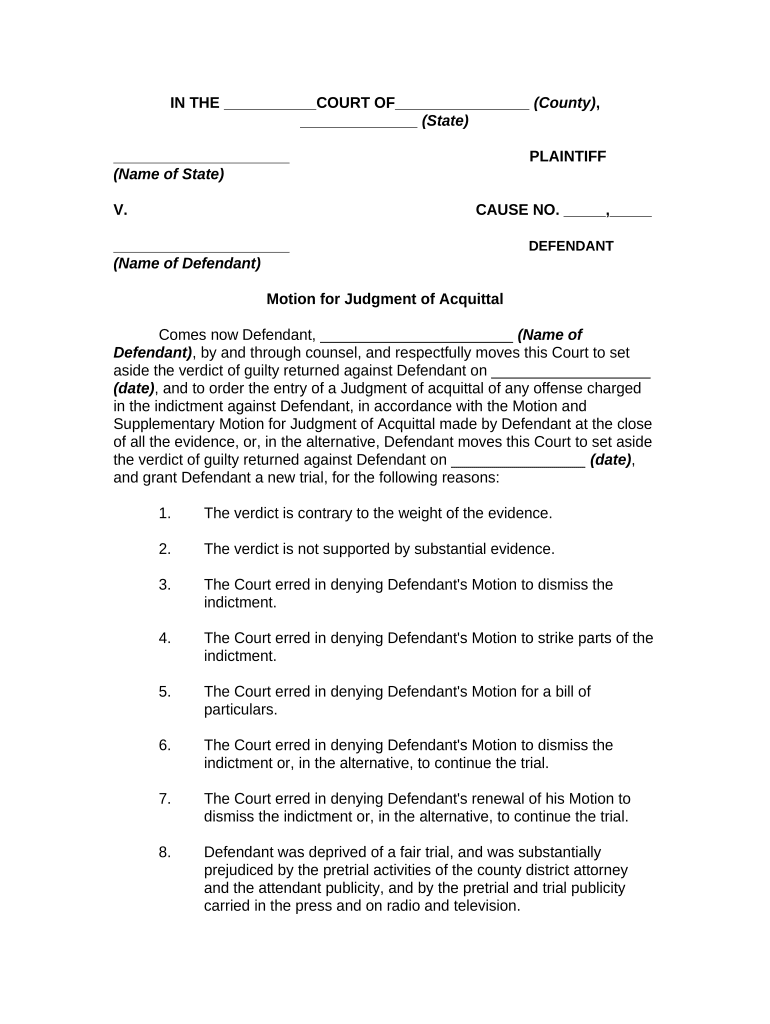
Motion for Judgment of Acquittal

This template is fully customizable. Edit the text, fill out the fields, and send it for signature. Give it a try!
Motion for Judgment of Acquittal

What the Motion for Judgment of Acquittal Is

A Motion for Judgment of Acquittal asks a criminal court to enter an acquittal because the evidence introduced at trial is legally insufficient to sustain a conviction. Under Federal Rule of Criminal Procedure 29, a defendant may move for acquittal at the close of the prosecution's case and again after jury verdict; many states have equivalent rules. The motion focuses on the legal standard for sufficiency of the evidence rather than factual credibility, and it preserves issues for appeal if timely made.

Why this motion matters and when it applies

The motion tests whether evidence presented meets the statutory elements beyond a reasonable doubt and can result in dismissal without a new trial. Timely filing preserves appellate rights and can narrow issues for the court.

Why this motion matters and when it applies

Who prepares and relies on this motion

Prosecutors may oppose the motion; courts resolve it by applying the applicable sufficiency standard and viewing evidence in the light most favorable to the prosecution.

  • Defense counsel: Prepares legal argument, cites case law and evidence insufficiency, and requests dismissal.
  • Criminal defendants: Benefit if the court finds insufficient evidence and enters acquittal on charged counts.
  • Appellate counsel: Uses timely motion as preservation for appellate review of sufficiency issues.

Core sections every professional motion should include

A clear, well-supported motion organizes legal standards, the relevant record, and a concise argument that specific elements lack sufficient evidence.

Caption

Complete case caption with court, docket number, parties, and judge so the clerk and record identify the filing immediately.
Introduction

Short statement of relief sought and the narrow legal question, stating that the motion is made under the governing procedural rule.

Statement of Facts

Concise, record-based summary of evidence admitted at trial that explains why the prosecution failed to meet essential elements.

Standard of Review

Cite the controlling sufficiency standard (e.g., Fed. R. Crim. P. 29) and appellate standards explaining how courts evaluate evidence in the prosecution's favor.

Argument

Pointed legal analysis showing absence of legally sufficient evidence for each element, using record citations and applicable precedent.

Prayer for Relief

Specify the requested order (judgment of acquittal on identified counts), and include certificate of service and proposed order.

Essential information to include on every motion

Case Caption: Court, parties, docket number
Defendant Name: Full legal name
Counts Challenged: Charge numbers or paragraphs
Trial Date(s): Dates evidence was presented
Counsel Contact: Attorney name, bar number
Signature Block: Attorney signature and date

Step-by-step process to prepare and file the motion

Follow a short, sequential workflow from drafting through filing to preserve timeliness and appellate rights.

  • 01
    Draft the motion: Cite rule and compile record citations.
  • 02
    Attach transcript citations: Identify transcript pages and exhibits relied upon.
  • 03
    File with clerk: File electronically or deliver to clerk per local rules.
  • 04
    Request ruling: Present oral argument or renew post-verdict if appropriate.

Customizing and completing the motion online

Configure a digital template so each motion is consistent, includes required fields, and captures necessary record citations.

Template Prepopulate caption | Standard clauses
Conditional Fields Show counts field when multiple counts exist
Citation Links Add transcript page and exhibit reference
Signature Method Select firm e-signature or court e-filing signature
Export Format PDF/A or court-accepted PDF

Where and how to file the motion

Filing pathways depend on jurisdiction: electronic filing systems, in-court hand delivery, or clerk submission are typical options.

  • E-filing system: Upload via the court's electronic filing portal
  • Clerk's office: Deliver paper copy when e-filing unavailable
  • In-court filing: Present orally as part of trial if permitted
  • Service on counsel: Serve prosecutor per local service rules

How to share, serve, and archive the motion

Retain copies in secure firm records and docket the service event so appellate preservation and record transfer are clear.

  • Email Service: Use counsel's authorized service address
  • Court E-service: Comply with the court's e-service rules
  • File and Archive: Store a signed PDF in the case file

Timing and important filing windows to preserve rights

Strict timing governs when motions are allowed and when renewals must be made; follow local rules and any judge-specific scheduling orders.

Trial-stage filing window:

Motion may be made at close of prosecution's case

Post-verdict renewal:

Renew the motion after jury verdict per local rule

Notice to opposing party:

Serve motion per local service deadlines

Hearing scheduling:

Request oral argument if permitted by court

Record designation:

Cite transcript pages promptly for appellate record

Common pitfalls to avoid when preparing the motion

  • Failing to cite exact trial record locations makes the motion harder to evaluate and increases the risk of denial.
  • Overstating credibility issues: sufficiency motions focus on legal sufficiency, not witness credibility, contrary approaches weaken the brief.
  • Missing the timely renewal: failing to renew a midtrial motion after verdict can forfeit appellate review of sufficiency claims.
  • Vague requests for relief: not specifying which counts should be acquitted can lead to ambiguous or incomplete court orders.

Consequences of an improperly prepared or untimely motion

Waived Issues: Preservation lost
Denial on Procedural Grounds: Motion dismissed
Sanctions Risk: Potential fee or conduct sanctions
Appeal Limitations: Appellate review restricted
Client Impact: Unfavorable plea or sentence outcomes
Record Problems: Incomplete record for review

Practical examples of how motions are used in court

Two brief, realistic scenarios show how the motion can be applied in federal and state settings.

Federal trial example

Defendant moves under Fed. R. Crim. P. 29 after prosecution rests, arguing element X lacks proof

  • Court reviews record pages and testimony
  • Judge grants acquittal on specified count where the prosecution offered no admissible evidence establishing the element, and the order is entered on the docket.

State court example

Defense counsel files a post-verdict renewal challenging sufficiency on Count 2

  • Trial transcript citations emphasize missing element evidence
  • The court denies the motion, noting reasonable-inference support, and counsel preserves the issue for appeal with a timely motion and docket entry.

eSignature vendor comparison for filing and serving motions

Basic vendor pricing and core features for document signing and workflow automation; verify plan details with each vendor before purchase.

signNow DocuSign Adobe Sign PandaDoc HelloSign
Starting Price $8/user/mo $15/user/mo $14/user/mo $19/user/mo $15/user/mo
Free Trial 7-day free trial Varies Varies Varies Varies
Bulk Send Yes Yes Yes Yes No
Audit Trail Yes Yes Yes Yes Yes
HIPAA Compliant Yes Yes Yes No No

Frequently asked questions about filing and preserving the motion

Answers to common practical and procedural questions encountered when preparing, filing, or renewing a motion for judgment of acquittal.


Need help? Contact support

be ready to get more
Join over 28 million airSlate SignNow users