Establishing secure connection…Loading editor…Preparing document…

Act of Donation Real Estate

This template is fully customizable. Edit the text, fill out the fields, and send it for signature. Give it a try!
Act of Donation Real Estate

What the Act of Donation Real Estate Is and When it Applies

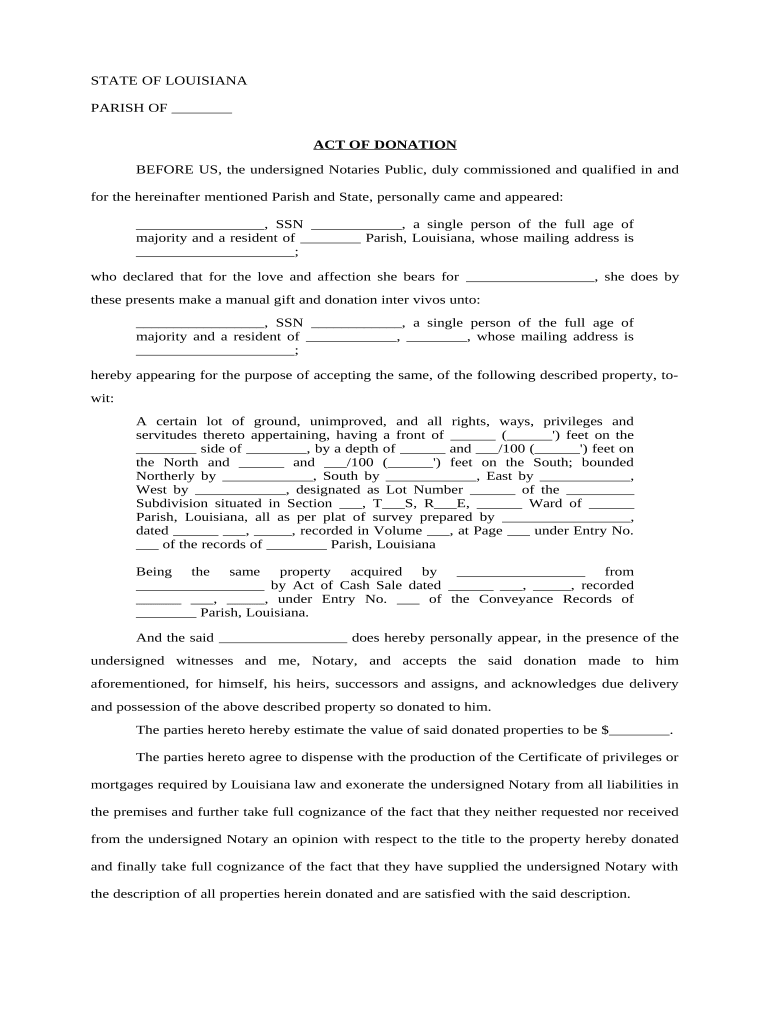
An Act of Donation Real Estate is a legal instrument used to transfer real property title from a donor to a donee without monetary consideration, typically as a gift. The document identifies the parties, provides the full legal description of the property, and includes the donor's statement of intent to transfer ownership. It must be signed, acknowledged before a notary or other authorized official, and recorded with the appropriate county recorder or land registry to complete the conveyance. Recording and notarization requirements vary by state and can affect enforceability and tax reporting.

Why an Act of Donation Real Estate Matters

Using a properly drafted and executed Act of Donation Real Estate documents the donor's intent, ensures clear title transfer, and protects both parties by creating a public record of the gift; recording limits later disputes and supports tax and estate planning needs.

Why an Act of Donation Real Estate Matters

Who commonly prepares and receives a donated property deed

Typical users include property owners (donors), recipients (donees), real estate attorneys, title companies, and county recorders involved in transferring and recording ownership.

  • Donors and donees: Individuals or entities giving or receiving property as a gift; responsible for accurate names and signatures.
  • Real estate attorneys: Draft and review deed language, confirm legal description, and advise on tax consequences and recording.
  • Title companies and recorders: Verify chain of title, prepare recording instruments, and record the deed to make the transfer public.

Who Signs and Who Reviews

Donor — Property Owner

The donor (grantor) must be the owner of record or have authority to convey the property; their signature is the primary act of transfer and must match recorded ownership to avoid title defects.

Donee — Recipient

The donee (grantee) is the intended recipient and should confirm the legal description and accept the grant; in many jurisdictions the donee's acknowledgment or acceptance is recorded but not always required.

Core Parts of a Professional Act of Donation Real Estate

A complete Act of Donation Real Estate contains specific clauses and technical details that establish the gift, define the property, and direct recording and post-transfer responsibilities to prevent ambiguity and later disputes.

Granting Clause

Clear statement that the donor conveys the property by gift, specifying the donor's present intent to transfer title without consideration and naming the donee(s) precisely to avoid ambiguity upon recording.
Legal Description

Full metes-and-bounds description or recorded parcel number (not a mailing address). Use the recorded legal description exactly as it appears in prior title documents to avoid recording rejection.

Habendum / Rights Conveyed

Language that defines the estate type being transferred (fee simple, life estate, etc.) and any reservations, easements, or conditions that survive the donation.

Consideration Statement

Typically states 'for love and affection' or 'as a gift' and clarifies that no monetary consideration is exchanged; helpful for recording and potential tax analysis.

Signature and Notary Block

Donor signature, date, and a notary acknowledgement complying with state notary law; witness lines if the state requires witnesses for deeds.

Recording Instructions

Directive to submit the deed to the appropriate county recorder and any supporting documents required for indexing, transfer tax payment, or exemption claims.

Step-by-Step: Prepare, Sign, and Record the Act of Donation Real Estate

Follow these sequential steps to complete a valid donation deed and minimize delays at the county recorder's office.

  • 01
    Draft: Prepare deed using precise legal description and correct grant language; consult title history.
  • 02
    Review: Confirm donor ownership, lien status, and any required consents or marital joinder.
  • 03
    Sign & Notarize: Donor signs before a notary; obtain witness signatures if state law requires them.
  • 04
    Record: Submit the signed deed to the county recorder with required fees and transfer tax documents.

Configuring an Online Workflow for the Act of Donation Real Estate

When using an e-signature platform, set up fields, signer order, and a notarization step to mirror the in-person process and meet recording requirements.

Field Configuration
Document Upload Upload a PDF/A version of the deed for stable rendering across devices.
Signature Fields Place signature, printed name, and date fields for donor and any witnesses.
Notary Field Add a notary acknowledgement block; configure for RON or in-person notarization as required.
Routing Order Set donor to sign first, then notary (or notary session), then recording agent if using a title company.

Where to Send the Completed Act of Donation Real Estate

After execution and acknowledgement, the deed must be delivered to appropriate parties and the county recorder to effect public transfer and perfect title.

  • Deliver to Donee: Provide the donee with a copy for their records and insurance purposes.
  • Title Company: If using a title company, send the executed deed for final review, escrow instructions, and recording.
  • County Recorder: Submit the original signed and notarized deed to the county recorder for indexing and public record.
  • Tax / Transfer Forms: Include any local transfer tax forms or exemption affidavits required by county rules.

Digital Signing and eSubmission Considerations

Choose an e-signature workflow that supports notarization steps, audit trails, and the file formats accepted by recorders and title companies.

  • File Formats: PDF/A and standard PDF are widely accepted for recorders and title review.
  • Integrations: Connect with systems like NetSuite, Salesforce, or Box for secure storage and routing.
  • Notarization Modes: Support for Remote Online Notary (RON) or in-person notaries varies by county and state.

Security, Compliance, and Data Protections to Consider

Encryption in Transit: TLS 1.2/1.3
Encryption at Rest: AES-256
Audit Trails: Detailed timestamped logs
HIPAA / BAA: HIPAA compliant (BAA required)
21 CFR Part 11: Compliant for regulated records
Certifications: SOC 2 Type II, ISO 27001

Common Preparation Errors to Avoid

  • Using a street address instead of the recorded legal description, which often causes rejection by the county recorder and delays in indexing the deed.
  • Mismatching donor name to recorded title (omitting middle names or suffixes), producing title defects that require corrective affidavits or re-execution.
  • Failing to identify outstanding liens or mortgage releases; an unaddressed mortgage may cloud title and complicate insurance or resale.
  • Omitting required witness signatures or incorrect notarization language for the state, which can render the deed unrecordable or challengeable in probate.

Consequences of an Incorrect or Defective Act of Donation Real Estate

Recording Rejection: Delays transfer of public title
Title Defect: Requires corrective deed or affidavit
Tax Exposure: Gift tax or transfer tax implications
Probate Challenges: Potential disputes over donor intent
Fraud Allegations: Might trigger criminal or civil claims
Notary Invalidity: Failure to notarize may void recording

eSignature Provider Comparison (pricing and core features)

Compare starting prices and common features for typical eSignature plans relevant to property deed workflows; signNow is listed first per vendor convention.

signNow DocuSign Adobe Sign PandaDoc HelloSign
Starting Price $8/user/mo $15/user/mo $14/user/mo $19/user/mo $15/user/mo
Free Trial Yes, 7-day free trial Varies Varies Varies Varies
Bulk Send Yes Yes Yes Yes No
Audit Trail Yes Yes Yes Yes Yes
HIPAA Compliant Yes Yes Yes No No

Real-World Use Cases for Donation Deeds

Examples show how donation deeds are used by families, nonprofits, and municipalities in practical scenarios.

Family Transfer

A parent conveys a vacation parcel to an adult child to avoid future probate

  • Gift language and correct legal description ensure clear title
  • The deed was notarized, recorded at the county recorder, and the family provided a copy to their title insurer to update ownership records.

Nonprofit Gift

An owner donates a vacant lot to a local nonprofit for community use

  • Transfer requires municipal clearance for deed restrictions
  • The nonprofit confirmed zoning and recorded the deed with transfer documentation to obtain tax-exempt status for the parcel.

Common Questions and Practical Answers

These FAQs address frequent execution, recording, and enforceability questions for Act of Donation Real Estate documents in the U.S.


Need help? Contact support

be ready to get more
Join over 28 million airSlate SignNow users