Establishing secure connection…Loading editor…Preparing document…

Letter Requesting Ad Valorem Tax Exemption

This template is fully customizable. Edit the text, fill out the fields, and send it for signature. Give it a try!
Letter Requesting Ad Valorem Tax Exemption

What the Letter Requesting Ad Valorem Tax Exemption Is

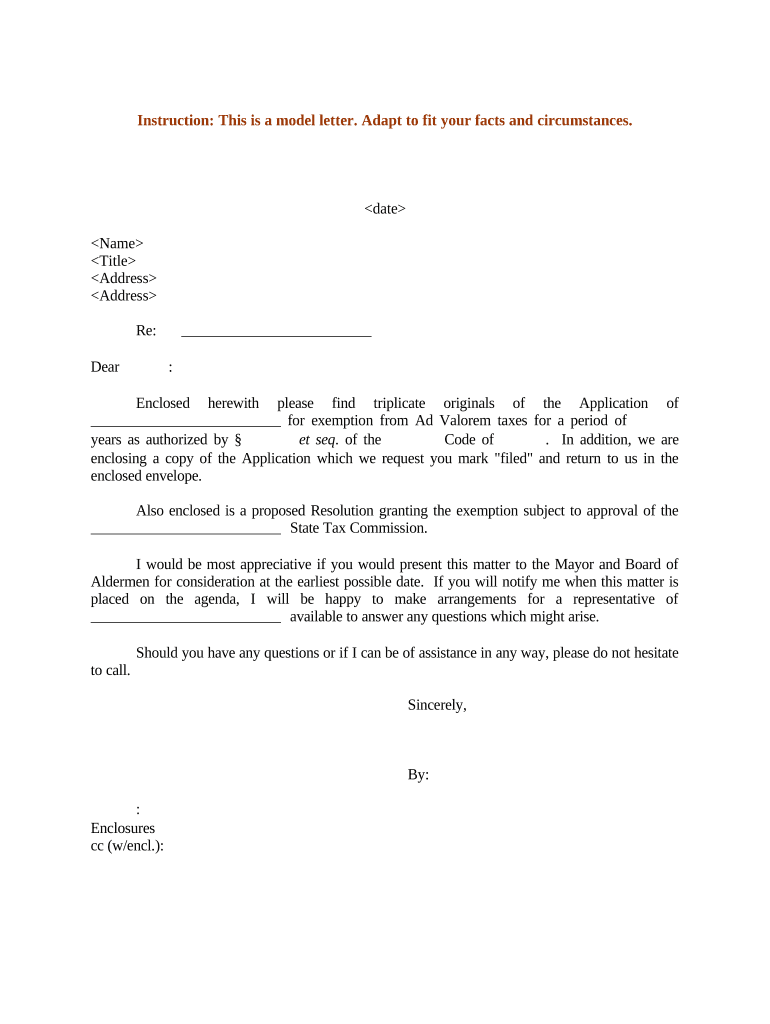
A Letter Requesting Ad Valorem Tax Exemption is a written request submitted to a local tax assessor or appraisal district asking that a specific parcel or class of property be excluded from ad valorem (property) taxation under applicable state or local statutes. The letter identifies the owner, parcel identifier, exemption category (for example, religious, charitable, historic, conservation, or homestead), the legal basis for the claim, and any supporting documentation. It creates an official record to begin administrative review and may trigger verification, a hearing, or request for additional evidence.

Why Sending a Clear Exemption Request Matters

A properly prepared letter documents eligibility, preserves appeal rights, and speeds administrative review. It reduces the chance of misfiled requests and supports timely tax assessments or refunds where statute permits.

Why Sending a Clear Exemption Request Matters

Who Typically Submits This Letter

Prepare the letter in the owner’s name or on official letterhead when filing for institutional exemptions to avoid processing delays.

  • Property owners seeking homestead or classification exemptions for their primary residence.
  • Nonprofit and religious organizations requesting charitable or institutional exemptions.
  • Property managers, attorneys, or tax agents filing on behalf of owners or estates.

Step-by-Step: Preparing and Submitting the Letter

Follow a short, documented sequence to avoid omissions and ensure the assessor accepts your request.

  • 01
    Draft Letter: State owner, APN, exemption type, and legal basis succinctly.
  • 02
    Attach Evidence: Include deeds, nonprofit charter, or appraisal as required.
  • 03
    Submit to Assessor: Send to the county appraisal district or tax assessor's office.
  • 04
    Confirm Receipt: Obtain a stamped copy, tracking number, or electronic receipt.

Essential Elements to Include in the Letter

A concise, well-structured letter should contain specific legal and factual elements to meet assessor requirements and reduce follow-up.

Header

Include date, recipient name and office (county appraisal district or tax assessor), and contact information for the filer to establish a clear record of the request.
Statement of Claim

Clearly state the exemption requested and cite any controlling statute, ordinance, or local rule to focus the review on the claimed legal basis.

Property Description

Provide the APN, legal description or deed reference, and full property address so the assessor can identify the parcel without ambiguity.

Ownership Details

List the legal owner(s), their relationship to the property, and whether the property is owner-occupied, leased, or institutionally held.

Supporting Documents

Attach required documents such as deed, proof of nonprofit status, affidavit of use, or previous tax bills; labeled exhibits reduce processing friction.

Signature and Verification

Include a dated signature and, if required, notarization or a sworn affidavit. Note the signer’s title if submitting on behalf of an entity.

Required Information Checklist

Applicant Identity: Full legal name
Tax Identifier: SSN or EIN
Parcel Identifier: Assessor Parcel Number
Property Address: Street, city, state, ZIP
Exemption Requested: Type or code
Supporting Proof: Deed, charter, affidavit

Penalties and Risks of Incorrect or Late Requests

Late Filing: Possible denial or loss of retroactive relief
Denial of Exemption: No tax relief for the period in question
Interest Charges: Interest on underpaid taxes
False Statements: Civil or criminal penalties
Refund Forfeiture: Unable to recover improperly paid tax
Processing Delay: Extended review and appeals

Common Mistakes to Avoid

  • Submitting an incorrect APN or property description that prevents the assessor from matching the request to records.
  • Citing the wrong exemption statute or failing to provide the specific qualifying facts under the claimed category.
  • Omitting required supporting documents such as deeds, IRS determination letters, or occupancy affidavits.
  • Using an unsigned or improperly witnessed document, or an e-signature method that lacks required consent or retention evidence.

Where to Send the Letter and What Happens Next

The letter routes through the local appraisal district or assessor and follows internal verification steps; understanding submission options helps track progress.

  • County Appraisal Office: Primary recipient for exemption applications.
  • Mail or Hand Delivery: Use certified mail or in-person drop-off for proof.
  • Electronic Submission: Accepted by some jurisdictions via email or e-file.
  • Follow-Up Process: Office may request additional documents or schedule inspection.

Setting Up an Online Submission Workflow

Configure a digital workflow to collect fields, attachments, and signatures consistently when submitting electronically.

Field Online Setting
Applicant Name Required textbox with autofill from profile
APN / Parcel ID Required field with pattern validation
Document Uploads Mandatory PDF uploads with file-size limits
Signature Method Email or SMS authentication option

Technical Options for eSubmission and Authentication

When using an e-signature platform, choose one that supports robust audit trails, secure storage, and integrations with systems like Salesforce or Google Workspace to simplify submission workflows.

  • File Formats: PDF and DOCX are widely accepted
  • Authentication: Email link, SMS code, or two-factor
  • Integrations: Common CRMs and cloud storage supported

Timing and Typical Processing Windows

Deadlines and review periods differ by county and state; plan submissions well before the local assessment or exemption cutoff to preserve rights.

Application Deadline:

Set by county; often early in the tax year

Inspection Period:

Assessor may inspect within 30–90 days

Appeal Window:

Appeal or protest deadlines vary by jurisdiction

Retroactivity:

Retroactive relief depends on local statute

Follow-Up Response:

Expect requests for additional evidence within weeks

Typical eSignature Pricing Options for Preparing and Signing Letters

Platform pricing varies by plan, features, and volume; signNow appears first for comparison and includes options for per-user and per-invite pricing models.

signNow DocuSign Adobe Sign PandaDoc HelloSign
Starting Price $8/user/mo $15/user/mo $14/user/mo $19/user/mo $15/user/mo
Free Trial Yes, 7-day trial No No Yes, limited Yes, limited
Bulk Send Yes Yes Yes Yes No
Audit Trail Yes Yes Yes Yes Yes
Envelope Cap No cap 100 envelopes/user/year Varies by plan Varies by plan Varies by plan

Real-World Uses of the Letter Requesting Ad Valorem Tax Exemption

Examples show how different owners use the letter to start formal exemption reviews and to document eligibility in municipal records.

Nonprofit Campus Exemption

A university submitted a campus-wide exemption letter citing institutional charters

  • Included IRS determination letter
  • The assessor requested site use affidavits and granted partial relief after review of exhibits and inspections, demonstrating the need for complete evidence.

Residential Homestead Claim

An owner sent a homestead exemption request with APN and proof of occupancy

  • Owner attached driver's license and utility bills
  • The county accepted the application, updated the roll, and provided a stamped receipt for tax records and future appeals.

Frequently Asked Questions About the Letter Requesting Ad Valorem Tax Exemption

Answers address common legal and procedural questions about preparing, signing, and submitting exemption requests to local authorities.


Need help? Contact support

be ready to get more
Join over 28 million airSlate SignNow users