Establishing secure connection…Loading editor…Preparing document…

Adoption Agreement

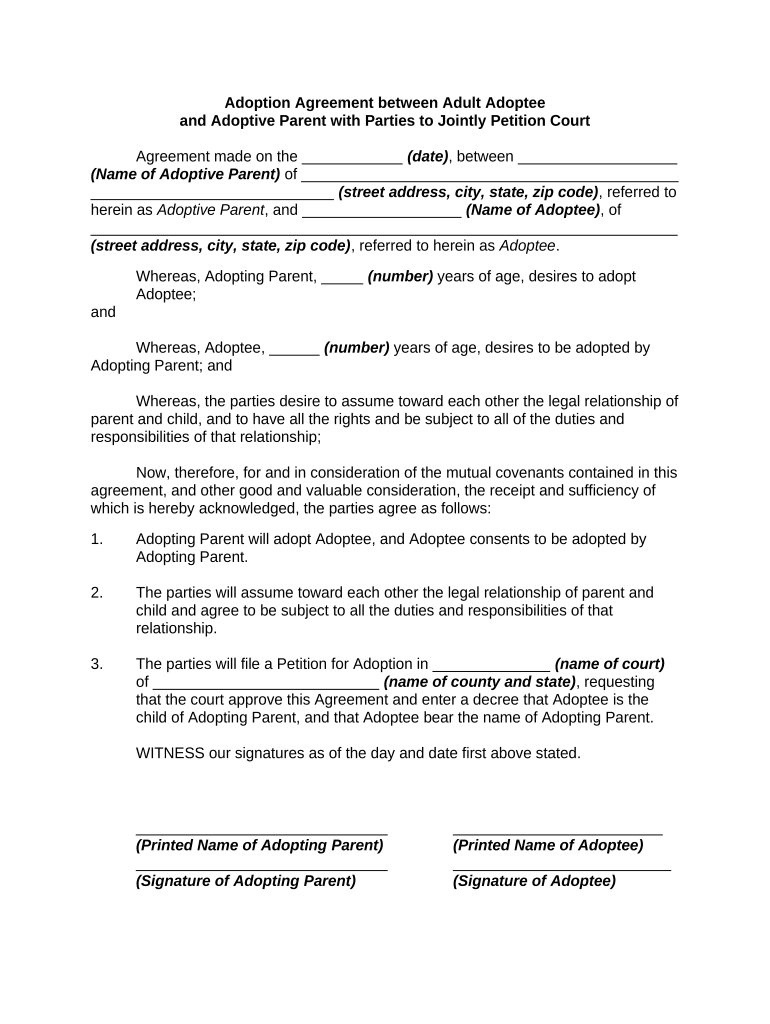
This template is fully customizable. Edit the text, fill out the fields, and send it for signature. Give it a try!
Adoption Agreement

What an Adoption Agreement is and when it applies

An Adoption Agreement is a legally binding document that memorializes the terms and conditions governing the permanent transfer of parental rights and responsibilities from one party to another. It typically identifies the adoptive parent(s), biological parent(s) or agency, the child, the effective date, and any conditions or services promised as part of the placement. Adoption Agreements are used in private agency adoptions, intercountry adoptions, and some stepparent or relative adoptions; they work together with court filings that finalize the adoption and create the official adoption decree.

Why clarity and correct execution matter for an Adoption Agreement

A clearly drafted Adoption Agreement reduces the risk of disputed terms, supports the court record, and documents consent, placement conditions, and any post-placement obligations. Because adoption affects parental status and custody, accuracy and proper filing are essential to ensure enforceability and to protect the child’s legal status.

Why clarity and correct execution matter for an Adoption Agreement

Typical parties involved and how they use the agreement

Adoption Agreements are prepared and reviewed by several professionals and parties before filing with the court.

  • Adoptive parents: Complete identifying information, sign consent forms, and acknowledge post-placement terms where required.
  • Biological parents or guardians: Provide informed consent or documented waiver consistent with state law and agency procedures.
  • Placement agencies and social workers: Attach home study reports, supervise placement conditions, and file supporting paperwork with the court.

Accurate execution supports finalization by the family court and reduces the need for supplemental affidavits or hearings.

Core elements to include in a professional Adoption Agreement

A complete Adoption Agreement combines identity data, consent language, placement terms, financial arrangements (if permitted), confidentiality protections, and references to supporting court or agency documents.

Parties

Full legal names, dates of birth, and contact details for adoptive parent(s), biological parent(s) or guardian(s), and the placing agency; clearly identify legal roles and relationships.
Child details

Child’s full legal name, date and place of birth, medical history summary, race/ethnicity if required by law, and any known legal identifiers such as a file number or case number.

Consent and relinquishment

Express written consent from the biological parent(s) or an explicit statement of relinquishment where permitted, including the date and circumstances of consent.

Placement conditions

Any agreed services, visitation rights, financial assistance provisions (where lawful), medical care obligations, and conditions precedent to finalization.

Supporting documentation

Referenced exhibits such as the home study, background checks, medical releases, agency reports, and the petition to the court.

Signatures and acknowledgements

Signature blocks for each party with printed name, date, capacity (e.g., adoptive parent, biological parent), and any required notarization or witness lines.

Required data fields to capture on the form

Child Name: Full legal name
Child DOB: MM/DD/YYYY
Birthplace: City, state, country
Biological Consent: Signed consent status
Home Study ID: Home study file/reference
Court Case No.: Court docket number

Step-by-step: completing an Adoption Agreement

Follow these steps in order to prepare the agreement, attach supporting documentation, and present the package to the court or agency.

  • 01
    Gather records: Collect birth certificate, IDs, home study, and consent forms.
  • 02
    Draft terms: Populate the agreement with complete parties and clear placement conditions.
  • 03
    Attach exhibits: Add home study, medical releases, and agency reports as exhibits.
  • 04
    Sign and notarize: Execute signatures and obtain any required notarizations or witnessed acknowledgements.

Where to submit the Adoption Agreement and supporting papers

Submission processes vary by jurisdiction; use the proper court or agency channel listed for the county or state where finalization will occur.

  • Court clerk filing: File the agreement with the family court handling the adoption.
  • Agency records: Provide copies to the placing agency for its file and for the home study record.
  • Child welfare: If required, submit to the state child welfare agency for approval or oversight.
  • Counsel for parties: Serve attorneys of record with the fully executed agreement and exhibits.

Customizing an online Adoption Agreement workflow

Set up a digital workflow that mirrors the required filing order and preserves evidentiary records for court review.

Field Configuration
Signer roles Define sign order and role names
Authentication Require SMS or ID verification
Conditional fields Show fields only when applicable
Attachments Require home study and medical exhibits

Digital signing and distribution considerations

Choose a platform that captures a court-ready audit trail and supports secure attachments and signer authentication.

  • Audit trail: IP, timestamps, and action log
  • Authentication: Email, SMS, or ID verification
  • Document formats: PDF/A with embedded exhibits

Preserve an immutable history of actions and deliver final signed copies to each party and to the court or agency as required.

Typical timelines and deadlines in adoption processing

Timelines vary widely between private, agency, and intercountry adoptions. Below are common milestones and typical timing considerations to track.

Home study completion:

Often required before placement; timing varies by agency

Consent waiting period:

Some states impose a statutory waiting period after consent

Petition filing:

File petition with family court to start finalization proceedings

Final hearing:

Court hearing to enter decree and terminate parental rights

Certificate issuance:

State issues amended birth certificate after decree

Key milestones from placement to final decree

A typical adoption progresses through placement, post-placement supervision, petition, hearing, and issuance of the final decree; courts set exact durations.

01

Placement

Child placed with adoptive family under agency supervision

02

Supervision

Post-placement visits and reports submitted to court

03

Petition

Formal petition for adoption filed in family court

04

Finalization

Court hearing results in final decree and certificate

Common mistakes to avoid when preparing an Adoption Agreement

  • Incomplete identities: omitting middle names or DOBs that differ from supporting IDs delays court review.
  • Vague terms: using non-specific language about financial support or visitation creates enforceability risks.
  • Missing exhibits: failing to attach the home study, medical releases, or consent documents prevents filing acceptance.
  • Improper execution: absent notarization or required witness signatures may render the agreement noncompliant with local rules.

Consequences and legal risks of errors or omissions

Invalid filing: Court may reject the package
Delay to finalization: Additional hearings or filings required
Confidentiality breach: Sensitive records improperly disclosed
Revoked consent: Consent challenges can derail adoption
Financial liability: Unauthorized payments may create penalties
Criminal risk: Fraudulent signatures carry legal exposure

Representative eSignature pricing and plan features for adoption document workflows

Compare common vendor starting prices and key plan limitations when selecting an eSignature provider for document execution and routing.

signNow DocuSign Adobe Sign PandaDoc HelloSign
Starting Price $8/user/mo $15/user/mo $14/user/mo $19/user/mo $15/user/mo
Free Trial 7-day trial No No No No
Bulk Send Yes Yes Yes Yes No
Audit Trail Yes Yes Yes Yes Yes
Envelope Cap No cap 100 envelopes/user/year No cap No cap No cap

Who is authorized to sign an Adoption Agreement

Adoptive Parent

An adoptive parent signs to accept parental rights; signature must match identification and any notarization or witness requirements in the jurisdiction.

Family Law Attorney

The attorney of record may sign acknowledgements or verification statements; counsel often files the signed agreement and ensures court-compliance.

Illustrative examples of how Adoption Agreements are used

The cases below show common scenarios where a clear, executed Adoption Agreement supports court finalization and agency oversight.

Private Agency Placement

A licensed agency prepares the agreement and home study

  • Agency supervises placement for six months
  • The signed agreement and home study are filed with the family court to support the petition for final decree and the issuance of an amended birth certificate.

Stepparent Adoption

A stepparent completes the agreement to establish parental rights

  • Biological parent provides consent or rights are terminated by court order
  • The agreement attaches consent forms and custody history, then is submitted with the petition for expedited review in many jurisdictions.

Frequently asked questions about executing and filing an Adoption Agreement

Answers address execution, eSignature feasibility, required attachments, corrections, and revocation options commonly asked by parties and practitioners.


Need help? Contact support

be ready to get more
Join over 28 million airSlate SignNow users