Establishing secure connection…Loading editor…Preparing document…

Adverse Possession of Property

This template is fully customizable. Edit the text, fill out the fields, and send it for signature. Give it a try!
Adverse Possession of Property

What Adverse Possession of Property Means

Adverse possession is a legal doctrine that allows an individual to claim ownership of real property after openly occupying and using it for a statutory period without the true owner's permission. Successful claims typically require proof that possession was actual, open and notorious, exclusive, hostile, and continuous for the period set by state law. Adverse possession itself is not a standard form; claimants usually prepare factual affidavits, documentary exhibits, and then seek quiet title or a declaratory judgment in court to convert possession into record title.

Why a Clear Adverse Possession Claim Matters

A well-documented adverse possession claim can resolve boundary disputes, clear title defects, and provide legal certainty for long-term occupants or neighboring landowners through quiet title proceedings.

Why a Clear Adverse Possession Claim Matters

Who Typically Prepares or Responds to These Claims

Parties involved include the occupying claimant, neighboring property owners, title companies, and attorneys handling real property litigation.

  • Occupying claimant asserting continuous possession and seeking title
  • Adjacent property owner defending boundary or title rights
  • Real estate or title professionals verifying chain-of-title effects

Representation by a real estate attorney is common because state statutes and evidentiary standards vary and court filings are usually required.

Step-by-step: Preparing an Adverse Possession Claim

Follow these sequential actions to assemble factual evidence and pursue a judicial remedy or related recording.

  • 01
    Gather Evidence: Collect photos, tax records, utility receipts, and witness affidavits showing uninterrupted use.
  • 02
    Describe the Property: Use the legal description and prepare a labeled exhibit map for court and recorder reference.
  • 03
    Consult Counsel: Have a real estate attorney review state statutory period, notice obligations, and likely defenses.
  • 04
    File Quiet Title: Prepare and file a complaint or affidavit seeking quiet title and record any court judgment as required.

Core Elements to Include in Your Claim Package

A complete claim package organizes facts, evidence, and formal requests so a court or recorder can evaluate the adverse possession claim efficiently.

Claim Summary

A concise statement of who is claiming the property, the basis for possession, and the relief sought, stated clearly for the court record and title examiner.
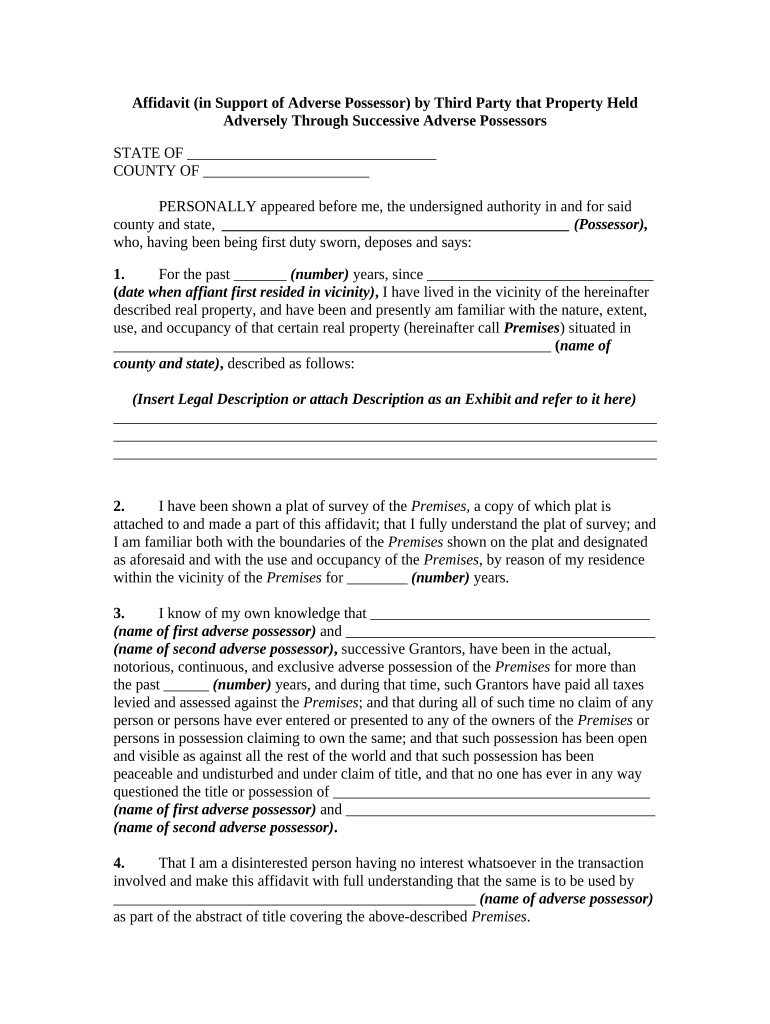
Legal Property Description

Exact parcel description or assessor’s parcel number (APN) with an attached exhibit map showing boundaries, structures, and points of entry or use.

Possession Timeline

Chronological list of acts and dates demonstrating continuous possession, including start date, key maintenance acts, and any interruptions or permissions.

Proof of Acts

Photographs, receipts, tax payments, improvements, utility bills, and other documents that corroborate exclusive and open use over time.

Witness Affidavits

Signed statements from neighbors or other observers describing what they witnessed, with contact information and dates of observation.

Requested Relief

Clear statement of the remedy sought, typically quiet title or a declaratory judgment, plus any requested recording or corrective entry instructions.

Essential Information and Checklist

Claimant Identity: Full legal name
Property ID: Parcel or legal description
Possession Dates: Start and end (if any)
Acts of Use: Fencing, residence, cultivation
Supporting Witnesses: Names and affidavits
Exhibits: Maps, photos, receipts

How to Customize and Complete Documents Online

Set up a digital workflow for affidavit preparation, signer collection, and secure submission using fields and authentication.

Field Configuration
Claimant Signature Required signature field with date
Exhibit Upload File attachment field for photos and maps
Witness Blocks Multiple signer roles with separate signature lines
Authentication Email, SMS code, or advanced ID verification as needed

Where to File or Submit an Adverse Possession Claim

Claims are typically initiated at the county level and proceed through civil court; follow local filing rules and recording procedures carefully.

  • County Court Filing: File a quiet title or declaration action in the county where the property is located.
  • Service of Process: Serve all titled owners and interested parties per state civil rules.
  • Recorder’s Office: Record any final judgment or corrective deed after entry.
  • Notice to Tax Authorities: Notify assessor or tax office if ownership changes post-judgment.

Digital Tools and Distribution Options

Use secure e-signature workflows and file attachments to collect sworn affidavits, witness signatures, and exhibits electronically.

  • File Formats: PDF, DOCX, JPEG supported
  • Integrations: Connect with Google Drive, NetSuite, Salesforce
  • Compliance: ESIGN / UETA / audit trail

Timelines and Statutory Considerations

Key timing items affect viability: statutory period length, interruption events, and tolling rules — these are state-specific and critical to claim planning.

Statutory Period Range:

Typically 5–20 years depending on state and claim type

Tolling and Interruptions:

Permission from owner usually interrupts the statutory period

Color of Title Effects:

Shorter periods may apply when claimant has color of title

Recording Judgment:

Record any quiet title judgment promptly to update title records

Post-Judgment Recording:

Follow county recorder rules for corrective deeds or certificates

Key Milestones From Possession to Title

A typical timeline shows evidence gathering, filing, adjudication, and recording stages that lead from possession to recorded title.

01

Evidence Collection

Document acts of use, improvements, and payments over the statutory period.

02

Pre-filing Notification

Obtain counsel and consider sending a notice or demand depending on state practice.

03

File Quiet Title

File complaint, serve parties, and attend required hearings to seek judgment.

04

Record Judgment

Record the court judgment or corrective instrument at the county recorder to affect title.

Common Preparation Errors to Avoid

  • Insufficient documentary evidence — photos alone rarely suffice without corroborating records or receipts.
  • Vague property description — using only a street address can lead to rejection or conflicting records.
  • Missing witness statements — independent, dated affidavits strengthen continuous-possession claims significantly.
  • Failing to check statutes — incorrect statutory period or tolling rules can doom a claim.

Risks and Consequences of a Flawed Claim

Claim Dismissal: Court may dismiss for lack of proof
Trespass Liability: Occupant may face damages if possession found wrongful
Legal Fees: Costs for quiet title litigation can be substantial
Adverse Tax Impact: Title changes may trigger reassessment or tax consequences
Counterclaims: Owner can counterclaim for ejectment or damages
Title Uncertainty: Incomplete documentation may leave title clouded

Real-World Scenarios Illustrating Typical Claims

These examples show how factual patterns convert possession into a legal remedy when supported by evidence and proper filings.

Boundary Fence Dispute

A homeowner maintained and replaced a boundary fence for 15 years, paying taxes on the parcel

  • Neighbor dispute over fence line persisted
  • After affidavits, tax receipts, and photos were assembled, the claimant filed quiet title and recorded the judgment to clear title.

Long-term Residence Claim

An occupant lived openly in a small cabin on fringe land with utility bills in their name for over a statutory period

  • Continuous residence and bills documented
  • Counsel filed a declaration and quiet title action; the court evaluated exclusive, notorious use and entered a corrective judgment.

eSignature Vendor Comparison for Document Execution

Compare starting prices and core capabilities for eSignature platforms used to collect affidavits, witness signatures, and recorded instruments.

signNow DocuSign Adobe Sign PandaDoc HelloSign
Starting Price $8/user/mo $15/user/mo $14/user/mo $19/user/mo $15/user/mo
Free Trial 7-day free trial Varies by vendor Varies by vendor Varies by vendor Varies by vendor
Bulk Send Yes Yes Yes Yes No
Audit Trail Yes Yes Yes Yes Yes
HIPAA Compliant Yes Yes Yes No No
Envelope Cap No cap 100 envelopes/user/year Varies Varies Varies

Frequently Asked Questions About Adverse Possession

Answers to common procedural and evidentiary questions when preparing an adverse possession claim.


Need help? Contact support

be ready to get more
Join over 28 million airSlate SignNow users