Title
A clear heading such as 'Affidavit of Death' plus jurisdiction and statutory reference if applicable to indicate the document’s legal purpose and scope.
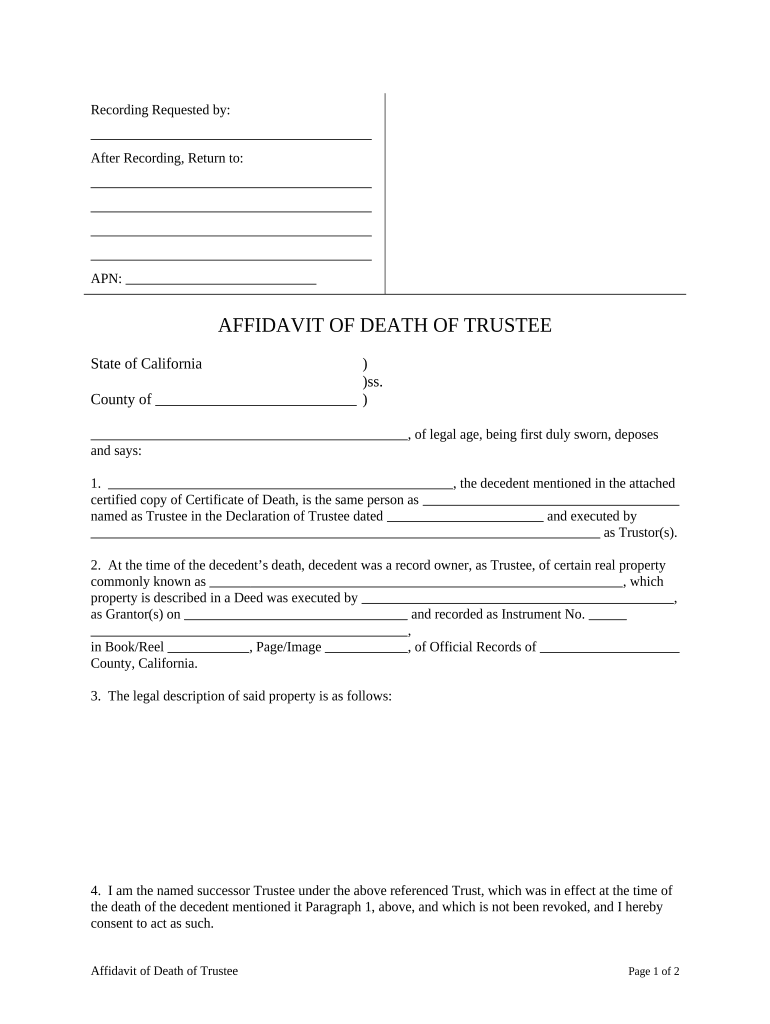
An Affidavit of Death reduces administrative friction by providing a sworn, documentable proof-of-death that third parties can rely on to release assets and close accounts. It can avoid immediate probate for limited-value matters and create a clear paper trail for payors and custodians.

Executors, personal representatives, surviving joint owners, financial institutions, title companies, and immediate family members commonly prepare or request Affidavits of Death during estate settlement.
Verify each recipient’s acceptable affidavit format, notarization, witness, or certified death certificate requirements before submission to avoid delays.
A clear heading such as 'Affidavit of Death' plus jurisdiction and statutory reference if applicable to indicate the document’s legal purpose and scope.
Full legal name, any aliases, date of birth, and last known address to precisely identify the deceased individual and avoid confusion with similarly named persons.
Exact date and place of death and, where available, death certificate number or issuing authority to tie the affidavit to official records.
A sworn declaration describing the affiant’s relationship to the decedent and the factual basis for their knowledge, signed under penalty of perjury.
Certified death certificate, government ID for the affiant, and any supporting documentation required by the receiving institution for verification.
Notary acknowledgment or remote online notarization record and witness information where state law or the recipient requires additional authentication.
| Field | Configuration |
|---|---|
| Document Upload | Upload PDF template and lock required text fields. |
| Signature Fields | Add affiant signature, date, and notary fields. |
| Authentication | Use email+SMS, KBA, or stronger ID verification. |
| Attachments | Require certified death certificate and ID uploads. |
Distribution methods include in‑person delivery, certified mail, secure portal upload, encrypted email, or eSubmission to institutions that accept electronic affidavits.
Verify the recipient’s acceptance policy: some banks require original notarized documents while others accept electronically signed affidavits with tamper‑evident audit trails and verifiable notarization records under ESIGN or state UETA statutes.
Request certified death certificate as soon as possible.
Inform banks promptly to avoid account misuse or fees.
File decedent’s final Form 1040 by April 15 (IRS deadline).
Act quickly where small estate affidavits have statutory time limits.
Probate filing requirements and deadlines vary by state and estate value.
A court‑appointed executor or personal representative signs when acting under letters testamentary or administration; their role and authority should be supported by probate documentation when requested by institutions.
Surviving joint owners, spouses, or immediate family members may sign affidavits under state small‑estate provisions; recipients may require proof of relationship and identity.
Optica streamlined customer interactions using digital affidavits and eSign workflows.
A real estate firm used affidavits to clear title matters for small estates.
| Criteria | Affidavit of Death | Small Estate Affidavit |
|---|---|---|
| Purpose | proof of death | transfer of small estate assets |
| Court Filing Required | no, usually | sometimes, depending on state |
| Typical Threshold | no fixed amount | statutory cap varies by state |
| Primary Use | account closure | collecting and transferring assets |
| signNow | DocuSign | Adobe Sign | PandaDoc | HelloSign | |
|---|---|---|---|---|---|
| Starting Price | $8/user/mo | $15/user/mo | $14/user/mo | $19/user/mo | $15/user/mo |
| Free Trial | 7‑day free trial, no card | Trial available | Trial available | Trial available | Trial available |
| Bulk Send | Yes | Yes | Yes | Yes | Varies |
| Audit Trail | Yes | Yes | Yes | Yes | Yes |
| HIPAA Compliant | Yes | Varies | Varies | No | No |
| Envelope Cap | No envelope cap | 100 envelopes/user/year | Varies | Varies | Varies |
Save the completed affidavit as a PDF/A to preserve the document and embedded audit trail; this format supports long‑term archiving and is widely accepted by institutions.
Request a certified paper copy from the recorder or order certified prints from the vital records office when an original notarized paper document is required by a recipient.
Keep an editable DOCX draft for internal updates and counsel review, but do not use drafts for official submission—always submit the final signed PDF.
Archive signed affidavits in encrypted cloud storage with restricted access and version history to maintain integrity and meet retention obligations.
Complete affidavit fields and attach death certificate prior to signing.
Affiant presents government ID and any required secondary evidence.
Select in‑person notarization or state‑approved RON where permitted.
If RON used, retain audio‑video and identity proofing records.
If state or recipient requires witnesses, secure them before signing.
Notary completes certificate and attaches seal or digital record.
Provide certified or electronic copies to institutions and retain originals.
Maintain an audit trail with timestamps and signer authentication data.