Establishing secure connection…Loading editor…Preparing document…

Affidavit of Survivorship

This template is fully customizable. Edit the text, fill out the fields, and send it for signature. Give it a try!
Affidavit of Survivorship

What an Affidavit of Survivorship Is and when it applies

An Affidavit of Survivorship is a signed, sworn statement used to confirm that property held in joint tenancy or as a tenancy by the entirety passes to the surviving owner(s) upon a co-owner's death. It identifies the decedent, the surviving joint owner(s), and the affected asset (real property, bank account, or titled personal property). Many jurisdictions accept a properly completed affidavit in lieu of probate for low-value transfers; the document typically accompanies a deed, account transfer form, or recording instrument. Electronic execution and retention are generally permitted under the ESIGN Act (15 U.S.C. ch. 96, 2000) and UETA (1999) where adopted.

Why an Affidavit of Survivorship matters for title transfer

The affidavit streamlines post-death transfers by providing documentary proof of survivorship that often avoids full probate, clarifies ownership for banks and registries, and reduces administrative delay when combined with required supporting documents and proper notarization.

Why an Affidavit of Survivorship matters for title transfer

Who typically prepares and relies on this affidavit

Parties who commonly complete or request an Affidavit of Survivorship include surviving joint owners, title companies, banks, and estate administrators when a joint-owner dies.

  • Surviving joint owners: Prepare and sign when claiming property formerly held with the decedent; submit to banks or county recorder.
  • Title and escrow professionals: Use the affidavit to clear title defects for closings and to update ownership records.
  • Estate administrators and attorneys: Rely on the affidavit for small-asset transfers to avoid probate for assets below jurisdictional thresholds.

Core elements to include in a professional Affidavit of Survivorship

A complete affidavit follows a clear structure and includes identity information, property details, a sworn survivorship statement, and signature authentication to satisfy recorders and financial institutions.

Document Caption

Title the form clearly as 'Affidavit of Survivorship' and include jurisdiction and county so recorders recognize the document immediately.
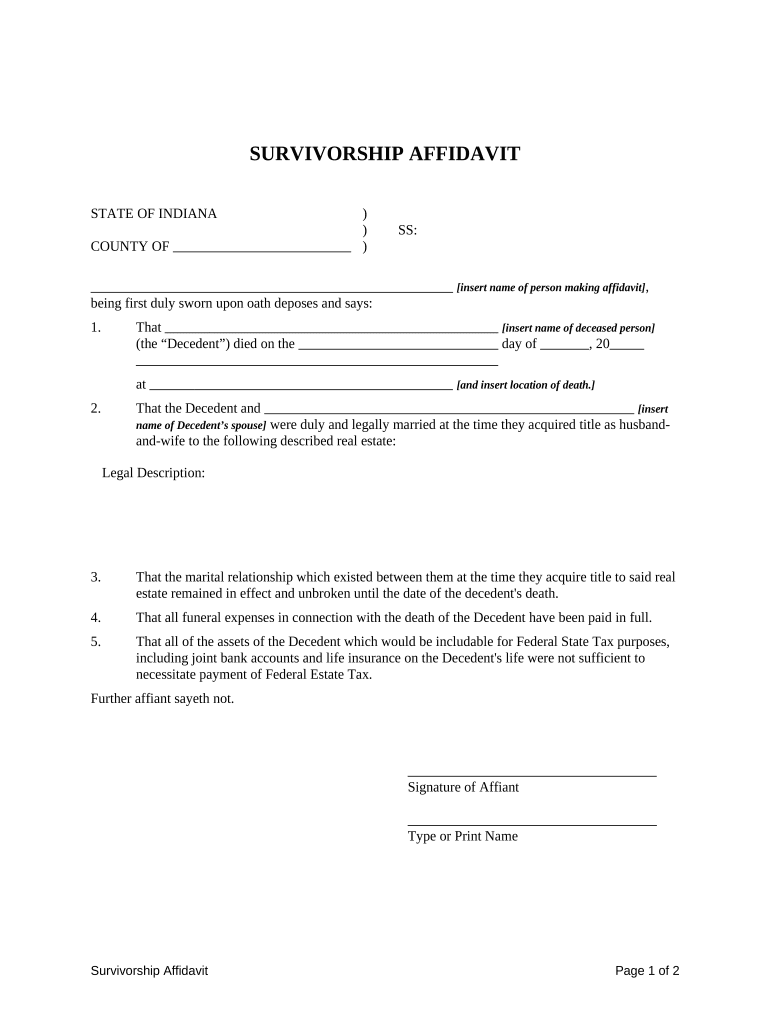
Parties Identified

List full legal names of the surviving owner(s) and the decedent exactly as on government IDs and title documents to avoid name-matching issues.

Property Description

Provide a precise legal description for real estate or account title and account numbers for financial assets; vague descriptions often lead to recording rejection.

Survivorship Statement

A direct sworn statement that the decedent held the property as joint tenant or tenancy by the entirety and that the named survivor(s) are the sole remaining owner(s).

Authentication Block

Include a notary acknowledgement and any required witness signature lines; note whether RON or in-person notarization was used, as permitted by state law.

Attachments and Recording

Reference attached certified death certificate, original deed or account statement, and provide instructions for recording or submitting to financial institutions.

Step-by-step: completing and submitting the affidavit

Follow these core steps to prepare, authenticate, and record an Affidavit of Survivorship.

  • 01
    Gather Documents: Collect death certificate, deed, account statements.
  • 02
    Complete Affidavit: Fill fields exactly and attach exhibits.
  • 03
    Authenticate: Sign before notary or use RON where permitted.
  • 04
    Record or Submit: File with county recorder or provide to financial institution.

How eSubmission and eSigning streamline the process

Electronic workflows reduce turnaround and maintain an audit trail; ensure the method complies with state notary and recording rules.

  • Prepare Digitally: Upload PDF or DOCX and add fields.
  • Authenticate Signer: Use email, SMS code, or stronger ID check.
  • Apply Signature: Signer applies e-signature; system captures timestamp.
  • Notarize & Deliver: Use RON where allowed, then send to recorder.

Typical eSigning workflow settings for this affidavit

Configure your digital workflow to match legal and recorder requirements before sending the affidavit for signature.

Field Configuration
Authentication Email + SMS code or KBA for identity proofing
Document format PDF/A preferred for long-term archiving
Notary option Select RON or in-person based on state law
Routing Signer → Notary → Recorder or bank reviewer

Technical considerations when eSigning and notarizing

Verify file types, authentication strength, and notary workflows before starting an electronic signing session.

  • File types: PDF, DOCX accepted
  • Integrations: Salesforce, NetSuite, Google Workspace
  • Authentication: Email, SMS code, or KBA

Timing: recording windows and related deadlines

Timing varies by asset type and by county; act promptly after a decedent's death to reduce creditor and title complications.

Recording after death:

Record as soon as practical to update title records.

Account transfers:

Banks may require the affidavit and certified death certificate.

Tax reporting:

Consider estate tax deadlines where applicable; consult IRS guidance

Notary journal:

Notaries retain RON recordings per state rules.

Creditor claims:

Act within state statutes to avoid unresolved creditor disputes.

Key milestones from preparation to recorded transfer

Track these stages to ensure the affidavit completes the transfer process without unnecessary delay.

01

Document preparation

Complete affidavit and assemble certified death record.

02

Notarization stage

Authenticate signatures in-person or via RON.

03

Submission stage

Deliver affidavit to county recorder or bank for review.

04

Recording completion

Recorder accepts and updates title or account ownership.

Security and compliance considerations for electronic affidavits

Encryption: TLS 1.2/1.3 in transit; AES-256 at rest
Audit Trail: Tamper-evident logs capture timestamp and IP
Certifications: SOC 2 Type II, ISO 27001 available
HIPAA: BAA required for protected health information
ESIGN / UETA: Electronic signatures recognized under federal and state law
21 CFR Part 11: Support for FDA-regulated electronic records where required

Risks and consequences of an incorrect or incomplete affidavit

Invalid Transfer: Property not transferred
Recording Rejection: County recorder rejects filing
Probate Delay: Estate proceeds to probate
Tax Exposure: Potential tax reporting issues
Creditor Claims: Creditors may assert rights
Perjury Risk: False sworn statements carry penalties

Common mistakes to avoid when preparing the affidavit

  • Using an imprecise legal description leads to recorder rejection and delays in updating title.
  • Mismatched names between the deed, death certificate, and affidavit often trigger requests for additional documentation.
  • Omitting the certified death certificate or attaching an uncertified copy causes banks and recorders to refuse the transfer.
  • Failing to follow state-specific notary or witness requirements results in invalid acknowledgements and possible re-execution.

Real-world scenarios where an affidavit resolves ownership

Two common application examples show how an Affidavit of Survivorship is used for financial accounts and real estate.

Bank Account Transfer

A surviving joint owner provides a completed affidavit with a certified death certificate to the bank

  • Bank verifies identities and updates account title
  • The account transfers to the survivor without probate, but the bank may require original documents and institution-specific forms.

Residential Property

A surviving spouse records an affidavit attached to the original deed

  • County recorder confirms the legal description and notarization
  • Once recorded, the survivor's name appears on the public record, simplifying resale or refinancing while preserving clear chain of title.

Supporting items commonly paired with the affidavit

Attach and reference supporting documents to strengthen acceptance by recorders and financial institutions.

Certified Death Certificate

A certified copy issued by the vital records office proves the decedent's death and is required by most banks and recorders to effect transfer.

Original Deed or Title

Provide the recorded deed, title policy page, or account statement that shows the joint tenancy or tenancy by the entirety designation.

Recorder Instructions

Check county-specific recording requirements, including fee amounts, cover sheets, and any mandatory forms to avoid rejection.

Legal Review

Consider a brief attorney review for complex ownership structures, liens, or when creditor claims are likely to ensure the affidavit accomplishes the intended transfer.

Typical eSignature vendor features relevant to this affidavit

Compare common eSignature pricing and capability points that affect notarization, bulk processing, and security when choosing a provider.

signNow DocuSign Adobe Sign PandaDoc HelloSign
Starting Price $8/user/mo $15/user/mo $14/user/mo $19/user/mo $15/user/mo
Free Trial 7-day trial Varies Varies Varies Varies
Bulk Send Yes Yes Yes Yes Yes
Audit Trail Yes Yes Yes Yes Yes
HIPAA Compliant Yes Yes Yes No No
Envelope Cap No cap 100 envelopes/user/year Varies by plan Varies by plan Varies by plan

Frequently asked questions about Affidavit of Survivorship

Answers to common questions about legality, notarization, recording, and acceptable electronic handling of an Affidavit of Survivorship.


Need help? Contact support

be ready to get more
Join over 28 million airSlate SignNow users