Case identification
Complete caption and case number so the affidavit attaches to the correct docket and is accepted by the clerk.
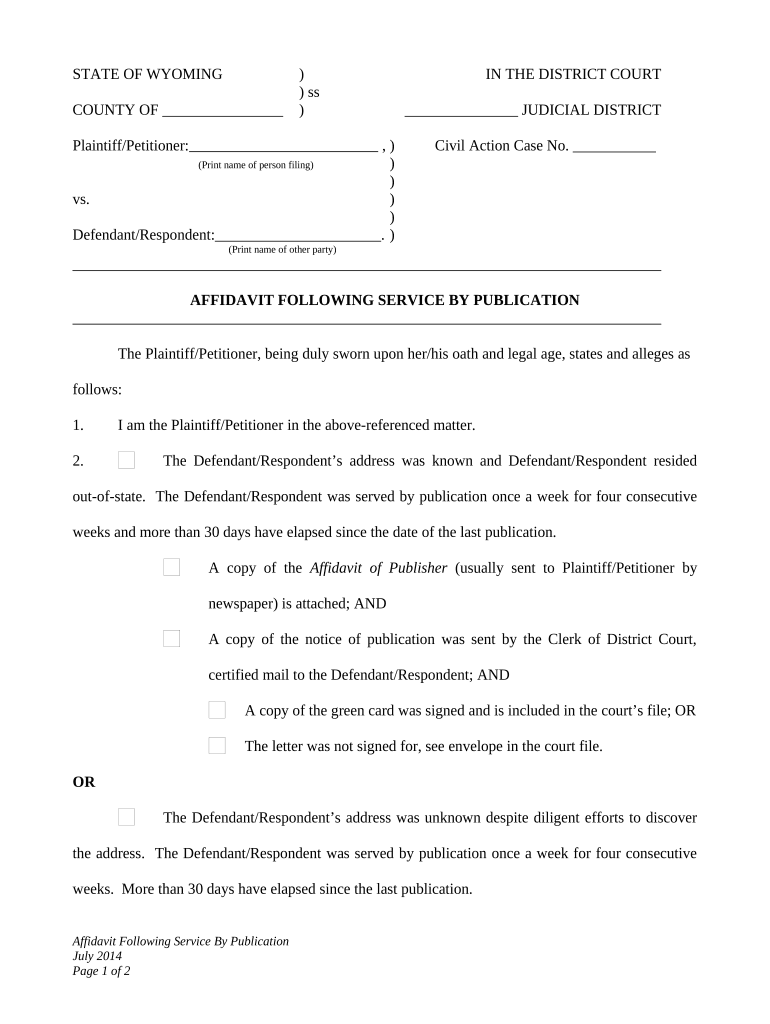
Courts require an affidavit to confirm reasonable, documented attempts at personal service and to ensure due process. The affidavit protects the moving party by creating a record of efforts to notify the other party and supplies the factual basis courts need to authorize substituted service.

Parties, attorneys, or process servers preparing a service-by-publication request must present a clear affidavit that traces attempts to locate and serve the defendant.
The affidavit supports the court’s decision to order publication instead of personal service and defines the scope, duration, and venue for the publication remedy.
| Field | Configuration |
|---|---|
| Signature field | Require signer to initial and full-sign; lock after signing |
| Date field | Use MM/DD/YYYY validation |
| Attachment field | Require uploads for proof of attempts (receipts, photos) |
| Notary block | Include standard notarial certificate placeholder |
Ensure the platform you use supports authenticated signatures, notarization workflows, and produces an audit trail for court submission.
Maintain the notarized original or a court-acceptable certified copy and preserve all digital evidence and the platform’s audit log for the court record.
Complete caption and case number so the affidavit attaches to the correct docket and is accepted by the clerk.
A sworn declaration from the person who performed or supervised service attempts, including their role and competence.
Detailed, dated record of each service attempt, who was contacted, and outcomes including returned mail or refusal.
Documented searches (databases, DMV, employer) showing due diligence to locate the defendant before seeking publication.
Proposed newspaper, publication frequency, and duration aligned with local court rules and statutory requirements.
Properly completed notarial certificate verifying the affiant’s oath and signature to ensure admissibility.
File affidavit as early as possible; courts may require it before issuing a publication order.
Commonly one to three weeks of consecutive publication depending on jurisdiction.
Publisher’s affidavit of publication typically filed within 7–30 days after final notice.
Service is often deemed effective on the last date of publication or as specified by the court.
Defendant may have a window to appear after publication; local rules define the precise period.
Gather detailed service attempt records and draft the sworn statement for filing.
Judge grants an order specifying publication medium, frequency, and duration.
Publisher runs notices per the order and provides proof of publication.
Submit publisher’s affidavit of publication and update the docket for case progression.
| signNow | DocuSign | Adobe Sign | PandaDoc | HelloSign | |
|---|---|---|---|---|---|
| Starting Price | $8/user/mo | $15/user/mo | $14/user/mo | $19/user/mo | $15/user/mo |
| Free Trial | 7-day free trial | Trial available | Trial available | Trial available | Trial available |
| Bulk Send | Yes | Yes | Yes | Yes | No |
| Audit Trail | Yes | Yes | Yes | Yes | Yes |
| HIPAA Compliant | Yes | Yes | Yes | No | No |
Affiant documents multiple attempts at the last known address and employer checks
Plaintiff’s attorney compiles title search results and process-server logs