Establishing secure connection…Loading editor…Preparing document…

Agreement Between Sponsor and Martial Arts Competitor

This template is fully customizable. Edit the text, fill out the fields, and send it for signature. Give it a try!
Agreement Between Sponsor and Martial Arts Competitor

What this Agreement Between Sponsor and Martial Arts Competitor Covers

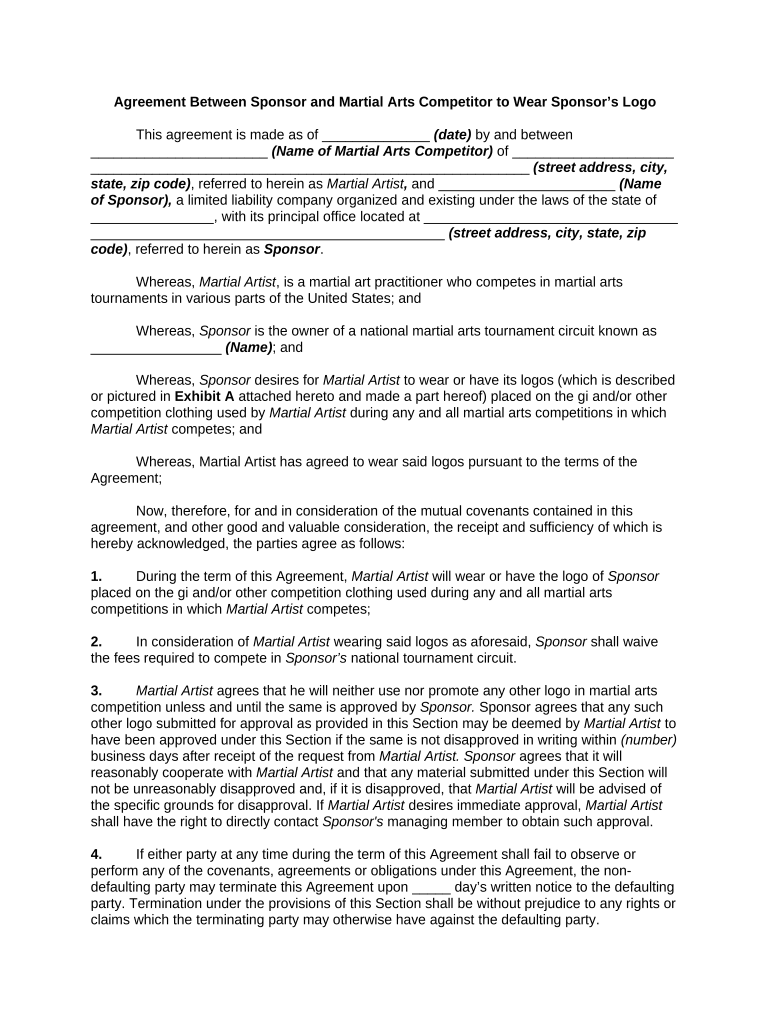
An Agreement Between Sponsor and Martial Arts Competitor is a contractual document that records the terms under which a sponsor provides financial support, equipment, promotion, or other benefits to a competitor in exchange for performance, promotional obligations, or exclusivity rights. It defines the parties, scope of sponsorship, duration, compensation or in-kind benefits, responsibilities for travel and insurance, intellectual property uses, termination triggers, and dispute-resolution provisions. The agreement can include payment schedules, deliverables, event obligations, and confidentiality or publicity clauses that protect both sponsor and competitor interests while documenting expectations in enforceable terms.

Why a Formal Sponsor–Competitor Agreement Matters

A written agreement clarifies compensation, deliverables, and usage rights, reduces disputes, and documents obligations for event participation and promotions. It creates enforceable expectations and preserves evidence of consent under ESIGN (15 U.S.C. ch. 96) and UETA where applicable.

Why a Formal Sponsor–Competitor Agreement Matters

Who Typically Prepares and Signs This Agreement

Sponsors, competitors, event promoters, and their legal or administrative teams commonly prepare and exchange this agreement to coordinate expectations.

  • Corporate sponsors and marketing teams arranging athlete endorsements or event support.
  • Individual competitors or their managers accepting financial or in-kind sponsorships.
  • Event promoters and organizers coordinating sponsor benefits and competitor obligations.

Roles Who Sign and Approve

Sponsor Representative

Typically a marketing or legal representative authorized to bind the sponsor; signs to accept payment terms, use rights, and performance expectations and may attach corporate signature authority documentation.

Competitor or Guardian

The athlete or their legal guardian (if a minor) signs to accept obligations such as appearances and promotional use of likeness; include government ID or manager authorization if signing digitally.

Essential Data Fields to Include

Party Names: Full legal names
Contact Details: Phone and email
Compensation: Amount or in-kind
Term: Start and end dates
Use Rights: Likeness and IP
Signatures: Signed and dated

Common Legal Risks and Consequences

Breach Liability: Damages possible
Tax Consequences: Reporting required
IP Disputes: Infringement risk
Minor Consent: Guardian needed
Insurance Gaps: Liability exposure
Invalid Signature: Enforceability risk

Avoidable Mistakes When Preparing the Agreement

  • Failing to identify the correct legal entity for the sponsor or competitor can make enforcement complicated and may invalidate indemnity or payment terms.
  • Using vague compensation language such as "reasonable efforts" without specific dollar amounts, dates, or deliverable lists creates disputes over performance expectations.
  • Omitting intellectual property or publicity rights leaves ambiguity about usage of competitor likeness and can result in unauthorized endorsements or removed marketing assets.
  • Not specifying who covers travel, insurance, and medical expenses at events often leads to last-minute disagreements and uncovered liability.

Practical Examples and Use Cases

Two short real-world scenarios illustrate common sponsorship arrangements and the clauses to emphasize when drafting.

Local Gym Sponsorship

A community gym sponsors a regional competitor with equipment and entry fees

  • Sponsor requires two event appearances and branded apparel
  • The agreement documents in-kind value, schedule, termination for poor conduct, and mutual publicity rights to avoid disputes.

Corporate Event Sponsorship

A regional brand provides cash and travel for a national tournament

  • Sponsor expects logo placement, social media promotion, and exclusivity in category
  • The contract includes payment schedule, scope of deliverables, termination rights, and indemnities for injuries at sponsored events.

Step-by-Step: How to Complete the Agreement Between Sponsor and Martial Arts Competitor

Follow these steps in order to ensure all material terms are captured and signatures are legally attributable, whether executed on paper or electronically.

  • 01
    Identify Parties: Enter full legal names and contact details.
  • 02
    Define Consideration: Specify cash amount or in-kind items precisely.
  • 03
    List Obligations: Detail appearances, deliverables, and schedules.
  • 04
    Sign and Date: All parties sign with dated blocks.

How Execution and Distribution Typically Flow

A typical execution path ensures the sponsor and competitor receive copies and that the agreement is stored with an audit trail for future reference.

  • Draft: Sponsor or counsel prepares initial draft.
  • Negotiate: Parties revise and agree on terms.
  • Execute: Signatures obtained in agreed order.
  • Archive: Finalized copy stored with retention metadata.

Core Clauses to Include in a Sponsor–Competitor Agreement

Ensure the contract addresses payment, obligations, rights to use name and likeness, and how disputes and termination will be handled to reduce ambiguity and litigation risk.

Compensation

State the exact payment amounts, schedule, and whether payments are conditional on results or appearances; include method (ACH, check) and tax reporting responsibilities.

Deliverables

Describe required appearances, promotional posts, logo placements, and any performance milestones tied to payment to create measurable obligations and avoid interpretation disputes.

Intellectual Property

Grant or license specifics for use of competitor name, image, and performance footage, including duration, media, territory, and ownership of jointly produced assets.

Termination and Indemnity

Include termination for material breach, moral character clauses if needed, and mutual indemnities covering injuries, IP claims, and third-party liabilities.

Practical Tips for Clear and Enforceable Agreements

Follow these drafting best practices to reduce ambiguity and support enforceability across jurisdictions.

Use Precise Language
Avoid undefined terms and ensure monetary amounts, dates, and deliverables are specific so performance obligations are objectively verifiable and enforceable in court or arbitration.
Address Minors Explicitly
If the competitor is a minor, require a parent or legal guardian to sign and confirm authority to enter into contracts to avoid voidability or parental consent defenses.
Clarify Tax Reporting
Specify whether compensation will be reported on Form 1099-NEC, and request a completed W-9 from the recipient to avoid backup withholding and reporting penalties.
Include Insurance Requirements
State required insurance coverages, whether sponsor or competitor provides policy, and name sponsor as additional insured when sponsor requires protection for events.

Key Contract Milestones from Draft to Archive

This milestone sequence tracks critical stages and target durations you should plan for during negotiation and execution.

01

Drafting

Prepare initial contract and attachments.

02

Negotiation

Allow 3–14 days for revisions.

03

Execution

Obtain all signatures and dates.

04

Retention

Archive final agreement with metadata.

Time-Sensitive Dates to Track

Record these dates on the contract and in your records to ensure compliance with payment, reporting, and termination windows.

Effective Date:

Date when obligations begin; use MM/DD/YYYY format.

Payment Dates:

Specify payment schedule and due dates.

Appearance Deadlines:

List event dates and notice periods.

Termination Notice:

Calendar any required notice windows.

Tax Reporting:

Collect W-9 before payments to meet IRS rules.

Additional Clauses Often Included

Beyond core terms, consider clauses that allocate risk, manage publicity, and define dispute resolution to produce a comprehensive sponsorship contract.

Exclusivity

Restricting competitor from promoting competing products or sponsors for a defined category and term, including carve-outs and penalties for violations.
Confidentiality

Protect sponsor trade secrets, campaign plans, and unpublished terms; define duration and permitted disclosures.

Publicity Rights

Set approval processes for marketing materials that use the competitor's likeness and require pre-approval for certain campaign assets.

Force Majeure

Allocate risk when events outside parties' control prevent performance, and describe suspension or termination mechanics.

Governing Law

Specify the state law that governs interpretation and the chosen forum for disputes to reduce uncertainty over venue.

Dispute Resolution

Include arbitration or mediation clauses, confidentiality of proceedings, and allocation of fees if a dispute arises.

How to Amend or Update the Agreement

Use a clear amendment process so all changes are documented, signed, and dated to avoid disagreements about verbal modifications.

01

Propose Amendment:

Prepare written amendment language.
02

Consent:

Obtain all party approvals in writing.
03

Sign:

All parties sign the amendment.
04

Attach:

Attach amendment to original file.
05

Archive:

Store with version history.
06

Notify:

Notify affected third parties.

Suggested Digital Workflow Settings for eExecution

Configure your eSignature workflow to capture intent, attribution, and retention in line with ESIGN/UETA requirements.

Field Configuration
Signature Authentication Email + optional SMS code for signer attribution
Audit Trail Enable IP, timestamp, and action logging
File Format Store final as PDF/A with embedded audit
Access Controls Restrict downloads and set retention metadata

Electronic Agreement vs Paper Agreement: Key Differences

Compare the practical differences so you can choose an execution method that meets enforceability, speed, and recordkeeping needs.

Criteria Electronic Agreement Paper Agreement
Execution Speed hours to days days to weeks
Proof of Signing audit trail physical signature
Storage digital archive physical file
Remote Notary available (ron) not applicable

eSignature Pricing and Feature Comparison for Sponsor Agreements

Compare starting prices and core features commonly needed for executing sponsor agreements. signNow is listed first per vendor comparison requirements.

signNow DocuSign Adobe Sign PandaDoc HelloSign
Starting Price $8/user/mo $15/user/mo $14/user/mo $19/user/mo $15/user/mo
Free Trial 7-day free trial Varies by plan Varies by plan Varies by plan Varies by plan
Bulk Send Yes (Business Premium) Yes Yes Yes No
Audit Trail Yes Yes Yes Yes Yes
HIPAA Compliant Yes Yes Yes No No
Envelope Cap No cap 100 envelopes/user/year Varies by plan Varies by plan Varies by plan

Technical Options for Digital Signing and Distribution

Choose a signing platform that supports required authentication, audit logs, and compliant storage for sponsor agreements.

  • Integrations: Salesforce, NetSuite, Google Workspace, Microsoft 365
  • File Types: PDF, DOCX, HTML
  • Security: TLS 1.2/1.3 in transit, AES-256 at rest

Frequently Asked Questions About Sponsor–Competitor Agreements

Answers to common questions about signatures, minors, tax forms, and enforceability for sponsorship contracts executed in the United States.


Need help? Contact support

be ready to get more
Join over 28 million airSlate SignNow users