Establishing secure connection…Loading editor…Preparing document…

Agreement Between Adjoining Landowners Regarding Overhanging Eaves

This template is fully customizable. Edit the text, fill out the fields, and send it for signature. Give it a try!
Agreement Between Adjoining Landowners Regarding Overhanging Eaves

What this Agreement Is and When it Applies

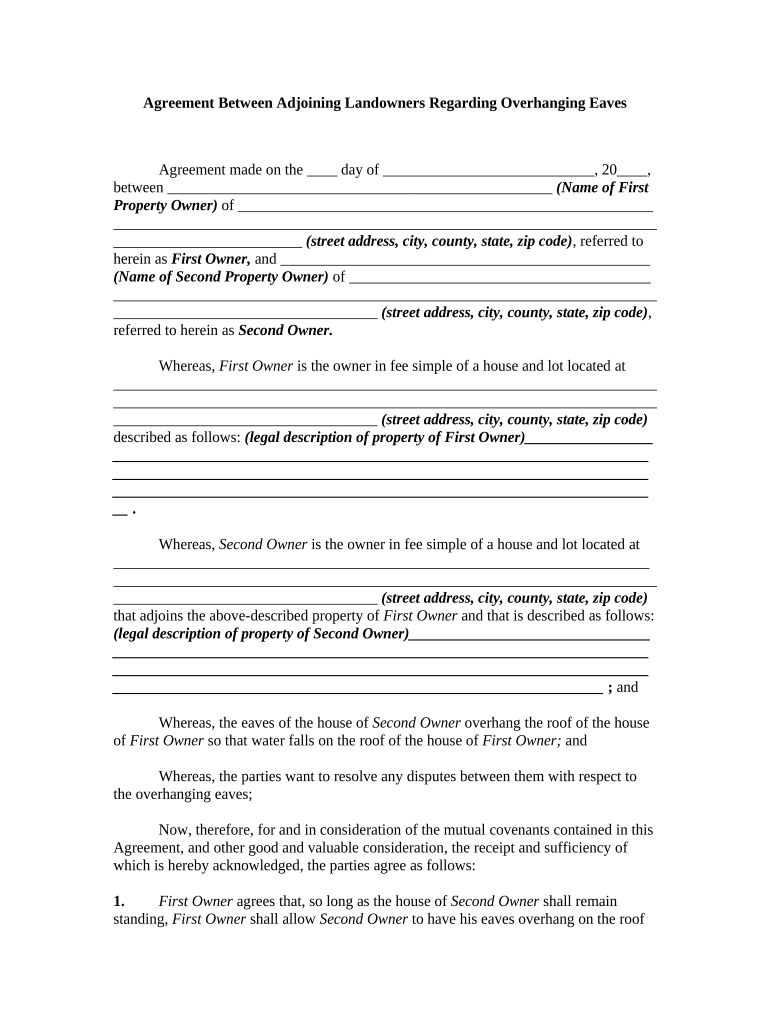
The Agreement Between Adjoining Landowners Regarding Overhanging Eaves is a written contract that documents rights, responsibilities, and access between neighbors where a roof eave extends over a boundary. It defines dimensions of the overhang, maintenance obligations, permitted access for repair, indemnities, and any recording or easement language. The agreement reduces ambiguity about repair, liability, and insurance coverage and provides an enforceable record if disputes arise or property transfers occur. Use this form to capture mutual consent and specify remedies for noncompliance.

Why formalizing overhanging eaves matters

A clear written agreement prevents boundary disputes, clarifies repair and access responsibilities, and helps preserve property values. It documents consent that can be recorded with the county if parties want public notice or an easement.

Why formalizing overhanging eaves matters

Who commonly uses this agreement

Typical users include private homeowners, condominium associations, and small-landlord property owners who share property lines and need to fix responsibilities in writing.

  • Adjoining homeowners who share property lines and require documented maintenance and access terms.
  • Homeowner associations and property managers handling recurring repairs or insurance claims across units.
  • Real estate attorneys and title companies reviewing encroachments during sale or refinance transactions.

Representative signers and roles

Adjacent Homeowner

An individual property owner who owns the parcel under the eaves and seeks a formal arrangement for access, maintenance, and cost-sharing; typically signs as a primary party to grant or accept limited rights.

Property Manager

An authorized agent or manager signing on behalf of a landlord or HOA, often with delegated authority to consent to maintenance access and to coordinate recordation with county clerks or title companies.

Core elements to include in a professional agreement

A robust overhanging eaves agreement should be specific about parties, property, dimensions, obligations, liability allocation, and recording options to avoid future ambiguity.

Parties

Full legal names of each owner or entity with capacity and mailing addresses to ensure enforceability and proper service of notices.
Property Description

Precise legal description or parcel ID and street address so the encroachment is accurately linked to official records and title reports.

Eave Dimensions

Measured overhang width and projection described in feet/inches with reference points that match a survey or drawing attached as an exhibit.

Maintenance Duties

Who is responsible for inspection, cleaning, repair, and trimming including frequency, notice procedures, and cost-sharing formulas.

Liability & Indemnity

Allocation of risk for damage, third-party claims, and insurance obligations including requirements for maintaining liability coverage.

Recording Option

Whether the agreement will be recorded as an easement or memorandum; recording affects notice to future owners and enforceability.

Step-by-step: completing and executing the agreement

Follow these sequential steps to prepare, agree, and finalize the document with minimal delays.

  • 01
    Prepare Parties: Collect legal names and property details.
  • 02
    Describe Eaves: Add measurements and attach a drawing or survey.
  • 03
    Agree Terms: Negotiate maintenance, liability, and recording.
  • 04
    Execute & Notarize: Sign, witness if required, and notarize.

Digital workflow settings to streamline completion

Configure eSignature and notarization settings before sending so the signer experience matches legal needs and local recording rules.

Field Configuration
Signature Authentication Email plus SMS code or stronger KBA
Notarization Option Enable RON where permitted by state law
Conditional Fields Show obligations only if party selects 'responsible'
Recording Request Flag document for county recording workflow

Typical electronic execution flow

An efficient eSignature workflow reduces friction and preserves audit evidence required for legal validity.

  • Upload Document: Sender uploads final agreement file.
  • Place Fields: Add signature, date, and initial fields.
  • Send to Signer: Distribute via email or secure link.
  • Store Signed Copy: Signed PDF and audit trail are saved.

Technical considerations for eSigning and notarization

Confirm the chosen platform supports required authentication, file formats, and optional remote notarization before sending.

  • File Formats: PDF and DOCX supported
  • Integrations: Google Workspace and Microsoft 365
  • RON Support: Remote notarization available

Essential data elements to capture

Signatures: Wet or eSignature
Dates: MM/DD/YYYY format
Legal Description: Parcel ID and deed text
Survey Exhibit: Attach survey drawing
Contact Info: Mailing address and email
Notary Block: Acknowledgement if notarized

Download and supporting document options

Provide signed copies in standard formats and bundle supporting materials for recording or title review.

PDF Export

Produce a tamper-evident PDF/A version including visible signatures and embedded audit trail for reliable long-term storage and county acceptance.

Editable DOCX

Retain an editable Word copy for future amendments and to facilitate attorney review without altering the executed PDF version.

Survey and Exhibit

Attach a clear survey or diagram showing the overhang measurements and tie points to the property corners as an exhibit for recording and dispute avoidance.

Title and Insurance

Include a recent title report excerpt and current liability insurance certificate if required by the parties or title insurer.

Comparison of common eSignature providers for executing this agreement

The table below shows representative pricing and capability indicators to help select an eSignature vendor that supports notarization, audit trails, and HIPAA compliance where required.

signNow DocuSign Adobe Sign PandaDoc HelloSign
Starting Price $8/user/mo $15/user/mo $14/user/mo $19/user/mo $15/user/mo
Free Trial 7-day free trial (no card) Varies by vendor Varies by vendor Varies by vendor Varies by vendor
Bulk Send Yes Yes Yes Yes Yes
Audit Trail Yes Yes Yes Yes Yes
HIPAA Compliant Yes Yes Yes No No
Envelope Cap No cap 100 envelopes/user/year Varies by plan Varies by plan Varies by plan

Common timing expectations to include in the agreement

Specify clear timeframes for inspection, notice, response, and recording to reduce disputes and provide enforceable deadlines.

Effective Date:

Date when obligations and rights begin; use MM/DD/YYYY

Inspection Period:

Allow a reasonable inspection window, commonly 30 days

Maintenance Response:

Require response to repair notices within 14 days

Recording Deadline:

If recording, file within 60 days of execution unless parties agree otherwise

Notice Period:

Standard notice periods are 30 days for nonemergency access

Milestones from negotiation to recorded notice

Track major milestones sequentially to ensure survey, execution, and recording occur smoothly.

01

Draft Agreement

Prepare initial draft and attach survey or diagram for review.

02

Review & Survey

Obtain or confirm a property survey and legal descriptions.

03

Signing & Notarization

All parties sign; notarize if required or desired for recordation.

04

Recording & Notice

File with county clerk if parties elected recording to give public notice.

Execution and authentication checklist

Follow these authentication steps to ensure the signed agreement is admissible and acceptable for recording when necessary.

01

Identify Signers

Confirm legal names and signatory authority before sending.

02

Verify IDs

Inspect government ID for wet notarization or use credential analysis for RON.

03

Obtain Consent

Document consent to electronic transactions if signing electronically.

04

Notary Acknowledgement

Complete notary block per state requirements when notarizing.

05

Record RON Session

Retain audio-video for the period required by state law when using RON.

06

Witness Attestation

Include witness signatures if state or county requires them for recording.

07

Notary Journal Entry

Notary records transaction details in journal for future reference.

08

Preserve Audit Trail

Store signed PDF and digital audit trail in secure repository.

Common mistakes to avoid when preparing this agreement

  • Using informal or incomplete property descriptions that do not match the deed or county parcel ID, causing recording or title issues.
  • Failing to attach a survey or exhibit with measurements, which creates ambiguity about the exact extent of the overhang.
  • Not specifying maintenance or cost-sharing terms clearly, leading to unexpected repair disputes or one-sided obligations.
  • Assuming verbal permission is sufficient; verbal agreements are difficult to enforce and may not bind future owners.

Potential legal and practical consequences of a flawed agreement

Boundary Dispute: May lead to litigation
Injunctions: Court orders to remove eaves
Property Damage: Repair liability may be imposed
Insurance Gaps: Claims denial without clear allocation
Recording Challenges: County may reject incomplete instruments
Loss of Rights: Unclear language can forfeit easement claims

Practical scenarios showing typical uses

Two concise examples illustrate how parties document and resolve common eave encroachment situations.

Residential Neighbor Agreement

Two adjacent homeowners agree to a 2-foot overhang measured from the exterior wall

  • Parties share routine cleaning costs 50/50
  • The agreement includes a recorded memorandum and a 30-day notice clause for access, reducing future title risk.

Landlord and Tenant Coordination

A landlord grants limited maintenance access to a tenant for eave repairs

  • Temporary access is conditioned on insurance and supervision
  • The agreement clarifies liability, requires proof of contractor insurance, and limits work hours to minimize disputes.

Frequently asked questions and practical answers

Answers to common legal and execution questions about overhanging eaves agreements, electronic signatures, and recording.


Need help? Contact support

be ready to get more
Join over 28 million airSlate SignNow users