Establishing secure connection…Loading editor…Preparing document…

Agreement of Understanding with Confidential Informant

This template is fully customizable. Edit the text, fill out the fields, and send it for signature. Give it a try!
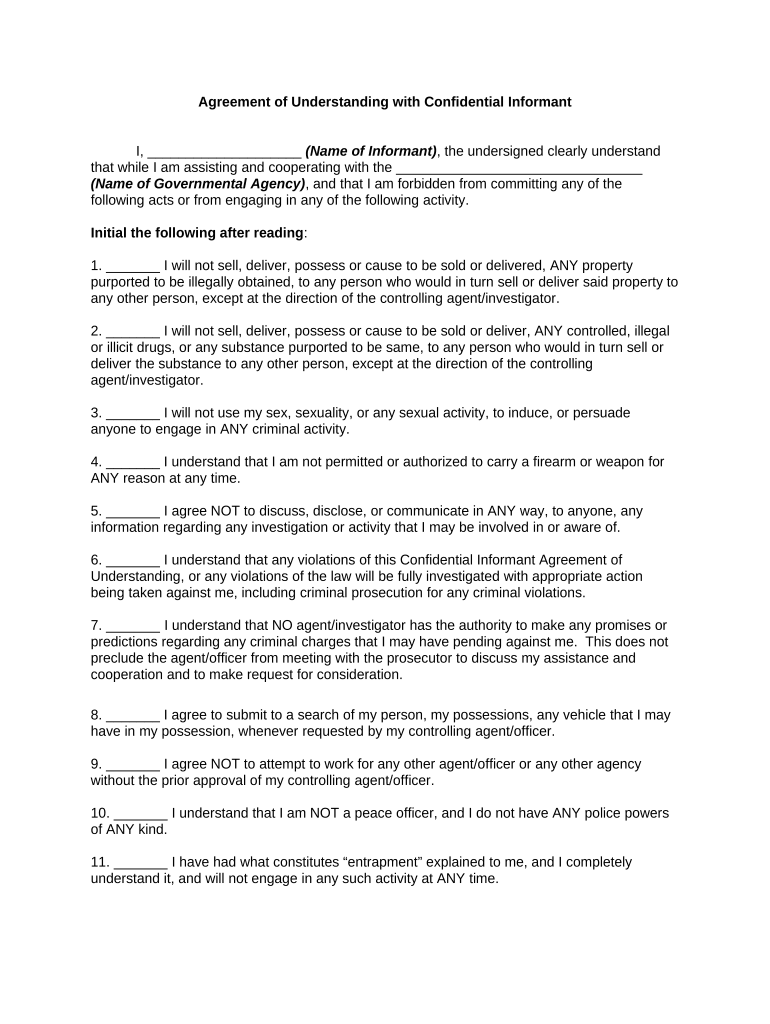
Agreement of Understanding with Confidential Informant

What the Agreement of Understanding with Confidential Informant Is

An Agreement of Understanding with Confidential Informant is a written contract used by law enforcement and prosecuting authorities to document the terms under which an individual provides information or assistance in an investigation. It defines the parties, scope of cooperation, obligations and protections for the informant, confidentiality restrictions, any payments or benefits, limits on use of the informant's identity, and procedures for handling evidence and records. The agreement clarifies expectations, reduces disputes about compensation or testimony, and establishes retention and disclosure obligations for case files and related records.

Why a Formal Agreement Matters for Confidential Informants

A clear written agreement protects both the investigating agency and the informant by documenting consent, scope of cooperation, confidentiality expectations, and payment terms, reducing legal risk and evidentiary disputes.

Why a Formal Agreement Matters for Confidential Informants

Who Typically Prepares and Relies on This Agreement

These agreements are completed and maintained by agencies and legal offices involved in criminal investigations or prosecutions.

  • Law enforcement handler: Prepares the operational terms, documents interactions, and coordinates identity-protection measures for investigative use.
  • Prosecutor / District Attorney: Reviews terms for legality, aligns cooperation with charging and disclosure policies, and approves payment or immunity provisions.
  • Records custodian / Compliance officer: Retains the signed document, applies redaction and access controls, and responds to discovery or records requests.

Who Signs and Authorizes the Agreement

Law Enforcement Handler

The handler, typically a sworn officer or designated investigator, signs to confirm operational terms, corroboration expectations, and safety protocols. The handler documents interviews, reporting requirements, and any handling of funds or property given to the informant.

Prosecutor

A prosecutor or supervising attorney signs to confirm legal terms, approvals for use in court, and alignment with disclosure obligations. The prosecutor's signature indicates review of legal risks and authority to offer any promises or consideration.

Core Sections Every Professional Agreement Should Include

A well-drafted agreement organizes expectations into discrete, enforceable sections so courts, counsel, and investigators can verify what was promised and when.

Parties & Definitions

Identify the informant by legal name and any aliases, name the agency and supervising prosecutor, and define key terms such as 'cooperation', 'confidential information', and 'protected identity'.
Scope of Cooperation

Specify the actions requested of the informant, geographic or subject limits, types of information to be provided, and conditions that will terminate cooperation.

Confidentiality Protections

Describe measures to protect the informant's identity, who may access identity information, and how confidentiality will be maintained in records and court filings.

Consideration & Payments

Detail any promised payments, reimbursement, timing, conditions for payment, recordkeeping, and tax reporting responsibilities associated with compensation.

Use and Disclosure

Explain how information may be used in investigations or prosecutions, obligations to disclose exculpatory or impeachment material, and procedures for redaction prior to disclosure.

Term, Withdrawal, Liability

State effective date, termination procedures, revocation or withdrawal of cooperation, and any indemnities, limitations of liability, or promises not to prosecute where applicable and lawful.

Essential Fields to Collect and Protect

Informant Legal Name: Full name on ID
Known Aliases: Other identifiers
Date of Birth: MM/DD/YYYY
Handler ID: Officer badge or unit
Case Number: Agency docket or file
Effective Date: MM/DD/YYYY

Step-by-Step: Preparing and Executing the Agreement

Follow a consistent process to verify identity, document approvals, and capture signatures to preserve admissibility and internal audit trails.

  • 01
    Gather identification: Collect government ID and corroborating documents before entry.
  • 02
    Complete form fields: Populate legal names, dates, case numbers, and payment terms.
  • 03
    Obtain approvals: Have supervisor or prosecutor review and sign where required.
  • 04
    Sign and retain: Capture final signatures, timestamp, and store in secure records.

Configure an Online Workflow for Secure Completion

Set up authentication, document routing, and retention settings to match your agency's policies before sending the agreement for signature.

Field Configuration
Authentication method Two-factor or ID credential check
Signature type Click-to-sign or digital certificate
Document retention Encrypted cloud storage, exportable PDF/A
Signing order Handler > Supervisor > Prosecutor

Where the Signed Agreement Goes and Who Sees It

After execution, route the agreement to internal stakeholders and secure records systems with restricted access and a traceable audit trail.

  • Agency case file: Primary record retained by investigator or unit.
  • Prosecutor file: Prosecutor's office keeps a redacted working copy.
  • Discovery controls: Apply redaction and access rules before disclosure.
  • Audit log: Maintain time, IP, and signer attribution records.

Digital Signing Considerations and Platform Requirements

Use a platform that supports secure authentication, audit trails, and exportable, tamper-evident signed PDFs for evidentiary reliability.

  • File formats: PDF and DOCX supported
  • Authentication: Email, SMS, or stronger ID proofing
  • Integrations: CRM, case mgmt, cloud storage

Key Timeframes and Review Deadlines

Track effective dates, periodic reviews of continuing cooperation, payment schedules, and how long records remain available for discovery or internal audit.

Effective date:

Agreement starts on the stated MM/DD/YYYY.

Payment schedule:

Document when and under what conditions payments are made.

Periodic review:

Review cooperation status and security every 6 or 12 months.

Discovery response:

Allow time for redaction and legal review before disclosure.

Retention checks:

Verify retention timelines with records custodian.

Risks and Legal Consequences of Errors or Noncompliance

Identity Exposure: Unauthorized disclosure could endanger the informant.
Discovery Sanctions: Incomplete records may lead to adverse court orders.
Payment Disputes: Vague compensation terms invite litigation.
HIPAA Violations: Improper PHI handling can trigger penalties.
Authentication Failure: Weak e-sign methods can be challenged.
Chain-of-Custody Gaps: Missing audit trail harms admissibility.

Common Mistakes to Avoid When Preparing the Agreement

  • Failing to verify the informant's legal name or using inconsistent identifiers across documents, which can create authentication and discovery issues.
  • Leaving payment terms vague or conditional without clear triggers, causing later disputes over whether compensation is owed or forfeited.
  • Not documenting or recording authentication and audit trails for electronic signatures, making signatures easier to challenge in court.
  • Overlooking required internal approvals from prosecutors or supervisors before promising consideration or immunity to the informant.

Practical Examples of How These Agreements Are Used

Two common scenarios demonstrate typical structure and practical concerns when an informant cooperates with investigations.

Narcotics Unit Example

An informant agrees to conduct controlled buys under supervision

  • Handler documents each transaction and expense
  • The signed agreement, witness notes, and recorded interactions are retained in a sealed unit file to protect identity while meeting disclosure obligations.

Financial Crimes Example

A cooperating source provides bank records and leads to a fraud investigation

  • Prosecutor reviews legal terms before authorizing limited immunity
  • The agreement specifies data handling, payment for verified information, and steps for redaction prior to any discovery sharing.

Practical Tips for Accurate, Defensible Agreements

Adopt consistent templates, document approvals, and secure storage procedures to reduce later disputes and support discovery obligations.

Use a standard template
Ensure all agreements contain required sections and consistent language to reduce ambiguity.
Record authentication
Capture signer identity checks, timestamps, and audit logs for every electronic signature event.
Limit access
Restrict full identity information to a narrow list of authorized personnel.
Coordinate with prosecutors
Have legal review before promising consideration or non-prosecution benefits.

Comparison: eSignature Platforms for Executing This Agreement

Platform choice affects authentication, audit trail detail, HIPAA support, and per-user cost; signNow appears first in the table as a reference example.

signNow DocuSign Adobe Sign PandaDoc HelloSign
Starting Price $8/user/mo $15/user/mo $14/user/mo $19/user/mo $15/user/mo
Free Trial 7-day free trial Varies by vendor Varies by vendor Varies by vendor Varies by vendor
Bulk Send Yes Yes Yes Yes Limited
Audit Trail Yes Yes Yes Yes Yes
HIPAA Compliant Yes Yes Yes No No

Frequently Asked Questions About the Agreement

Answers to common questions about execution, enforceability, identity protection, and retention for Agreement of Understanding with Confidential Informant.


Need help? Contact support

be ready to get more
Join over 28 million airSlate SignNow users