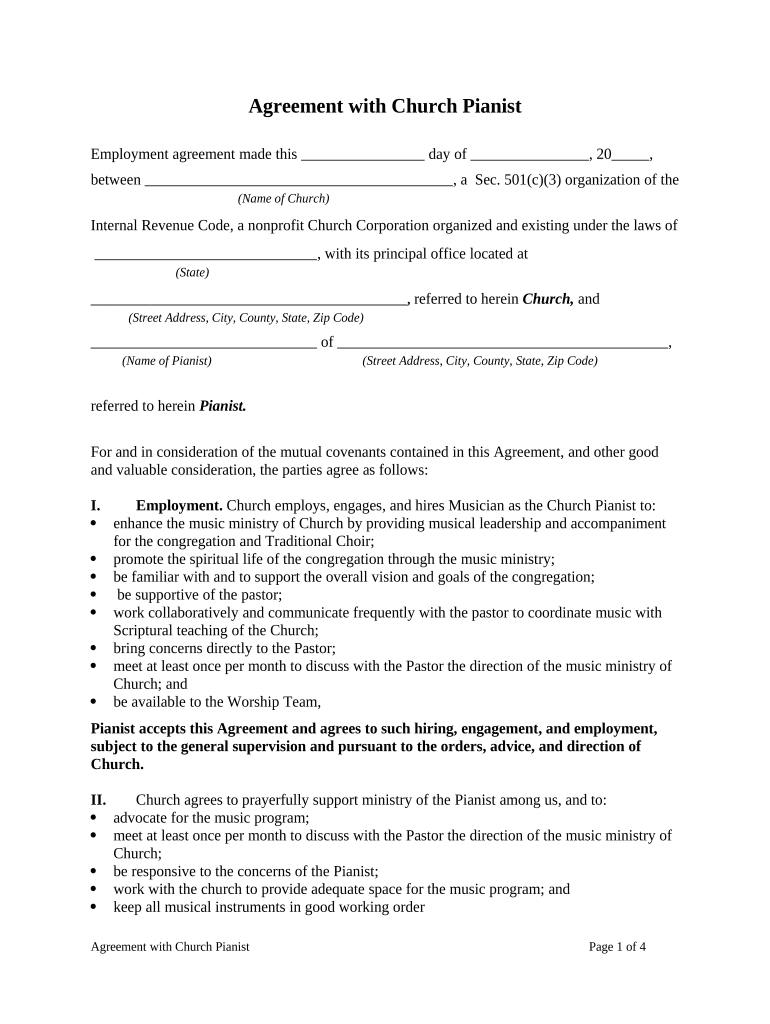
Agreement with Church Pianist
What the Agreement with Church Pianist Covers
Why Use a Formal Agreement with a Church Pianist
Use this Agreement with Church Pianist to reduce misunderstandings, document payment and scheduling, and protect intellectual property and privacy. A clear contract helps determine tax classification, sets expectations for rehearsals and performances, and creates an enforceable record of each party’s obligations.
Who Typically Completes This Agreement
Common users include church administrators, music directors, freelance pianists, and volunteer coordinators responsible for scheduling and payments.
- Church music directors who manage worship teams and arrange service music.
- Church administrators handling budgets, contracts, and payroll or contractor classification.
- Freelance pianists offering performance and rehearsal services to multiple congregations.
Representative Roles and Responsibilities
Music Director
Music director or worship leader responsible for selecting repertoire, scheduling rehearsals, coordinating volunteers, and approving arrangements. They use the agreement to define expectations, limit liability, and ensure budgeted compensation aligns with church policy and payroll classification.
Freelance Pianist
Freelance pianist who performs services, provides invoices, and may work for multiple congregations. The agreement protects payment terms, clarifies tax reporting obligations, and documents rights to recordings, commissions, and sheet music handling.
How to Complete the Agreement — Step by Step
-
01Prepare Document: Gather names, dates, service schedule, compensation, and provisions.
-
02Review Terms: Confirm duties, rehearsal expectations, and equipment responsibilities.
-
03Set Compensation: Enter fee, payment schedule, reimbursements, and tax status.
-
04Sign and Store: Obtain signatures, record dates, and save a secure copy.
Setting Up a Simple Digital Signing Workflow
| Field | Configuration |
|---|---|
| Signer Order | Single signer or church first, pianist second |
| Authentication | Email link with optional SMS code |
| Reminders | Automated reminders at 3 and 7 days before event |
| Storage | Encrypted cloud storage with access logs retained |
From Draft to Signed: Typical Workflow
-
Upload: Upload template and attach schedule exhibit.
-
Assign Fields: Place signature, date, and payment fields.
-
Send to Signer: Deliver via email link or guest signing URL.
-
Archive: Store executed PDF and audit trail securely.
Platform Capabilities to Support Execution
For digital execution, ensure the platform supports fillable PDFs, e-signatures, basic authentication, and secure storage.
- File Formats: PDF and Word DOCX supported
- Integrations: Google Workspace, Microsoft 365, calendars
- Authentication: Email, SMS code, optional KBA
Key Dates to Track in the Agreement
Effective Date and Term:
Start date in MM/DD/YYYY and contract term length.
Payment Due Dates:
Specify net terms (e.g., Net 30) and exact due dates.
Cancellation Notice Window:
Minimum notice required for cancellations, e.g., 7–30 days.
Rehearsal and Performance Schedule:
List dates and arrival/setup times for all services.
Record Retention Trigger:
Date that starts the retention clock for records.
Milestones from Negotiation to Retention
Negotiation
Agree scope, schedule, fee, and tax classification.
Execution
Both parties sign; date and initial required pages.
Service Delivery
Pianist performs services per agreed schedule; document changes.
Post-Term Retention
Archive signed agreement and supporting receipts per retention rules.
Common Preparation Mistakes to Avoid
- Vague compensation terms leading to late payments or disputes; failing to specify rate, payment schedule, or who covers travel and rehearsal fees increases disagreement risk.
- Misclassifying the pianist as an employee or contractor without consulting tax rules can trigger payroll liabilities, withholding errors, and penalties from IRS or state tax agencies.
- Omitting detailed schedule exhibits or failing to update dates can cause missed services and confusion about which events the pianist must attend.
- Not including cancellation, replacement, or force majeure provisions leaves parties exposed to disputes when events are rescheduled or canceled due to weather or illness.
Primary Risks and Penalties to Consider
Comparing eSignature Vendors for This Agreement
| signNow | DocuSign | Adobe Sign | PandaDoc | HelloSign | |
|---|---|---|---|---|---|
| Starting Price | $8/user/mo | $15/user/mo | $14/user/mo | $19/user/mo | $15/user/mo |
| Free Trial | 7-day free trial | Varies by plan | Varies by plan | Varies by plan | Varies by plan |
| Bulk Send | Yes (Business Premium+) | Yes | Yes | Yes | No |
| Audit Trail | Yes | Yes | Yes | Yes | Yes |
| HIPAA Compliant | Yes | Yes | Yes | No | No |
Frequently Asked Questions — Agreement with Church Pianist
-
Can this agreement be signed electronically?
Yes. Electronic signatures are legally effective under the federal ESIGN framework and state UETA laws when intent, consent, attribution, and record retention requirements are met; certain narrow exceptions like wills and some court filings remain excluded.
-
How should the pianist be classified for taxes?
Classification as an employee or independent contractor affects withholding, reporting, and benefits. Consider IRS guidance and state rules; require a W-9 from contractors and consult payroll counsel for consistent treatment to avoid liability.
-
Is notarization required for this contract?
Generally not required for a services contract between a church and pianist. Notarization or RON can add authentication and may be used where local practices or venue rules request notarized agreements.
-
When is a W-9 or 1099 required?
If you pay a non-employee pianist $600 or more in a tax year, obtain a W-9 and issue Form 1099-NEC as required by IRS reporting rules; verify thresholds and exceptions with IRS guidance.
-
How do we cancel or amend the agreement?
Follow the contract's termination and amendment clauses, provide written notice per the stated notice period, and document any agreed changes in a signed amendment to avoid later disputes.
-
How long must we keep the signed agreement?
Retain signed agreements at least until any applicable statute of limitations or audit period ends; IRS guidance suggests minimum 3 years, HIPAA requires 6 years for PHI, and many organizations keep records for 7 years.