Establishing secure connection…Loading editor…Preparing document…

Agreement with Online Game Developer to Sell Game Online

This template is fully customizable. Edit the text, fill out the fields, and send it for signature. Give it a try!
Agreement with Online Game Developer to Sell Game Online

What this Agreement Is and When it’s Used

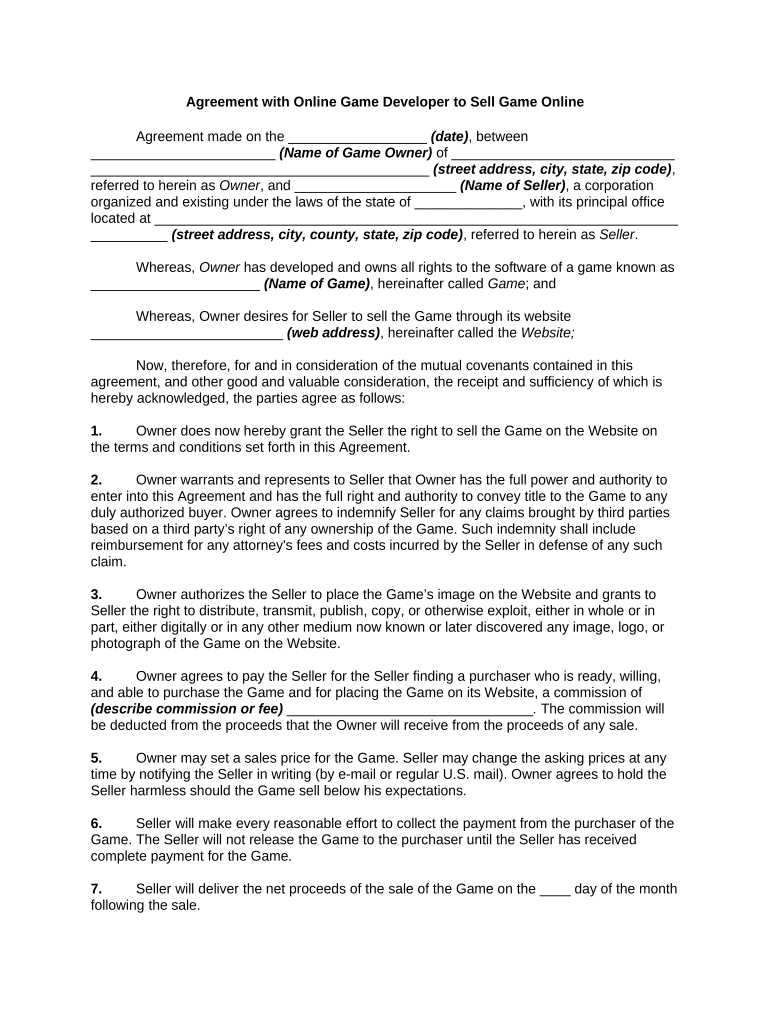
An Agreement with Online Game Developer to Sell Game Online is a contract that documents terms for distributing, marketing, and monetizing a video game through digital channels. It sets out whether rights are licensed or assigned, payment and royalty mechanics, delivery and acceptance milestones, intellectual property ownership, support and maintenance obligations, and termination conditions. Parties typically include the game developer and a publisher, distributor, or platform operator. The agreement governs revenue splits, platform fees, territorial rights, content standards, and any developer warranties or indemnities that apply during the commercial lifecycle.

Why a Written Agreement Matters for Selling a Game Online

A clear written agreement reduces ambiguity about ownership, payment timing, and risk allocation for online sales. It protects copyright and trade-dress rights, defines revenue reporting and audit rights, and documents compliance obligations for payments, taxes, and platform rules.

Why a Written Agreement Matters for Selling a Game Online

Who Commonly Uses This Agreement

Each party’s business model (license vs. sale), geographic scope, and platform rules determine which clauses are essential.

  • Indie developers seeking distribution or revenue-share deals with publishers or marketplaces.
  • Digital publishers and marketplaces onboarding third-party games for sale on consoles, mobile, or PC.
  • Legal and business teams negotiating IP, payment, or compliance terms for online distribution.

Key signers and their roles

Developer

Chief creative and technical owner of the game content who warrants originality, delivers code and assets, and typically assigns or licenses rights according to the contract.

Publisher

Entity responsible for distribution, marketing, platform relationships, and payment remittance; usually enforces platform compliance and reports royalties to the developer.

Essential data and security provisions to include

Party Names: Legal entity names
Contact Details: Address and email
Payment Terms: Currency and schedule
IP Designation: Licensed vs assigned
Delivery Items: Build and asset list
Security Controls: Access and storage rules

Consequences and legal risks to address

Breach Damages: Contract damages
IP Disputes: Injunctions, royalties
Tax Exposure: Backup withholding
Platform Sanctions: Delisting risk
Data Breach: Regulatory fines
Indemnity Costs: Defense obligations

Common errors people make when preparing this agreement

  • Vague ownership language that fails to specify whether source code, art assets, and trademarks are assigned or merely licensed, creating downstream IP disputes.
  • Unclear payment mechanics or failure to specify gross versus net revenue and platform fees, which leads to disagreements about royalty calculations.
  • No acceptance testing criteria or delivery milestones, enabling disputes over whether the delivered build meets contractual requirements.
  • Insufficient audit and reporting rights for royalties, or no defined remediation steps for underpayments discovered during audits.

How to complete the agreement step by step

Follow a consistent sequence: identify parties, define rights and payments, set delivery and acceptance, add compliance clauses, and obtain authorized signatures.

  • 01
    Prepare document: Gather developer and publisher legal names and addresses.
  • 02
    Define rights: State whether IP is assigned or licensed, with territory and term.
  • 03
    Set payments: Specify currency, royalty computation, reporting cadence, and deductions.
  • 04
    Sign and retain: Obtain authorized signatures and archive a signed copy with audit trail.

Where to send and file the executed agreement

Determine practical routing: each party keeps an original signed copy, and the publisher archives the agreement with sales records for compliance and audits.

  • Developer Archive: Store signed PDF and source references in secure repository.
  • Publisher Archive: Keep contract with royalty reports and invoices.
  • Accounting: Forward copies to payroll and tax teams for reporting.
  • Legal Counsel: Provide counsel a copy for dispute preparedness.

Key provisions every online game sales agreement should include

A complete agreement balances commercial mechanics with risk controls: rights and scope, payment terms, delivery/acceptance, warranties and indemnities, confidentiality, and termination procedures.

License or Assignment

Specify whether the developer assigns copyright or grants a license, define exclusivity, territorial scope, sublicensing rights, and duration to prevent future ownership disputes.
Payment and Royalties

Detail revenue share formula, platform fee passthrough, timing and frequency of royalty statements, minimum guarantees, and audit rights with remedies for underpayments.

Delivery and Acceptance

List deliverables (builds, assets, source code if required), acceptance tests, defect correction windows, and deadlines for milestone payments tied to acceptance.

Warranties and IP

Developer warrants ownership and noninfringement, discloses third-party material, and provides remediation obligations for IP claims and third-party licenses.

Support and Updates

Define patching, maintenance windows, service-level expectations, and who bears costs for post-launch fixes and platform certification updates.

Termination and Remedies

Specify termination rights for material breach, insolvency, and platform delisting, plus post-termination obligations for unsold inventory and outstanding payments.

Key dates and recurring deadlines to include

Define milestones and recurring reporting deadlines in the contract so both parties can track obligations and tax reporting.

Effective Date:

Agreement commencement date in MM/DD/YYYY format

Developer Delivery:

Deadline for initial build and asset handover

Acceptance Testing:

Window for testing and remediation after delivery

Royalty Reporting:

Periodic statements and payments; 1099-NEC to independent developers by Jan 31

Tax Reporting:

Coordinate with accounting to meet federal filing deadlines

Milestone timeline from negotiation to revenue reporting

Track major milestones as sequential stages so responsibilities and timing are clear from negotiation through ongoing reporting.

01

Negotiation Complete

Finalize commercial terms, IP scope, payment mechanics, and reporting obligations

02

Signing Executed

Both parties sign and confirm effective date and initial payment (if any)

03

Delivery & Acceptance

Developer delivers build; publisher performs acceptance testing and issues acceptance notice

04

Ongoing Reporting

Publisher issues royalty statements and payments on agreed cadence

Practical tips for accurate and enforceable agreements

Adopt clear drafting, consistent data, and documented processes to reduce disputes and support audits.

Be explicit about IP
Clearly state if copyrights, source code, and assets are assigned or licensed, include dates and territory, and list any third-party components or middleware with license terms to avoid downstream infringement claims.
Define financial mechanics
Use exact mathematical formulas for royalties, define gross versus net receipts, itemize permissible deductions and platform fees, and include worked examples to reduce ambiguity in payment calculations and audits.
Set clear acceptance criteria
Specify pass/fail criteria for builds, acceptance test steps, and remedies for failed acceptance (e.g., remediation timelines, partial payments, or termination rights) to avoid disagreements on deliverable quality.
Preserve audit rights
Include inspection and audit rights with defined scope, frequency, and confidentiality protections, and require retention of supporting sales records for the audit period specified in the contract.

Digital signing and workflow configuration checklist

Configure digital workflow settings to match the signing order, authentication, and archival requirements of the agreement.

Field Configuration
Authentication Email link, SMS code, or KBA as required
Signature Order Specify sequential or parallel signing
Reminders Automatic email reminders and expiration dates
Storage Secure PDF archival with audit trail

Sale agreement versus license agreement: key contrasts

Choose the contract type that matches your commercial intent: transfer ownership (sale) or grant usage rights (license).

Criteria Sale Agreement License Agreement
Transfer of Ownership
Scope Limited
Sublicensing Allowed varies often allowed
Typical Use buyout ongoing distribution

Comparing eSignature options commonly used for executing game distribution agreements

Platform pricing, bulk-send capability, audit trails, and compliance features differ; signNow is listed first for direct feature comparison without implying recommendation.

signNow DocuSign Adobe Sign PandaDoc HelloSign
Starting Price $8/user/mo $15/user/mo $14/user/mo $19/user/mo $15/user/mo
Free Trial Yes, 7-day trial Varies by vendor Varies by vendor Varies by vendor Varies by vendor
Bulk Send Yes Yes Yes Yes No
Audit Trail Yes Yes Yes Yes Yes
HIPAA Compliant Yes Yes Yes No No
Envelope Cap No envelope cap 100 envelopes/user/year Varies by plan Varies by plan Varies by plan

FAQs: legal and practical questions about this agreement

Answers to frequent questions about enforceability, signatures, notarization, taxes, and cancelling an agreement.


Need help? Contact support

be ready to get more
Join over 28 million airSlate SignNow users