Establishing secure connection…Loading editor…Preparing document…

Allonge Note

This template is fully customizable. Edit the text, fill out the fields, and send it for signature. Give it a try!
Allonge Note

What an Allonge Note Is and when it’s used

An Allonge Note is a short attachment to a promissory note used to record an endorsement, assignment, or change in the payee when the original note lacks space for additional endorsements. Common in mortgage and commercial lending, an allonge preserves the chain of title and documents transfer of rights, tax treatment, and payment direction without altering the original note language. It is often signed by the endorsing party and attached physically or electronically to the promissory note for storage, delivery to investors, or recording where required by local practice.

Why an Allonge Note matters for enforceability and transfers

An allonge clarifies the endorsement chain and the identity of the holder, reducing disputes about payee rights, facilitating sales to investors, and supporting enforceability in court. It is a practical solution when a note has no room for more endorsements and helps custodians and servicers preserve chain-of-title integrity.

Why an Allonge Note matters for enforceability and transfers

Typical users and stakeholders involved with an Allonge Note

The Allonge Note is used by parties involved in loan origination, servicing, transfer, and legal validation.

  • Lenders and originators who need to document an endorsement or assignment clearly for downstream holders.
  • Loan servicers and custodians that maintain payment records and must show an unbroken chain of ownership.
  • Secondary-market investors and trustees who require clear documentation to support purchase and pooling of notes.

Core components to include in a professional Allonge Note

A well-constructed allonge contains concise, auditable elements that identify the note, the parties, and the transfer details needed for legal and recordkeeping purposes.

Attachment reference

State that the allonge is attached to a specific promissory note by date, original lender, and loan number to avoid ambiguity in identity.
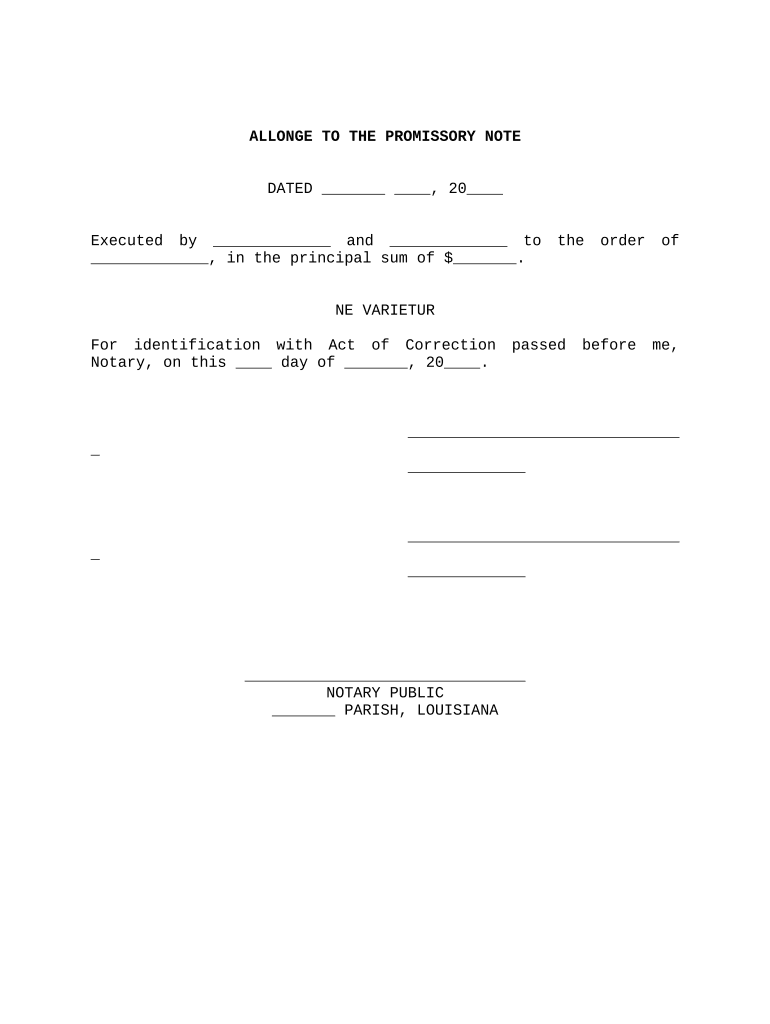
Endorsement language

Include clear words of assignment or endorsement (for example, 'pay to the order of' or 'endorse and assign unto') to show intent and effect.

Named parties

List full legal names and roles for endorser and endorsee so attribution of rights is unmistakable for custodians or courts.

Effective date

Specify the date the endorsement or assignment takes effect, which can determine priority against other claims or lien recordings.

Notarial block

If notarization is used, include a state-appropriate notary acknowledgment or RON session details to meet recorder or investor requirements.

Reference to security

Reference the associated security instrument (mortgage or deed of trust) and recording details where applicable for lien tracing.

Essential identification fields to record

Borrower name: Full legal borrower name
Original lender: Name as on original note
Note date: MM/DD/YYYY
Original principal: Numeric amount
Loan or note number: Servicer identifier
Mortgage reference: Recorder book/page or instrument ID

Step-by-step: preparing and executing an Allonge Note

Follow a clear sequence to prepare, sign, notarize if required, and distribute the allonge to preserve chain-of-title and meet recording or investor standards.

  • 01
    Prepare text: Draft allonge with reference to the exact promissory note identifiers.
  • 02
    Confirm parties: Verify legal names and authority of signers before placing fields.
  • 03
    Sign and notarize: Have authorized signer execute; add notary or RON acknowledgement if required.
  • 04
    Attach and distribute: Attach to the original note and deliver to servicer, custodian, or recorder as needed.

Configuring an online workflow for an Allonge Note

When converting this process to an electronic workflow, map each step to fields, authentication, attachments, and audit requirements before sending to signers.

Field | Configuration Field name | Online setting
Template name Use consistent naming for version control
Conditional fields Show notary block only when state requires notarization
Authentication level Choose email, SMS code, or KBA per investor policy
Attachment handling Require PDF of the original note before completion

Common destinations and routing after execution

Identify where the executed allonge must be sent—custodian, servicer, investor, and sometimes county recorder—and prepare routing rules to ensure each recipient gets the correct document set.

  • Servicer: Primary recipient for loan servicing records
  • Custodian: Document custodian for investor custody and audits
  • Investor: Provide endorsed allonge to buyer in sale transactions
  • County recorder: Record only when local practice or investor requires it

Technical considerations for electronic completion and distribution

Choose a platform that supports PDF, DOCX, and preserves audit trails and attachments when converting an allonge to an electronic workflow.

  • Integrations: Salesforce, NetSuite, Microsoft 365 integrations
  • File formats: PDF and Word DOCX supported
  • Authentication: Email, SMS, KBA, and RON-ready options

Key dates and timing to track for an Allonge Note

Track execution dates, notarization timing, and any recording or investor delivery windows to avoid disputes or missed transfer obligations.

Execution date:

Date of signature determines when endorsement takes effect

Notarization window:

Complete notarization promptly when required by jurisdiction

Investor delivery:

Deliver endorsed allonge per purchase agreement deadlines

Recording timeframe:

Record only if required; county windows vary by jurisdiction

Retention trigger:

Retention begins on execution or payment finalization

Common mistakes to avoid when preparing an Allonge Note

  • Using informal or vague endorsement language that fails to transfer legal title and triggers disputes among servicers and investors.
  • Mismatching party names between the allonge and the original note, which can break attribution and cause recording or custodial rejection.
  • Failing to attach the allonge to the correct promissory note PDF or original paper note, creating gaps in the documented chain of title.
  • Omitting notarization or RON session details where required by local practice or investor protocols, leading to challenges during due diligence.

Risks and practical consequences of incorrect Allonge Notes

Invalid transfer: Loss of enforcement rights
Custodial rejection: Sale or pooling delays
Recording denial: County may refuse acceptance
Tax impact: Backup withholding risk
Litigation exposure: Increased dispute risk
Investor noncompliance: Repurchase or indemnity demand

How an Allonge Note compares to related transfer documents

These documents overlap but serve distinct legal and operational purposes; select the instrument that matches your transfer goal and recordkeeping needs.

Document Type Primary Purpose Typical Use
Allonge Note attach endorsement clarify payee
Assignment of Mortgage convey lien rights record with county
Endorsement in blank transfer note rights negotiable bearer
Transfer letter administrative notice investor instruction

Frequently asked questions about Allonge Notes

Answers to common practical and legal questions about drafting, execution, notarization, eSigning, recording, and disputes.


Need help? Contact support

be ready to get more
Join over 28 million airSlate SignNow users