Establishing secure connection…Loading editor…Preparing document…

Arizona Correction Deed

This template is fully customizable. Edit the text, fill out the fields, and send it for signature. Give it a try!
Arizona Correction Deed

What an Arizona Correction Deed Is and when it's used

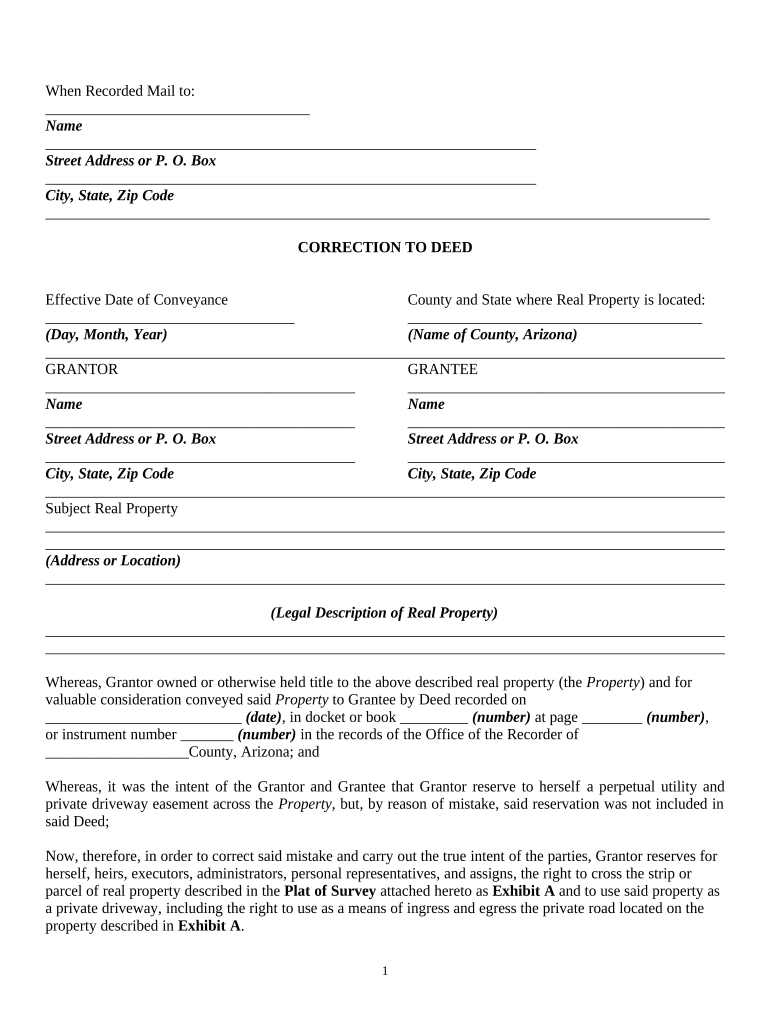
An Arizona Correction Deed is a legal instrument used to amend, clarify, or correct a previously recorded deed affecting real property in Arizona. It addresses clerical mistakes such as misspelled names, inaccurate legal descriptions, scrivener errors, or other non-substantive inaccuracies that do not change the grant of title. The Correction Deed cites the original recording (instrument number, book and page, or recorder identifier), states the precise correction, and must be signed and notarized by the grantor. Recording the corrected instrument with the county recorder updates the public land record and preserves chain of title clarity.

Why a Correction Deed matters for title clarity

Use an Arizona Correction Deed when recorded instrument errors create ambiguity in title records. It clarifies public records, prevents future disputes, and maintains continuity in chain of title when recorded with the proper county recorder.

Why a Correction Deed matters for title clarity

Who typically prepares and files Correction Deeds

Typical users include property owners, title companies, real estate attorneys, and county recorders handling deed corrections.

  • Property owners correcting misspellings, middle names, or conveyance errors after recording.
  • Title companies curing chain-of-title defects discovered during closing or title search.
  • Real estate attorneys preparing precise corrective language and verifying legal descriptions.

Who can sign and who represents parties

Grantor — Owner

The grantor who executed the original deed or their lawful successor must sign the Correction Deed. If ownership has transferred, the current recorded owner or an authorized representative must sign; corporate grantors require an authorized officer and proof of corporate authority.

Attorney-in-Fact

An attorney-in-fact under a valid power of attorney may sign if the POA expressly authorizes real estate conveyances; counties often require a certified copy of the POA or additional notarization for acceptance.

Essential elements to include in a professional Correction Deed

A complete Arizona Correction Deed includes precise correction language, a reference to the original instrument, the full legal description, signature and notary blocks, and recording instructions tailored to county requirements.

Original Reference

Cite the original deed by instrument number, book and page, or recorder identifier so the county can accurately link the correction to the prior recorded instrument.
Correction Clause

Explicitly state the error and provide the exact corrected wording; avoid ambiguous phrases and make clear the correction is clerical, not a substantive transfer of title.

Legal Description

Include the full recorded legal description—lot, block, subdivision, and county—to prevent ambiguity and ensure the recorder assigns the correction to the correct parcel.

Consideration

State consideration if customary in the county; many correction deeds recite nominal consideration to satisfy recording practice without altering conveyance intent.

Signature Block

Provide signature lines for the grantor with printed name and date; entities should include title lines and evidence of corporate authority when applicable.

Notary Block

Include a notary acknowledgement with venue and date; if using Remote Online Notarization, include the state-compliant notary language and retention evidence as required.

Step-by-step: prepare and record a Correction Deed

Follow these steps to prepare, sign, notarize, and record an Arizona Correction Deed accurately and in compliance with county requirements.

  • 01
    Gather Documents: Obtain original deed copy, current deed, and title report if available.
  • 02
    Draft Correction: Specify the error and present corrected wording with citation to the original instrument.
  • 03
    Sign & Notarize: Grantor signs before notary; include date and venue information.
  • 04
    Record: Submit to county recorder with required fees and return instructions.

Setting up an online workflow for Correction Deeds

Set up an online workflow to collect signatures, populate correction fields, and prepare a recording-ready PDF for county submission.

Field Configuration
Document Template Pre-fill original deed reference and full legal description for accuracy
Signature Order Grantor signs first, then witnesses or certifying parties as required
Authentication Email link plus SMS code or RON where allowed by law
Output Format Create flattened PDF with audit trail and metadata for recorder

Technical requirements for digital signing and e‑submission

Digital filing and e-signature require compatible PDF generation, a notarization method accepted by the recorder, and signer authentication aligned with state rules.

  • Formats: PDF, DOCX supported
  • Authentication: Email, SMS, or RON verification
  • Security: TLS 1.2/1.3 and AES-256

Where to file and how recording affects public records

File the Correction Deed with the county recorder where the property is located; recording updates the public record and gives notice to third parties about the corrected information.

  • County Recorder: Record in the property county where the APN is assigned.
  • Recording Requirements: Submit original signed and notarized deed plus any required cover sheet.
  • Fees: Pay county recording fee; amounts vary by county.
  • Return Documents: Provide return address or instructions for returning recorded copies.

Timing and scheduling considerations

Key timing considerations when preparing, notarizing, and recording an Arizona Correction Deed to minimize title disruption and recording delays.

No fixed deadline:

Record as soon as practical to preserve notice and clear chain of title.

Notarization timing:

Sign and notarize in the same session when possible to avoid re-execution.

RON availability:

Use RON only where state rules permit and the recorder accepts RON originals.

Title company notice:

Notify the title insurer if correction affects insured matters before closing.

County processing:

Recorder processing times vary from same day to several weeks.

Key milestones from drafting to recorded correction

Follow these numbered milestones to move an Arizona Correction Deed from preparation through notarization, recording, and post-recording notification.

01

Draft

Prepare correction text, reference instrument, and obtain legal description.

02

Review & Approval

Have grantor and any affected parties approve language before signing.

03

Sign & Notarize

Grantor appears for notarization; include notary venue and seal.

04

Record & Distribute

File with recorder, pay fees, and distribute stamped copy to parties.

Common preparation mistakes to avoid

  • Failing to reference the original deed accurately (book/page or instrument number) causes ambiguity and may result in recorder rejection or ineffective correction.
  • Altering substantive terms rather than clerical errors can create unintended conveyances; use Correction Deeds only for clerical or non-substantive fixes.
  • Mismatched grantor name spelling between original and correction may nullify the correction; ensure signatures match recorded grantor names exactly.
  • Skipping notarization or using an improper notary venue/statement results in non-acceptance by the county recorder and loss of filing fees.

Risks and consequences of an incorrect or improper Correction Deed

Title Dispute: Potential litigation over ownership rights
Recorder Rejection: Deed may be refused; refile required
Tax Implications: Possible reassessment notices
Costs: Additional filing and attorney fees
Notary Liability: Improper notarization may void correction
Insurance Issues: Title policy exceptions may arise

Supporting documents and file formats to prepare

Include supporting exhibits, choose recorder-friendly file formats, and prepare a clean, flattened PDF to streamline recording and retrieval.

Supporting Docs

Attach a certified copy of the original deed or title report if requested by the recorder to verify the connection between instruments.

Affidavits

Supply affidavits or sworn statements when the correction arises from scrivener error or to clarify chain-of-title facts.

File Formats

Use PDF/A or flattened PDF for recording; keep an editable DOCX copy for revisions and internal use.

Return Envelope

Include a stamped, addressed return envelope or electronic return instructions so the recorder can return the recorded instrument efficiently.

Practical tips to avoid delays and rejections

A consistent checklist reduces errors and accelerates recording. Follow these best practices when preparing an Arizona Correction Deed.

Verify original instrument details before drafting
Confirm recording reference, grantor/grantee names, and full legal description by pulling the recorded deed and title report; discrepancies at drafting cause most rejections.
Use precise corrective language not substantive change
Frame the deed as a correction or clarification; if a substantive title change is needed, consider a different conveyancing instrument prepared with legal counsel.
Coordinate with title insurer early in the process
Notify the title company; their endorsement procedures may be necessary to maintain or update coverage and they can advise on required documents.
Confirm county recording formats and fees in advance
Check PDF specs, page size limits, cover sheets, and payment methods; nonconforming submissions may be rejected or delayed.

Common Correction Deed scenarios and outcomes

Real-world examples illustrate when an Arizona Correction Deed resolves recording errors and preserves clear title history.

Misspelled Grantor

A seller's middle name was omitted from the recorded deed, causing title search discrepancies and lender concerns.

  • The Correction Deed inserted the missing middle name and cited the original instrument.
  • The deed was notarized and recorded; the title company updated records and the lender accepted the correction without altering mortgage priority.

Incorrect Legal Description

A lot and block number was transposed in the recorded instrument, creating ambiguity in parcel identification.

  • The Correction Deed restated the full legal description and referenced the original recording.
  • After notarization and recording, the county assigned the correction to the correct parcel and the title insurer removed the exception.

Comparing eSignature plan features relevant to Correction Deeds

Compare common eSignature plan pricing and features that matter when preparing, signing, and distributing an Arizona Correction Deed; signNow appears first for comparison.

signNow DocuSign Adobe Sign PandaDoc HelloSign
Starting Price $8/user/mo $15/user/mo $14/user/mo $19/user/mo $15/user/mo
Free Trial 7-day free trial, no credit card required Varies by vendor Varies by vendor Varies by vendor Varies by vendor
Bulk Send Yes (Business Premium+) Yes Yes Yes Yes
Audit Trail Yes Yes Yes Yes Yes
HIPAA Compliant Yes Yes Yes No No

Frequently asked questions about Arizona Correction Deeds

Answers to common concerns when preparing, signing, notarizing, and recording an Arizona Correction Deed.


Need help? Contact support

be ready to get more
Join over 28 million airSlate SignNow users