Establishing secure connection…Loading editor…Preparing document…

Articles of Association

This template is fully customizable. Edit the text, fill out the fields, and send it for signature. Give it a try!
Articles of Association

What the Articles of Association are and how they function

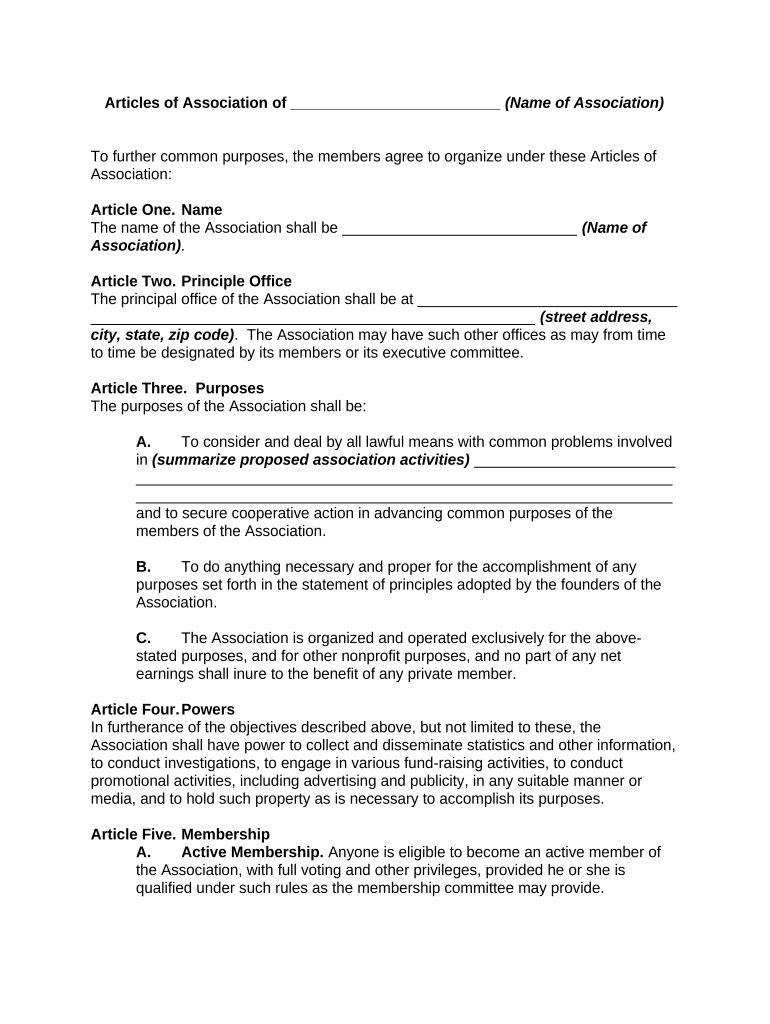
Articles of Association is a company governance document that sets out the rules for membership, share capital, director powers, meeting procedures, and internal administration. In U.S. practice the closest equivalents are articles of incorporation and corporate bylaws; many jurisdictions accept electronic execution under ESIGN and state UETA laws. Properly drafted Articles establish initial authority, define classes of shares and voting rights, and create the baseline rules that officers and shareholders must follow during the company lifecycle.

Why a clear Articles of Association matters for governance

Well-drafted Articles of Association reduce dispute risk, clarify decision-making, and support regulatory filings. They also make capital changes, director appointments, and statutory compliance easier to manage across the company lifecycle.

Why a clear Articles of Association matters for governance

Who typically prepares and approves Articles of Association

Each party’s role should be documented to ensure valid approvals and to satisfy filing requirements.

  • Founders and incorporators: Draft and sign initial Articles to establish company structure and initial share allocation.
  • Corporate counsel and accountants: Review for statutory compliance, tax implications, and shareholder protections.
  • Board and shareholders: Approve amendments, vote on changes, and enforce governance provisions.

Core components to include in professional Articles of Association

Articles should be concise but complete: include identification, share structure, governance rules, directors’ powers, meeting protocols, and amendment procedures so stakeholders and regulators can interpret corporate authority clearly.

Company Identity

Legal name, formation type, and registered office address for official records and filings.
Share Capital

Classes of shares, authorized amount, par value (if any), and rights attached to each share class.

Members and Subscribers

Initial subscribers, share allocations, and any pre-emptive or transfer restrictions.

Board and Officers

Number of directors, appointment procedures, term lengths, and officer duties.

Meetings and Voting

Notice periods, quorum requirements, voting thresholds, and proxy rules for shareholder meetings.

Amendments

Procedure for modifying the Articles, required majorities, and effective date of changes.

Essential information fields every Articles of Association should contain

Company Name: Exact legal name
Registered Office: Full street address
Share Structure: Authorized classes
Subscriber Details: Names and initial shares
Director Details: Names and appointment dates
Governing Law: Chosen state jurisdiction

Step-by-step: preparing and completing the Articles of Association

Follow these steps sequentially to prepare, sign, and file Articles correctly.

  • 01
    Draft: Assemble identity, share, and governance clauses.
  • 02
    Review: Have counsel confirm statutory compliance.
  • 03
    Authorize: Obtain required board or shareholder approvals.
  • 04
    File and Record: Submit to state filing office and retain execution copies.

Customizing and eCompleting Articles online

Configure an electronic workflow to place fields, route signatures, and capture audit trails.

Field Configuration
Signature Fields Place signer, date, and initials fields where required
Signer Order Set sequential or parallel routing depending on approvals
Authentication Choose email, SMS code, or KBA as needed
Audit Trail Enable full event logging and PDF certificate

Where to file and how signed Articles are processed

After execution, file the signed Articles with the state business filing office and retain copies for corporate records.

  • State Filing: Submit signed Articles to Secretary of State or equivalent
  • Processing Times: State offices provide standard and expedited options
  • Certificate Returned: State issues formation certificate or stamped copy
  • Corporate Record: Keep executed originals in minute book and electronic archive

Digital signing and eSubmission essentials

Ensure the chosen platform can export signed PDFs, preserve metadata, and support retention policies for compliance.

  • File Formats: PDF and DOCX supported
  • Authentication: Email, SMS code, or stronger methods
  • Audit Trail: IP, timestamp, and event log

Timelines and expected processing milestones

Know when approvals, filings, and public notices must occur to keep corporate actions lawful and timely.

Initial Filing:

File Articles when incorporators have signed and paid state fees

Effective Date:

May be immediate or delayed per Articles wording

Publication:

Some states require publication within set days

Amendments:

File amended Articles promptly after shareholder approval

Annual Filings:

Many states require annual reports and fees

Common mistakes to avoid when preparing Articles of Association

  • Using an informal or trade name rather than the exact legal name can cause rejection or later disputes about authority.
  • Failing to specify share classes and rights clearly creates ambiguity in voting and dividend entitlements during capital raises.
  • Not aligning amendment procedures with state corporate law can leave the company unable to lawfully change governance provisions.
  • Neglecting to obtain the required board or shareholder approvals before filing may render the filing ineffective or voidable.

Penalties and legal risks associated with incorrect Articles

State Rejection: Filing may be rejected for errors
Operational Risk: Unclear rules can trigger disputes
Tax Impact: Incorrect structure affects tax treatment
Civil Liability: Directors may face fiduciary claims
Delay Costs: Expedited corrections increase fees
Regulatory Sanctions: Late reports risk fines

Real-world examples of Articles use

These examples show common formation scenarios and the governance choices that follow.

Small Startup Formation

A two-founder tech startup set clear share classes to preserve founder control

  • Adopted a vesting schedule for founder equity
  • The Articles also required unanimous board consent for major asset sales, helping prevent premature dilution during early fundraising.

Property-Holding Entity

A real estate holding company limited transferability of interests to co-owners

  • Required board approval for sales
  • The Articles included lien and mortgage approval thresholds that streamlined financing while protecting minority member rights.

Who typically signs and authorizes the Articles

Incorporator

An incorporator or authorized founder signs the initial Articles to create the entity; their signature effects formation subject to filing acceptance and statutory requirements in the chosen state.

Company Secretary

The corporate secretary or authorized officer signs certified copies and maintains executed originals in the company minute book for inspection and compliance purposes.

Comparing eSignature vendors for signing Articles of Association

Key vendor differences for Articles signing include per-user pricing, availability of trials, bulk send, audit trails, and HIPAA compliance for healthcare-related formations.

signNow DocuSign Adobe Sign PandaDoc HelloSign
Starting Price $8/user/mo $15/user/mo $14/user/mo $19/user/mo $15/user/mo
Free Trial 7-day free trial No No Yes, limited Yes, limited
Bulk Send Yes Yes Yes Yes No
Audit Trail Yes Yes Yes Yes Yes
HIPAA Compliant Yes Yes Yes No No

Frequently asked questions about Articles of Association

Answers to common questions about validity, amendment, filing, and electronic execution for Articles of Association.


Need help? Contact support

be ready to get more
Join over 28 million airSlate SignNow users