Establishing secure connection…Loading editor…Preparing document…

Artist Agreement

This template is fully customizable. Edit the text, fill out the fields, and send it for signature. Give it a try!
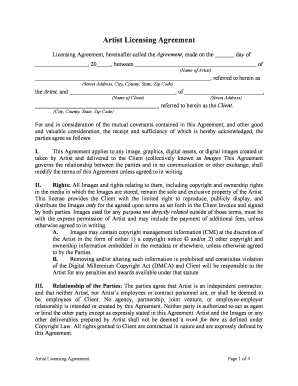
Artist Agreement

What an Artist Agreement Is and when it applies

An Artist Agreement is a written contract that documents the relationship between an artist and a commissioning party, specifying services, deliverables, timelines, payment, intellectual property rights, and termination details. It clarifies who owns finished work, how and when payments are made, any licensing terms, and quality or delivery standards. Artist Agreements are used by visual artists, musicians, performers, designers, galleries, producers, and clients to reduce disputes and to create an enforceable record of expectations and obligations for both parties.

Why a clear Artist Agreement matters

A concise, well-drafted Artist Agreement reduces ambiguity about scope, ownership, payment, and deadlines, lowering legal risk and preventing common disputes that can delay projects or increase costs.

Why a clear Artist Agreement matters

Who typically uses an Artist Agreement

Artist Agreements are used by creators and commissioning parties across commercial and private projects to document expectations before work begins.

  • Independent artists and freelancers who sell original work, commissions, or performances to clients or galleries.
  • Galleries, producers, publishers, and brands that commission work or license creative content for commercial use.
  • Agencies or arts organizations that hire artists for exhibitions, residencies, events, or cross-promotional projects.

Use an Artist Agreement whenever parties want enforceable terms for payment, delivery, licensing, or dispute resolution.

Typical signatories and their roles

Artist

The creator or their authorized representative who delivers the work, grants licenses or assigns rights, and warrants originality and authority to enter into the agreement.

Commissioner

The client, gallery, producer, or organization contracting the artist to produce or license work; responsible for payment, approvals, and specifying deliverables.

Key compliance and security facts to note

Encryption: TLS 1.2/1.3 in transit, AES-256 at rest
Audit Trail: Timestamps, IP, action history
HIPAA: BAA required for PHI workflows
ESIGN / UETA: Electronic signature legal basis
Certifications: SOC 2 Type II, ISO 27001
Accessibility: WCAG 2.0 Level AA compatible

Common legal risks if the agreement is incorrect

IP Disputes: Ownership ambiguity causes litigation
Payment Claims: Unclear schedule triggers disputes
Breach Liability: Damages and lost revenue
HIPAA Exposure: Improper PHI handling fines
Notarization Errors: Execution defects reduce enforceability
Tax Withholding: Incorrect contractor classification

Avoidable mistakes when preparing an Artist Agreement

  • Using vague scope language like 'work as needed' that leaves deliverables and acceptance criteria undefined and invites disagreements.
  • Failing to address intellectual property—whether rights are assigned, licensed, limited by term, or reserved—and how third-party materials are handled.
  • Omitting a clear payment schedule, milestone triggers, refund or dispute procedures, and consequences for late or nonpayment.
  • Neglecting termination and remedy clauses, including whether work-in-progress is deliverable and what fees survive termination.

Essential provisions to include in a professional Artist Agreement

A complete Artist Agreement balances commercial clarity with practical project controls. The following six components commonly resolve the most frequent disputes.

Scope of Work

Describe deliverables, formats, quantities, milestones, and acceptance criteria so both parties share the same expectations for completed work.
Compensation

State total fees, deposit amounts, milestone payments, invoicing terms, late fees, and whether expenses or materials are reimbursable.

Intellectual Property

Specify ownership vs. license, exclusive or nonexclusive rights, duration, territory, moral rights waivers, and permitted uses of the work.

Warranties & Representations

Include assurances of originality, authority to grant rights, and indemnities against third-party claims to protect each party.

Delivery & Acceptance

Set delivery formats, review windows, defect remedies, and what constitutes formal acceptance of the deliverable.

Termination

Define termination rights, notice periods, payment on termination, return of property, and survival of key clauses like IP and confidentiality.

Step-by-step: completing an Artist Agreement form

Follow these sequential steps to prepare, review, execute, and record an Artist Agreement so it is clear and enforceable.

  • 01
    Prepare Draft: Identify parties, scope, and compensation before filling fields.
  • 02
    Review Terms: Confirm IP, licensing, and termination provisions with stakeholders.
  • 03
    Add Signers: Include authorized representatives and date fields.
  • 04
    Execute: Sign, date, and store executed document securely.

Where the signed Artist Agreement goes next

After execution, route copies to all parties, store records securely, and update related project or financial systems.

  • Provide Copies: Send a final PDF to artist and commissioner for records.
  • Accounting: Record payment schedule and deposit invoicing in finance systems.
  • Project Files: Attach agreement to project management or production folders.
  • Long-term Storage: Archive executed copy for retention and audit purposes.

Typical digital workflow settings for eSigning an Artist Agreement

Configure a reliable electronic workflow: upload the contract, place signature fields, set signer order, and apply authentication and reminders.

Upload Document Add the agreement PDF or DOCX to the eSignature platform.
Place Fields Insert signature, initials, date, and optional checkbox fields.
Signer Order Set sequence: artist, commissioner, witness or agent if required.
Authentication Choose email, SMS, or stronger ID verification.
Reminders Schedule automated reminders and expiration settings.

Technical considerations for eSigning and delivery

Ensure the platform supports required file formats, signer authentication, and audit-trail records for enforceability.

  • File Formats: PDF, DOCX, and HTML supported
  • Integrations: CRM, cloud storage, and ERP integrations
  • Authentication: Email, SMS, or advanced methods

Choose a platform that preserves signed PDFs, provides tamper-evident audit trails, and integrates with your document storage and accounting systems for consistent recordkeeping.

Typical deadlines and timing you should document

Record precise dates and timeframes to avoid disputes about delivery, acceptance, and payment obligations.

Effective Date:

Date when obligations and rights begin; enter as MM/DD/YYYY.

Delivery Milestones:

Specific calendar dates for drafts, revisions, and final delivery.

Payment Due Dates:

Net terms, deposits, milestone triggers, and late fee dates.

Review Period:

Number of days for the commissioner to accept or request changes.

Termination Notice:

Days required for written termination notice and cure periods.

Key processing milestones after agreement drafting

Track each milestone from draft to archive so parties and administrators know next actions and timing.

01

Draft Approval

Internal legal and project approval completed before sending to signers.

02

Signer Execution

All required signatures collected and timestamps recorded.

03

Payment Processing

Deposit or milestone payment processed after execution.

04

Archival

Final signed PDF stored in secure repository for retention.

Real-world examples of Artist Agreements in use

These short examples show how organizations use Artist Agreements to simplify execution and recordkeeping.

Optica Ventures (Brian Fitzgibbons)

Optica used a standardized Artist Agreement to capture licensing terms and payment milestones.

  • The contract clarified IP and payments quickly.
  • As a result the team reduced negotiation cycles and stored signed PDFs centrally for accounting and audit.

Martin Properties (Tim Martin)

Martin Properties used a site-specific Artist Agreement for commissioned murals and installations.

  • The agreement included installation responsibilities.
  • This ensured clear insurance coverage and expedited approvals between property managers and artists.

Comparing eSignature vendors for Artist Agreements

Price and feature differences matter when you need bulk send, HIPAA compliance, or high-volume signature invites; signNow is listed first per platform comparison rules.

signNow DocuSign Adobe Sign PandaDoc HelloSign
Starting Price $8/user/mo $15/user/mo $14/user/mo $19/user/mo $15/user/mo
Free Trial 7-day free trial Varies Varies Varies Varies
Bulk Send Yes (plan dependent) Yes Yes Yes No
Audit Trail Yes Yes Yes Yes Yes
HIPAA Compliant Yes Yes Yes No No
Envelope Cap No envelope cap 100 envelopes/user/year Varies Varies Varies

Frequently asked questions about Artist Agreements and eSigning

Answers to common execution, enforceability, and storage questions for Artist Agreements and electronic signing workflows.


Need help? Contact support

be ready to get more
Join over 28 million airSlate SignNow users