Establishing secure connection…Loading editor…Preparing document…

Bank Request to Release Funds for Deceased

This template is fully customizable. Edit the text, fill out the fields, and send it for signature. Give it a try!
Bank Request to Release Funds for Deceased

What a Bank Request to Release Funds for Deceased Is

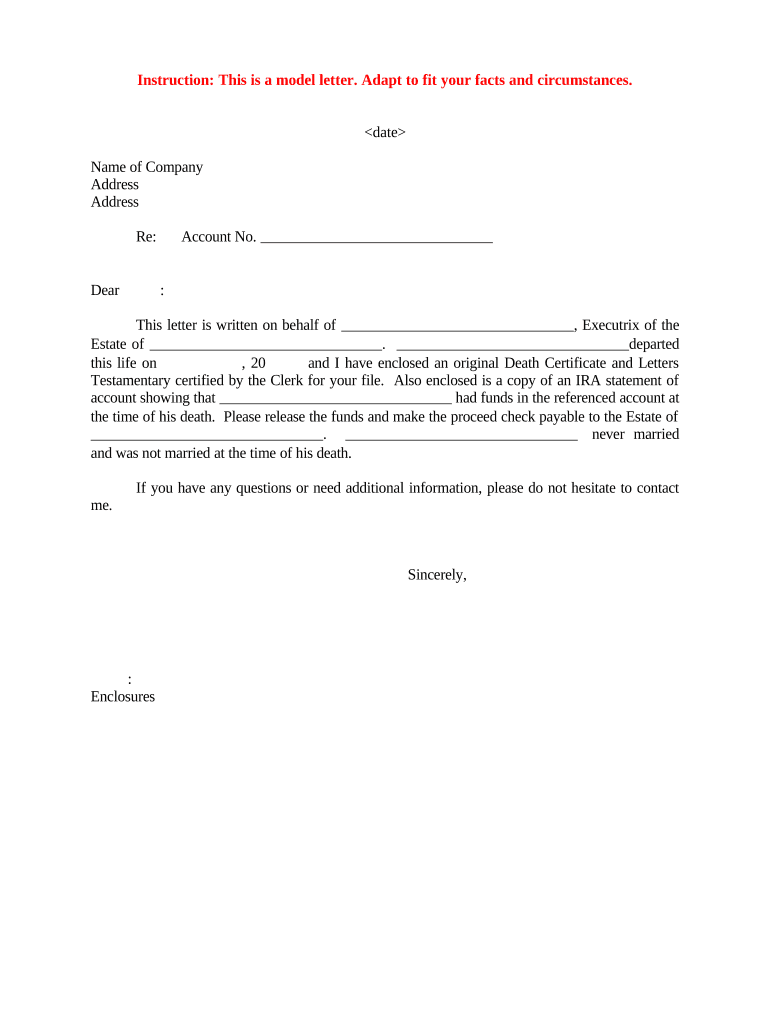
A Bank Request to Release Funds for Deceased is a formal written request submitted to a financial institution asking that funds in an account owned by a deceased person be released to an authorized recipient (executor, administrator, joint account holder, or designated beneficiary). The request typically accompanies proof of death, identification for the claimant, and documentation establishing authority to receive or manage estate assets. Banks use this packet to verify identity, validate legal authority such as letters testamentary or small-estate affidavits, and to follow state probate and anti-fraud controls before releasing funds.

Why this request matters for estates and beneficiaries

A correctly prepared request speeds lawful release of funds, reduces the chance of bank holds or reversals, and helps protect the bank and claimant from liability. It provides a clear audit trail for estate accounting and eases tax and probate reporting obligations.

Why this request matters for estates and beneficiaries

Who commonly prepares or receives these requests

Knowing the typical roles helps ensure the request includes the right authority documentation and follows the bank's acceptance requirements.

  • Estate executors and administrators — persons appointed by a will or court to manage estate assets and distribute funds under probate rules.
  • Surviving joint tenants or POD/beneficiaries — account holders or named pay-on-death recipients who can claim funds without probate when designation applies.
  • Bank trust or cashier officers — bank personnel who review proof of death, verify authority, and execute disbursement consistent with bank policy and state law.

Representative signer roles

Executor

Name and job title: Estate Executor. The executor is court-appointed by probate and must present letters testamentary or court order, valid photo ID, and a death certificate to support fund release requests; banks generally verify authority before disbursing estate funds.

Bank Officer

Name and job title: Trust/Account Officer. The bank officer reviews submitted documentation, runs internal anti-fraud checks, may require notarization or RON, and records disbursement in account history per bank policy and applicable state law.

Core elements any professional request should include

A complete request reduces back-and-forth and helps the bank process the payment consistently. Include clear headings for each supporting document and use consistent names and dates to match the bank's records.

Cover Letter

Brief summary stating the account number, decedent name, requested disbursement amount or full-account release, and the legal basis for the request (e.g., letters testamentary, small-estate affidavit, joint ownership, POD).
Proof of Death

Certified death certificate or certified copy; banks typically require an official vital record rather than an online obituary to accept the claim.

Authority Document

Letters testamentary, letters of administration, small-estate affidavit, or beneficiary designation showing entitlement to funds and the scope of authority.

Claimant Identification

Government-issued photo ID for the person requesting funds, with name matching the authority document; secondary ID or proof of address may be requested.

Account Documentation

Copy of the decedent's account statement, signature card, or contract that establishes ownership, joint tenancy language, or pay-on-death beneficiary designation.

Tax & Withholding Info

Completed forms or TIN verification (W-9 for recipients if required) to address backup withholding or reporting obligations.

Step-by-step: preparing and submitting the request

Follow these sequential steps to prepare a complete submission and reduce processing delays at the bank.

  • 01
    Gather documents: Collect death certificate, ID, and authority documents.
  • 02
    Complete form: Fill every required field and sign where indicated.
  • 03
    Authenticate: Notarize or use RON if the bank accepts it.
  • 04
    Submit: Send per bank instructions (in-person, mail, secure portal).

Bank-side processing: what happens after submission

Banks follow internal verification and legal checks before releasing funds; understanding their typical workflow clarifies expected next steps.

  • Reception: Bank logs request and assigns a case number.
  • Verification: Documents are compared to account records and the death certificate.
  • Authority check: Bank confirms letters testamentary or affidavit validity.
  • Disbursement: Funds released or held pending court instructions.

Configuring an online workflow for electronic submission

When submitting digitally, set a required-document checklist, signer roles, and verification steps to minimize manual review by bank staff.

Field Configuration
Document checklist Require death certificate, ID, authority document
Signer role Claimant must be identified as 'Executor' or 'Beneficiary'
Authentication Enable SMS code or knowledge-based authentication
Delivery Send to bank secure email or portal per bank policy

Digital submission and authentication options

Prepare both a physical and an electronic packet, and label files and attachments consistently to simplify bank review and archive ingestion.

  • Accepted formats: PDF or certified PDF preferred
  • Authentication methods: Photo ID, notarization, RON, SMS code
  • Integrations: Secure portals, SFTP, or supported eSignature platforms

Key timing and filing expectations

Times below are typical benchmarks; banks and courts can set longer internal timelines. Start early to allow for probate or creditor holds.

Immediate bank hold:

Bank may freeze accounts upon notice of death

Probate filing window:

File probate petitions per state timelines (varies)

Estate tax return:

Form 706 due 9 months after date of death (IRS)

Final income tax:

Decedent's final Form 1040 due by regular filing deadline

Bank processing:

Processing often completes within 2–8 weeks if documentation is complete

Typical milestone sequence for a release request

A clear sequence clarifies responsibilities and expected wait times for claimants and fiduciaries.

01

Notify Bank

Submit death certificate and initial inquiry to bank.

02

Provide Authority

Deliver letters testamentary, affidavit, or beneficiary ID.

03

Bank Review

Bank completes internal verifications and anti-fraud checks.

04

Release or Hold

Bank disburses funds or requests court direction.

Common preparation mistakes that cause delays

  • Submitting uncertified death certificates or photocopies that the bank does not accept.
  • Using mismatched names or dates between ID and authority documents that trigger additional verification.
  • Omitting the account number or providing a partial number that prevents account matching.
  • Failing to notarize or follow the bank's remote-notarization policy when required.

Legal and financial risks of incorrect requests

Incorrect Payee: Funds sent to wrong party
Probate Delay: Court orders to recover funds
Tax Penalties: Reporting errors can trigger IRS penalties
Bank Liability: Bank may seek indemnity or recovery
Fraud Exposure: Identity fraud risk if verification weak
Data Breach: Sensitive data mishandling risk

Security, privacy, and legal compliance considerations

Encryption: TLS 1.2/1.3; AES-256 at rest
Audit Trail: Timestamped signing and action logs
ESIGN / UETA: Electronic signature legal framework
HIPAA (if applicable): BAA required for PHI handling
SOC 2: Controls and report availability
21 CFR Part 11: Compliance for regulated records

Practical examples of typical requests

Two common scenarios illustrate how documentation and authority affect bank response and timelines.

Small-Estate Affidavit Example

A surviving spouse uses a state small-estate affidavit

  • The bank requires the original certified death certificate
  • The affidavit and supporting ID allowed release within three weeks when the bank's small-estate policy applied and documentation matched.

Executor with Letters Testamentary

An executor submits letters testamentary and a certified death certificate

  • The bank confirms authority and account ownership
  • The bank disburses funds for creditor payments and final account transfer after a 10–21 day review and record checks.

Practical tips for accurate and efficient submission

Small errors or missing items are the most common causes of delay; follow these operational best practices.

Match names exactly
Use the decedent's name exactly as it appears on the bank record and on the death certificate; inconsistent formatting or use of initials often triggers manual verification that can add days to processing.
Provide certified copies
Where possible, obtain a certified death certificate and certified copies of court-issued authority; many banks will not accept digital images unless explicitly permitted by policy.
Confirm bank policy first
Call the bank's estate or trust desk to confirm required documents, whether RON is permitted, and acceptable delivery channels to avoid unnecessary notarization or extra fees.
Organize attachments
Label each attachment (e.g., 'Death Certificate — Certified Copy') and include a checklist in the cover letter so the bank can quickly route materials to the correct review team.

Representative eSignature pricing and capability comparison

Basic price and a few capability indicators for common providers. signNow is listed first; verify plan details directly with each vendor for exact features and billing terms.

signNow DocuSign Adobe Sign PandaDoc HelloSign
Starting Price $8/user/mo $15/user/mo $14/user/mo $19/user/mo $15/user/mo
Free Trial 7-day trial Varies Varies Varies Varies
Bulk Send Yes Varies Varies Varies No
Audit Trail Yes Yes Yes Yes Yes
HIPAA Compliant Yes Yes Yes No No

Frequently asked questions and answers

Answers to common questions about preparing and submitting a request to release funds from an account of a deceased person.


Need help? Contact support

be ready to get more
Join over 28 million airSlate SignNow users