Establishing secure connection…Loading editor…Preparing document…

California Holographic Will

This template is fully customizable. Edit the text, fill out the fields, and send it for signature. Give it a try!
California Holographic Will

What a California Holographic Will Is

A California holographic will is a testamentary document written entirely in the handwriting of the testator and signed by that person. Unlike formal wills executed with witnesses and notarization, a holographic will relies on the handwritten text and signature for validity. California recognizes holographic wills when they clearly express testamentary intent, include dispositive provisions or appointment of an executor, and are proven to the probate court. Holographic wills cannot be created by typed text alone and are treated differently than electronically signed wills under federal e-signature law.

Why a Holographic Will May Matter in California

A holographic will can provide a low-cost, immediate way to record testamentary intent when formal execution is impractical. It is most useful for straightforward estates or last-minute circumstances, but it carries higher risk of probate challenges and evidentiary hurdles than a formally executed will.

Why a Holographic Will May Matter in California

Who Typically Creates or Relies on a Holographic Will

Common users include people needing a quick handwritten testament and those in situations where witnesses are unavailable.

  • Individuals with simple assets and clear beneficiaries who need an immediate record of intent.
  • Service members or travelers who may execute handwritten instructions while abroad or in transit.
  • DIY estate planners who accept the tradeoff between speed and potential probate scrutiny.

Primary Roles Involved

Testator

An adult who is mentally competent at the time of writing and signing. The testator must handwrite the will’s operative text and sign it for California courts to consider it holographic; incapacity or later disputes may trigger independent medical or handwriting evidence in probate.

Estate Attorney

A lawyer who reviews testamentary language, advises on potential probate issues, and files the will for admission to probate. Attorneys often prepare a formal will or advise how to convert a holographic draft into a formal, witnessed document to reduce contest risk.

Essential Information to Include

Full legal name: Exact name on ID
Date of document: MM/DD/YYYY
Handwritten dispositive text: Clear, unambiguous bequests
Signature: Signed by testator
Executor name: Named personal representative
Witness note: If applicable, include witness details

Key Risks and Legal Consequences

Invalidity: Will may be rejected
Probate delay: Longer court proceedings
Will contest: Higher litigation risk
Ambiguous bequests: Estate distribution disputes
Tax impact: Unplanned estate tax results
Lost original: Original absence can impair proof

Practical Examples and Typical Outcomes

Two concise scenarios illustrate how holographic wills are used in practice and the outcomes commonly seen in probate.

Solo Testator Case

A single adult writes a handwritten will leaving their small bank account to a sibling.

  • The document is dated and signed but unsigned by witnesses.
  • Probate admitted the holographic will after handwriting verification; distribution proceeded but required additional court time and evidentiary proof.

Traveler Case

An individual traveling abroad scribes a will naming an executor for personal effects.

  • No witnesses present at time of writing.
  • The probate court considered the holographic instrument but required testimony to confirm authorship and intent, increasing time to distribution.

Step-by-Step: Create a Clear Holographic Will

Follow these steps to prepare a handwritten will that clearly expresses your testamentary intent and reduces avoidable ambiguities.

  • 01
    Write in your hand: Compose the entire dispositive text by hand.
  • 02
    State intent: Include a clear declaration of intent to make a will.
  • 03
    Sign and date: Sign with full name and date the document.
  • 04
    Store safely: Keep the original where it can be retrieved for probate.

Where and How to File or Submit for Probate

A holographic will must be presented to the appropriate county probate court for formal admission; the court will evaluate handwriting and testamentary intent before allowing probate.

  • Locate county court: File for probate in the decedent’s county of residence.
  • File petition: Submit a petition to admit the will and appoint a personal representative.
  • Provide proof: Offer handwriting or witness evidence to support authorship.
  • Court determination: Judge rules on admission; if admitted, probate proceeds.

Core Elements of a Professionally Prepared Holographic Will

A well-drafted holographic will focuses on specific elements to reduce ambiguity and ease probate review; attention to these components helps protect testamentary intent.

Handwritten text

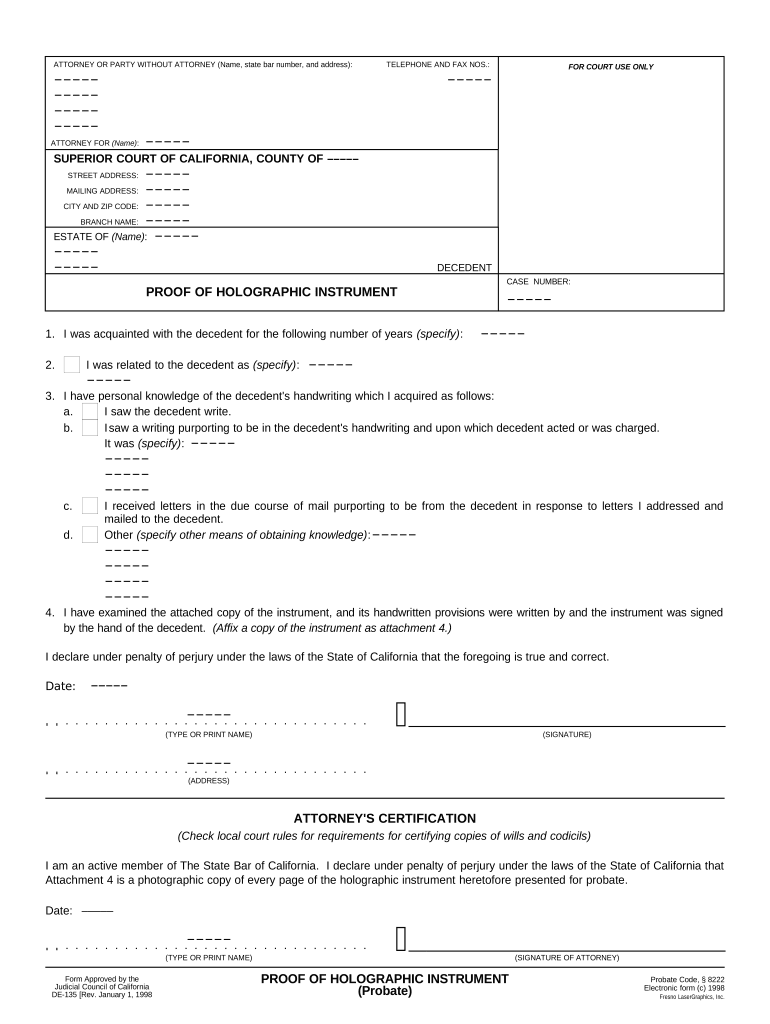
All dispositive language must be in the testator’s handwriting; avoid mixing typed and handwritten content to prevent invalidation or disputes in probate.
Signature

The testator’s handwritten signature must appear on the document; absence of signature often leads to rejection or need for corroborating evidence.

Date

A clear date reduces ambiguity about testamentary capacity and priority when multiple versions exist, and helps courts determine the controlling instrument.

Clear beneficiaries

Identify beneficiaries with sufficient detail to avoid confusion—use full legal names and relationships where possible to prevent contested interpretation.

Executor appointment

Name a successor or personal representative to administer the estate; include contact details to streamline probate administration.

Codicils and amendments

Handwritten changes should follow the same requirements; multiple handwritten versions can create conflict, so date and sign each amendment.

Notarization and Witness Authentication Flow

Follow this sequence to confirm whether notarization or witnesses are needed and to prepare the document for probate submission.

01

Determine recognition

Confirm whether the jurisdiction recognizes holographic wills before relying on handwritten execution.

02

Prepare handwritten text

Compose clear dispositive language and include beneficiary names, executor, and asset specifics.

03

Sign and date

Testator signs and dates the document in their handwriting to evidence authorship.

04

Assess witness need

If state law requires witnesses, arrange for two competent adult witnesses to attest.

05

Notarize if required

In states requiring notarial acknowledgment, include a notary block and proper identification.

06

Self-proving affidavit

Consider a self-proving affidavit to avoid live witness testimony at probate.

07

File petition

Submit an application to the probate court to admit the will and appoint an executor.

08

Preserve original

Keep the original document intact and produce certified copies for administration.

Digital Signing and eSubmission: Platform Considerations

Use secure platforms for storage, limited distribution, and audit-ready records when digitizing related estate documents.

  • Formats supported: PDF, DOCX; scanned handwriting preserved as high-resolution PDF
  • Integrations: Salesforce, NetSuite, Google Workspace, Microsoft 365 supported
  • Authentication: Email, SMS codes, and advanced options available

eSignature Vendor Pricing and Feature Snapshot

Vendor pricing and feature availability vary by plan; the table below highlights starting prices and common feature differences for e-signature platforms relevant to document handling and storage.

signNow DocuSign Adobe Sign PandaDoc HelloSign
Starting Price $8/user/mo $15/user/mo $14/user/mo $19/user/mo $15/user/mo
Free Trial 7-day free trial Varies Varies Varies Varies
Bulk Send Yes Yes Yes Yes No
Audit Trail Yes Yes Yes Yes Yes
HIPAA Compliant Yes Yes Yes No No
Envelope Cap No envelope cap 100 envelopes/user/year Varies Varies Varies

Frequently Asked Questions About California Holographic Wills

Answers to common questions about validity, proof, electronic signatures, storage, and when to seek legal counsel for a holographic will.


Need help? Contact support

be ready to get more
Join over 28 million airSlate SignNow users