Establishing secure connection…Loading editor…Preparing document…

Certiorari Order

This template is fully customizable. Edit the text, fill out the fields, and send it for signature. Give it a try!
Certiorari Order

What a Certiorari Order Is and when it appears

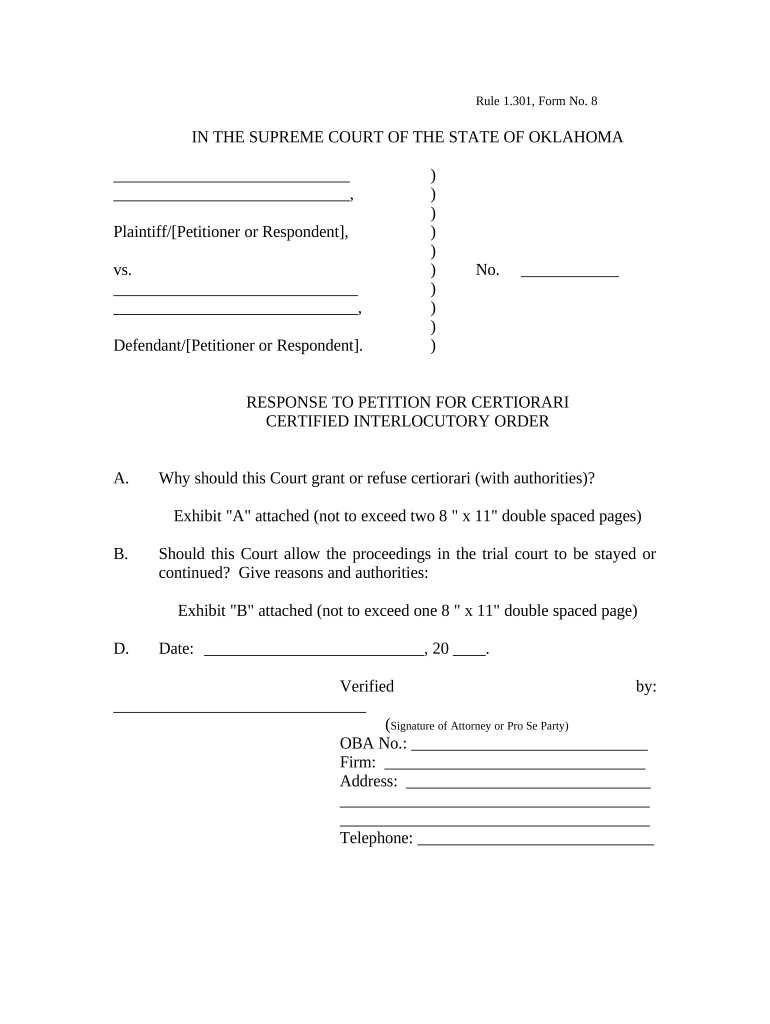
A Certiorari Order is a judicial document reflecting a court's decision to grant or deny a petition for certiorari, most commonly issued by the U.S. Supreme Court or state high courts. It records the court's action on a petition seeking discretionary review of a lower-court judgment or order and often sets deadlines and directions for further briefing or proceedings. Practitioners use the order to confirm the scope of review, the parties covered, and any procedural steps the court requires before oral argument or final disposition.

Why the Certiorari Order matters to case strategy

The Certiorari Order defines whether discretionary review proceeds and frames the issues the court will consider. It shapes appellate strategy, briefing schedules, and preservation of issues for further review.

Why the Certiorari Order matters to case strategy

Who commonly prepares or receives a Certiorari Order

Several parties interact with a Certiorari Order during appellate review; identify where you fit in the process before preparing or responding to the order.

  • Appellate counsel and litigators who draft petitions, responses, and subsequent briefs for discretionary review.
  • Clerk's offices and court staff who docket, issue, and serve the official order to parties and counsel.
  • In-house legal teams and agency counsel tracking precedent, compliance, or litigation risk that follows a grant or denial.

Step-by-step: preparing or responding to a Certiorari Order

Follow these primary steps in order to prepare, file, or respond to a Certiorari Order efficiently and accurately.

  • 01
    Review the Order: Read the court's text and any attached directives carefully for scope and deadlines.
  • 02
    Calendar Deadlines: Enter response, brief, and filing deadlines in your docket system immediately.
  • 03
    Assemble Records: Gather the lower-court record, relevant transcripts, and exhibits required for further briefing.
  • 04
    File or Serve: Submit required filings to the clerk and serve all parties according to court rules.

Essential components to include in a professional Certiorari Order

A well-drafted Certiorari Order contains discrete elements that make the court's action clear and defensible; include each to reduce procedural disputes.

Caption

Full case caption identifying parties and court to ensure the order attaches to the correct docket and case file.
Docket Reference

Official docket number and lower-court citation for accurate cross-referencing and clerk processing.

Disposition

Clear statement of action (grant, deny, grant limited review, vacate and remand) to avoid interpretive ambiguity.

Scope of Review

If partial or limited, specify the questions presented or issues the court has accepted for review.

Procedural Directions

Set briefing schedules, page limits, submission deadlines, or requirements for additional materials.

Signature and Date

Clerk or judge signature line, printed name, and date for official authentication and recordkeeping.

Required factual details to include on the order

Full Caption: Party names and case title
Docket Number: Court-assigned case number
Lower Court: Name of issuing lower court
Judgment Date: MM/DD/YYYY format
Disposition: Grant or deny action
Clerk Signature: Name and signature block

Where to file and how the order is routed

Certiorari Orders are typically filed and issued by the court clerk; follow the court's filing and service rules to ensure proper docketing.

  • Clerk Filing: Submit the order to the issuing court's clerk for docketing.
  • Service on Parties: Serve all counsel and parties per the court's service rules.
  • Docket Entry: Clerk posts the order on the public docket or internal case file.
  • Notice to Lower Court: Notify the lower court of the grant, denial, or remand if required.

Digital signing and e-submission basics for court documents

Courts increasingly accept electronically signed filings where the rules permit; confirm the target court's e-filing and signature policies before submission.

  • Accepted Formats: PDF/A or court-specified PDF
  • Signature Evidence: Audit trail and signer attribution
  • Authentication: Email, SMS, or stronger methods

Configuring an online workflow for a Certiorari Order

Set up field placement, signer roles, and required attachments to streamline preparation and secure e-filing.

Field Configuration
Case Metadata Auto-fill caption and docket number
Signer Roles Assign clerk or counsel signature role
Authentication Email code or multi-factor
Attachments Attach lower-court judgment and record

Common timing rules and deadlines to track

Timelines for certiorari-related filings vary by court. Note key deadlines immediately upon receipt of the order.

Petition Filing Deadline:

Often 90 days from entry of judgment in the lower court (check court rule).

Response Deadline:

Court may set a specific days count; consult the order for the exact date.

Briefing Schedules:

Page limits and filing windows are set in the order or local rules.

Extension Requests:

Requests must follow court rules and be submitted to the clerk in writing.

Oral Argument Dates:

If set, appear on the court calendar with preparatory deadlines.

Key processing milestones after an order issues

Track these sequential milestones to keep filings current and preserve appeal rights.

01

Order Issued

Court publishes the order and serves counsel and parties.

02

Docketing

Clerk enters the order on the official docket and assigns deadlines.

03

Briefing Phase

Parties file briefs, responses, and required appendices per schedule.

04

Disposition

Court grants, denies, or schedules argument and issues final disposition.

Common mistakes to avoid when preparing the order

  • Using inconsistent party names between the order and case caption can misdirect the clerk and delay processing.
  • Failing to calendar court-set deadlines immediately risks forfeiture of the right to respond or to seek extensions.
  • Omitting required attachments, such as the lower-court opinion or appendix, results in clerical rejection or need for refiling.
  • Relying on an unsigned or improperly authenticated electronic signature without audit evidence can create acceptance issues with the clerk.

Consequences of errors or noncompliance

Dismissal Risk: Late or deficient filings
Procedural Waiver: Loss of issues for review
Sanctions: Court-imposed costs or fines
Delay: Extended litigation timeline
Refiling Costs: Additional attorney and filing fees
Record Deficiencies: Incomplete appellate record

Real-world examples of digitized appellate workflows

These brief examples show how organizations use digital signing and structured workflows to manage high-volume or time-sensitive appellate documents.

Optica Ventures LLC

A lean litigation team needed reliable remote signing and distribution for appellate filings.

  • They reduced manual routing and service delays.
  • "The interface is simple and easy-to-use for our team; more importantly, it is just as easy for our customers." The result was faster turnaround and fewer clerical corrections.

Martin Properties

A regional firm coordinated multi-party signatures for court filings across jurisdictions.

  • They used a standardized template and remote notarization when allowed.
  • "I can process and execute all of these documents online with 100% compliance and built-in security." The process decreased in-person meetings and shortened filing cycles.

Practical tips for accurate and efficient completion

Follow consistent procedures and cross-check critical fields to reduce rejections and preserve appellate rights.

Standardize captions and metadata
Use a template or case-management field set to auto-populate caption, docket number, and court name to avoid transcription errors and misfilings.
Verify signature method
Confirm the court accepts electronic signatures, retain an audit trail, and use stronger authentication for sensitive matters.
Attach required records
Include the required lower-court opinion, appendix pages, and any certified transcripts in the exact format the clerk requires.
Preserve service proof
Keep certificates of service, e-mail receipts, or platform audit logs to document compliance with service rules.

Comparing eSignature vendor pricing and basic features for document workflows

Below is a compact comparison of starting prices and common capabilities; verify vendor plans and features before selecting a solution for court-related workflows.

signNow DocuSign Adobe Sign PandaDoc HelloSign
Starting Price $8/user/mo $15/user/mo $14/user/mo $19/user/mo $15/user/mo
Free Trial 7-day trial Varies by plan Varies by plan Varies by plan Varies by plan
Bulk Send Yes (Business Premium) Varies by plan Varies by plan Varies by plan Varies by plan
Audit Trail Yes Yes Yes Yes Yes
HIPAA Compliant Yes Yes Yes No No

FAQs: common questions about Certiorari Orders and e-submission

Answers to frequent operational and legal questions when handling a Certiorari Order, including e-signature and filing considerations.


Need help? Contact support

be ready to get more
Join over 28 million airSlate SignNow users