Claimant Details
Full legal name, business name if applicable, mailing address, phone, email, and taxpayer identification to allow the estate to locate and verify the creditor.
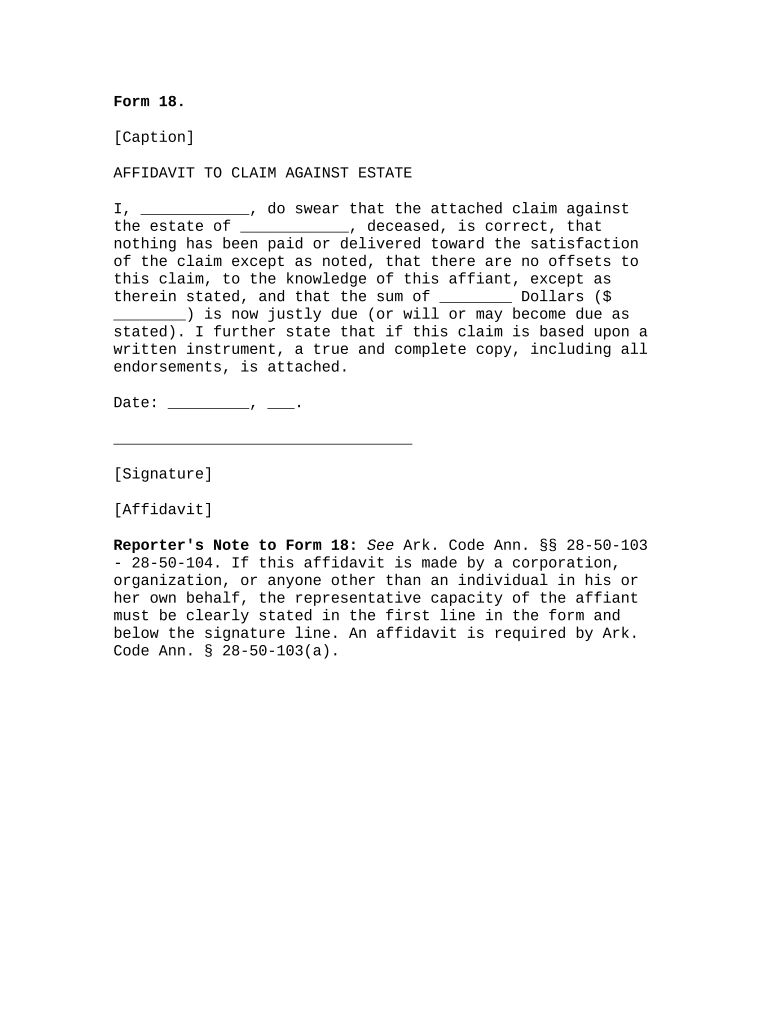
Filing a correct and timely Claim Against Estate preserves your legal right to seek payment and allows the estate representative and probate court to evaluate obligations accurately. A complete claim reduces delays, improves the chance of allowance, and helps prevent forfeiture due to missed deadlines or procedural defects.

Knowing each role clarifies where to send the claim, which supporting documents to attach, and whether legal counsel is advisable.
A business or individual owed money who prepares the claim with documentation (invoices, contract, promissory note) and sends it to the estate representative or probate court; may pursue allowance or litigation if refused.
The executor or administrator who receives claims, verifies validity against estate assets, and either allows, pays, rejects, or petitions the probate court for instructions when claims are disputed.
Full legal name, business name if applicable, mailing address, phone, email, and taxpayer identification to allow the estate to locate and verify the creditor.
Full name of the decedent, date of death, probate case number and county if known — necessary to match the claim to the correct estate file.
Specific dollar amount claimed, with a clear breakdown of principal, interest, fees, and the date the amount became due.
Short statement of why the debt exists (contract, medical bills, promissory note, judgment) and the relevant dates and parties involved.
Attach invoices, signed contracts, payment history, medical billing statements, judgments, or promissory notes as PDF attachments or certified copies.
Signed by the claimant or authorized agent, dated, and include a printed name and title; notarization only if state or court requires it.
| Field | Configuration |
|---|---|
| File Format | PDF preferred; combine multi-page documents into single PDF |
| Authentication | Use email + optional SMS code for signer verification |
| Delivery Method | Email to executor, upload to court portal when required |
| Retention | Keep original signed PDFs and audit trail for recordkeeping |
Ensure the chosen workflow produces a tamper-evident signed PDF and preserves the audit trail for potential court review.
Many states require claims within 3–6 months after notice.
If no notice was issued, deadlines often extend to 1–2 years depending on state law.
Some jurisdictions require formal filing instead of submission to the executor.
Executors often have 30–90 days to allow or reject claims.
If rejected, prompt filing of a judicial petition preserves rights.
Deliver claim and attachments to the executor or file with probate court.
Representative verifies documents, matches claim to estate assets.
Claim is allowed, paid, or formally objected to by the executor.
Disputed claims proceed to probate court for adjudication.
| signNow | DocuSign | Adobe Sign | PandaDoc | HelloSign | |
|---|---|---|---|---|---|
| Starting Price | $8/user/mo | $15/user/mo | $14/user/mo | $19/user/mo | $15/user/mo |
| Free Trial | 7-day free trial | Varies by plan | Varies by plan | Varies by plan | Varies by plan |
| Bulk Send | Yes (premium) | Yes | Yes | Yes | No |
| Audit Trail | Yes | Yes | Yes | Yes | Yes |
| HIPAA Compliant | Yes (BAA available) | Yes | Yes | No | No |
| Envelope Cap | No cap | 100 envelopes/user/year | Varies | Varies | Varies |
A vendor submits an itemized invoice and delivery receipts to the executor to document unpaid services.
A healthcare provider bills the estate for inpatient services with itemized charges and patient authorization.