Establishing secure connection…Loading editor…Preparing document…

Tennessee Agreement of Common Carrier for Workers' Compensation Coverage

This template is fully customizable. Edit the text, fill out the fields, and send it for signature. Give it a try!
Tennessee Agreement of Common Carrier for Workers' Compensation Coverage

What the Tennessee Agreement of Common Carrier for Workers' Compensation Coverage Is

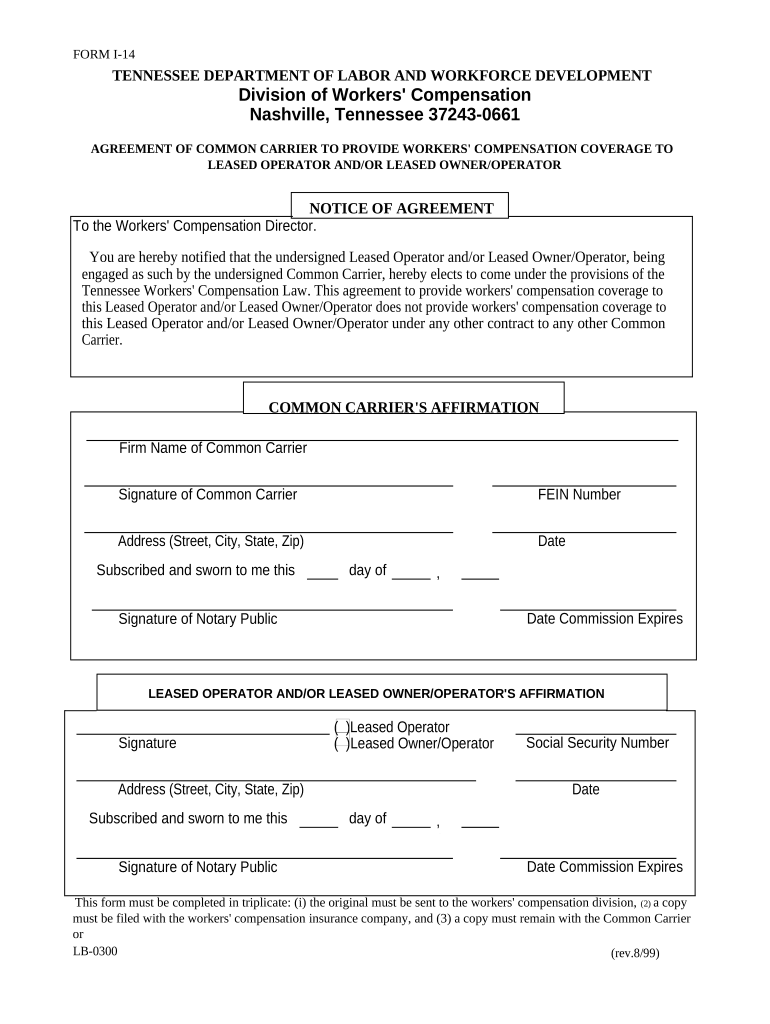
The Tennessee Agreement of Common Carrier for Workers' Compensation Coverage is a standardized contract used by common carriers and their drivers to allocate responsibility for workers' compensation benefits under Tennessee law. It documents whether an independent contractor or carrier entity will provide workers' compensation coverage for drivers performing transportation services, and it records the parties' intent, effective dates, and insurance details. The form helps clarify liability, supports insurance underwriting, and provides evidence in claim or audit situations. This guide explains required fields, completion steps, state-specific considerations, and options for electronic execution.

Why a Clear Agreement Matters in Tennessee Transport Contracts

Using a formal Tennessee Agreement of Common Carrier for Workers' Compensation Coverage reduces ambiguity about insurer responsibility, supports compliance with Tennessee workers' compensation requirements, and documents risk allocation for contracts involving drivers. Clear documentation lowers disputes and provides a record for audits or claim resolution.

Why a Clear Agreement Matters in Tennessee Transport Contracts

Typical Parties and Stakeholders

Common users include motor carriers, owner-operators, fleet managers, insurers, and counsel handling Tennessee transportation and insurance agreements.

  • Motor carriers and trucking companies documenting coverage for contracted drivers and leased operators.
  • Independent owner-operators proving they maintain workers' compensation or confirming carrier-provided coverage.
  • Insurance carriers and risk managers reviewing contractual allocation of compensability and premium responsibility.

Who Signs and What Their Role Means

Carrier Representative

A carrier's authorized representative—risk manager or operations director—who signs to confirm that the carrier will maintain workers' compensation coverage for named drivers. Authority should be documented; corporate resolutions or power of attorney may be required for insurer or corporate signers.

Owner-Operator

An individual operator or sole proprietor who may sign to accept responsibility for providing their own workers' compensation coverage. They should provide insurance policy details or a certificate of insurance showing active coverage matching the agreement dates.

Essential Data Elements to Include

Effective Date: Enter MM/DD/YYYY date format
Parties' Legal Names: Full legal entity names required
Insurance Carrier: Name of insurer on policy
Policy Number: Exact insurer policy or certificate number
Coverage Period: Policy start and end dates
Signatures and Dates: All parties sign and date

Consequences of Incorrect or Missing Information

Civil Liability: Exposure to injury claims and damages
Penalties: State fines and administrative sanctions
Uninsured Claims: Employer pays medical and wage costs
Contract Voidance: Agreement may be unenforceable if invalid
Premium Audits: Higher premiums and retroactive assessments
Reputational Risk: Loss of contracting opportunities

Common Preparation and Submission Errors

  • Using incomplete insurer details (missing policy numbers or expiration dates) leads to coverage disputes and delayed claim processing during audits or incidents.
  • Failing to verify signatory authority — corporate officers or authorized agents — can result in invalid agreements and insurer denial of coverage.
  • Entering inconsistent party names across exhibits, certificates, and riders creates ambiguity that carriers use to contest claims or coverage scope.
  • Relying on unsigned or undated signatures, initials only, or electronic acknowledgements lacking intent evidence may weaken enforceability.

Step-by-Step: Completing and Executing the Agreement

Follow these steps to complete, verify, and execute the Tennessee Agreement accurately, whether using paper or electronic signature workflows.

  • 01
    Prepare Document: Populate parties, dates, and insurance details
  • 02
    Verify Coverage: Confirm insurer name, policy, and effective dates
  • 03
    Obtain Signatures: All parties sign and date in signature block
  • 04
    Retain Records: Store originals and copies for required retention

How to Configure an Online Signing Workflow

Configure an online workflow that captures attestations, attaches insurance certificates, and enforces signer authentication for Tennessee agreements.

Field Name and Setup Instructions Configuration or validation rules for each field
Effective Date — Field Settings Use date picker; require MM/DD/YYYY format validation
Party Legal Name — Field Settings Text field; require full legal names; no abbreviations
Insurance Certificate — Attachment Field Allow PDF upload; require certificate and insurer contact details
Signature Block — Authentication Settings Enable signer email + SMS code; record audit trail

Platform Capabilities and Security to Require

Ensure your eSignature platform supports document storage, audit trails, and secure signer authentication for Tennessee workers' compensation agreements.

  • Formats: PDF, DOCX, and image support
  • Integrations: Connectors: NetSuite, Salesforce, Google Workspace
  • Security: TLS 1.2 and 1.3; AES-256 at rest

Where Completed Agreements Are Routinely Sent

This section explains where to send completed agreements, routing to insurers, employers, and retained records.

  • To Carrier: Send signed copy to insurer for policy file
  • To Driver: Provide driver a fully executed copy for personal records
  • To Employer: Retain employer copy in HR and safety files
  • For Audits: Store certificate and supporting documents centrally

Core Components of a Professional Agreement

Key elements of a complete Tennessee Agreement include party identification, insurance details, explicit coverage allocation, and signature blocks, ensuring enforceability and clarity for claims and audits.

Parties

Identify carrier, employer, driver, and any contracted entities using full legal names and addresses; include DBA names and state of registration to avoid ambiguity during claims or underwriting reviews.
Coverage

Specify whether workers' compensation is provided by the carrier or by the individual operator; attach certificate of insurance showing policy limits, insurer contact, and policy period matching agreement dates.

Policy Details

Record insurer name, policy number, limits, and effective/expiration dates; include endorsements or exclusions that alter coverage, and require updated certificates on renewal or upon requested change in operations.

Liability Allocation

Describe who is responsible for premiums, claims handling, and indemnity; state whether the agreement allocates statutory employer obligations or preserves subrogation and reimbursement rights in covered loss scenarios.

Signatures

Include signature blocks with printed name, title, date, and contact information; attach corporate authorization or power of attorney if signatory acts on behalf of a company or insurer.

Attachments

Attach proof of insurance, endorsements, and any contractual exhibits such as lease schedules or driver affidavits; clearly reference attachments in the main agreement body for enforceability.

Practical Best Practices to Reduce Disputes

Adopt these best practices to reduce disputes and facilitate electronic processing, audits, and insurer acceptance.

Verify signatory identity and authority in writing
Confirm signers are authorized corporate officers or documented agents; obtain a corporate resolution or power of attorney when required, and match printed name, title, and contact information to supporting corporate records to prevent invalidation.
Require current certificate of insurance
Require an insurer-issued certificate that lists the named insured, policy number, limits, and specific coverage period; verify endorsements that waive subrogation or add additional insureds where contractually required; reject expired certificates.
Use clear effective dates and renewal terms
State the agreement effective date, the coverage period required, and obligations on renewal or change in operations. Include deadlines for updated certificates and consequences for failure to provide timely evidence of coverage.
Preserve dispute resolution language and records
Include explicit dispute resolution, choice-of-law, and indemnity provisions; maintain complete execution records, correspondence, and certificate history. Clear contract language reduces litigation risk and supports defenses in claim audits or coverage disputes.

Illustrative Use Cases from Practice

Sample scenarios illustrate how the Tennessee Agreement is used by carriers, drivers, and insurers in contracting and claims contexts.

Case Study — Fleet

A regional motor carrier engaged independent drivers and required a clear allocation of workers' compensation responsibility when drivers used company trailers across state lines.

  • Agreement explicitly specified carrier-provided workers' compensation coverage.
  • With complete insurer details and signed certificates on file, the carrier resolved a subsequent claim without litigation, supported by audit-ready documentation and prompt claims reporting to the insurer and TDLWD as required.

Case Study — Owner-Operator

An owner-operator leased to multiple carriers and needed to document whether they carried their own workers' compensation or relied on carrier coverage for each trip.

  • Signed affidavits clarified coverage per contract.
  • Providing certificates and a signed agreement reduced payment holdbacks, allowed quick verification during audits, and established a clear record for insurance audits and any state-level inquiries regarding compensability.

Key Dates, Notices, and Deadlines to Track

Key dates and deadlines for the agreement focus on execution, insurance effective dates, renewals, and record retention obligations.

Execution Date:

Document effective date when all parties have signed

Insurance Effective Date:

Policy must be effective on or before execution date

Renewal Notice Deadline:

Require updated certificate within 30 days of renewal

Certificate Update Deadline:

Request new certificate upon insurer change or cancellation

Retention Start:

Retention begins on execution date for recordkeeping

Frequently Asked Questions and Practical Answers

Frequently asked questions address e-signature validity, notarization, signer authority, record retention, and handling disputed claims for the Tennessee Agreement.


Need help? Contact support

Pricing and Feature Comparison — signNow First

Comparison of starter pricing and common features across major eSignature vendors to inform platform selection for document execution and compliance.

signNow DocuSign Adobe Sign PandaDoc HelloSign
Starting Price $8/user/mo $15/user/mo $14/user/mo $19/user/mo $15/user/mo
Free Trial 7-day free trial Varies Varies Varies Varies
Bulk Send Yes Varies Varies Varies Varies
Audit Trail Yes Yes Yes Yes Yes
HIPAA Compliant Yes Varies Varies Varies Varies
Envelope Cap No cap 100 envelopes/user/year Varies Varies Varies
be ready to get more
Join over 28 million airSlate SignNow users