Establishing secure connection…Loading editor…Preparing document…

Contract Between Landowner and Contractor to Swath Hay

This template is fully customizable. Edit the text, fill out the fields, and send it for signature. Give it a try!
Contract Between Landowner and Contractor to Swath Hay

What this Contract Covers and when to use it

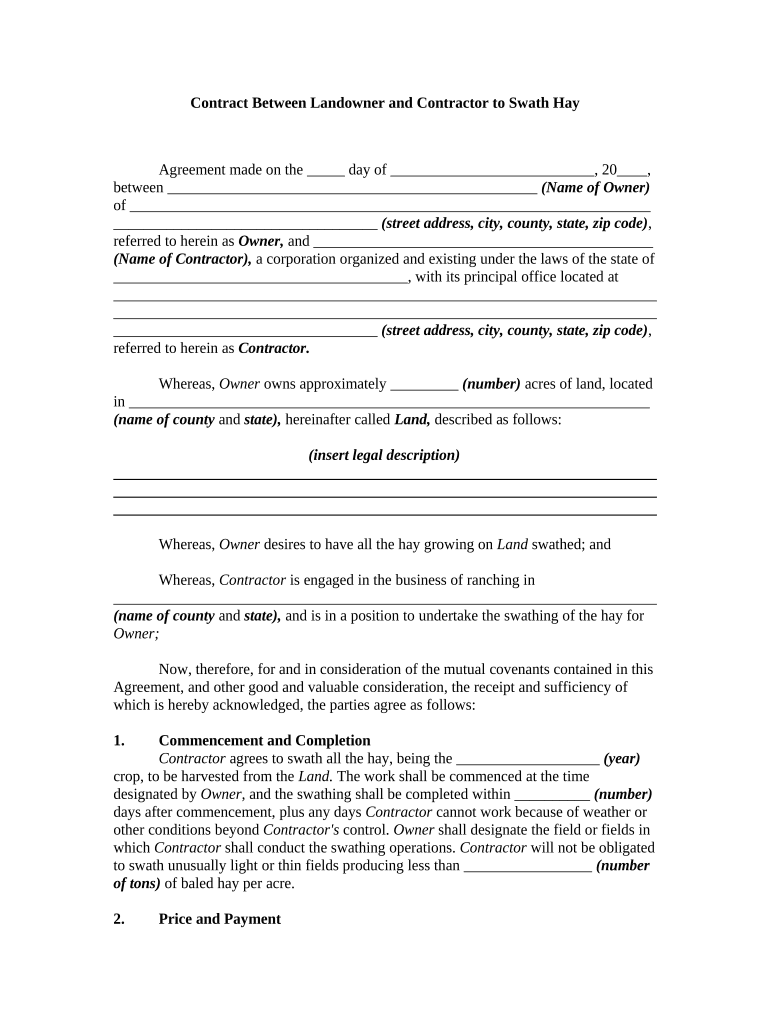
The Contract Between Landowner and Contractor to Swath Hay is a written agreement that sets out the scope, timing, payment, and liability terms for cutting and swathing hay on a specified parcel. It allocates responsibilities between the landowner (who provides access and any necessary permissions) and the contractor (who provides labor, equipment, fuel, and operators). Typical provisions include field identification, acres to be swathed, equipment specifications, payment rate or acreage charges, timing and weather contingencies, damage and indemnity clauses, insurance requirements, and termination rights.

Why a written swathing contract matters

A clear contract reduces disputes by documenting expectations for timing, payment, and risk allocation, and it clarifies who is responsible for equipment, fuel, and crop damage. Well-drafted terms also help establish insurance coverage and permit compliance with any local land-use restrictions.

Why a written swathing contract matters

Who typically signs a swathing contract

Parties should confirm signatory authority and insurance coverage before work begins to avoid delays and liability gaps.

  • Independent contractors and custom haying operators who provide equipment and crews to swath fields.
  • Landowners or lessees who need hay cut and prepared and who control access to the fields.
  • Agricultural managers or farm operators coordinating multiple fields, contractors, or harvest windows.

Signatory roles and typical authorizers

Landowner / Lessor

An individual or business that owns or leases the parcel and grants access for swathing; must have authority to allow agricultural operations and to accept liability terms on behalf of the property.

Contractor / Custom Harvester

Company or independent operator that supplies equipment and labor; signatory should be an authorized representative with power to bind the business to payment, indemnity, and insurance commitments.

Essential contract elements to include

A professional swathing agreement balances operational detail with legal clarity. Include items below as core sections to reduce ambiguity and support enforceability.

Parties and Property

Full legal names, contact details, and a clear legal description or map of the field(s) to be swathed, including parcel ID or GPS references when available.
Scope of Work

Detailed tasks (swathing height, windrow width, straw handling), equipment to be used, expected acres per day, and any included post-cut services such as raking or baling coordination.

Timing and Weather

Start and end dates, allowable weather delays, notice periods for postponement, and how frost or rain days affect scheduling and payment.

Payment Terms

Rate structure (per acre, per hour, per field), deposit or retainer, invoicing cadence, payment due days, and late fee or interest provisions.

Liability and Insurance

Indemnity clauses allocating responsibility for crop damage, equipment damage, and third-party claims; required insurance limits and certificates to be provided before work.

Termination and Remedies

Grounds for termination, cure periods, final accounting on termination, and procedures for resolving disputes (mediation, governing law).

Step-by-step: completing and executing the contract

Follow this sequence to prepare, agree, and record the swathing contract to minimize delays and disputes.

  • 01
    Prepare Draft: Complete party and field details, scope, and price
  • 02
    Review Insurance: Confirm contractor's certificate and required policy limits
  • 03
    Agree Schedule: Set start window and weather contingency rules
  • 04
    Sign and Exchange: Execute signatures, distribute countersigned copies

Where to send the finished contract and key routing steps

Determine the authoritative repository and required recipients before signing to ensure notice and compliance with contract obligations.

  • Landowner Copy: Provide a signed original or certified electronic copy to the landowner for records
  • Contractor Copy: Contractor retains signed copy for insurance and invoicing
  • Insurance Provider: Send certificate of insurance to landowner or their agent when required
  • Accountant / Bookkeeper: Forward final signed contract for tax and recordkeeping purposes

Configuring an online signing workflow for this contract

Set up digital fields and signer order to reflect the on-paper flow and to capture required evidence of consent and attribution.

Field Configuration
Signature Required for Landowner then Contractor
Date Auto-fill MM/DD/YYYY on signing
Insurance Upload Required file attachment before signing
Notices Enable delivery confirmation to all parties

Digital signing considerations and technical prerequisites

Ensure the selected vendor supports retention, tamper-evident signed copies, and any industry compliance such as HIPAA if health data is involved.

  • File Formats: PDF and Word DOCX supported
  • Integrations: Works with Google Workspace, Microsoft 365, and NetSuite
  • Authentication: Email link or SMS code; stronger 2FA for higher assurance

Timing expectations, notice periods, and common deadlines

Define dates that trigger work, payments, and termination rights to avoid misunderstandings and to support recordkeeping.

Start Window:

Specify start range and firm start date

Weather Notice:

Require X hours notice before weather delay

Payment Due:

Net 15 or Net 30 from invoice date

Insurance Proof:

Certificate required before work begins

Termination Notice:

Provide written notice and specified cure period

Key milestones from agreement to completion

Track milestones as a sequence to coordinate field access, equipment arrival, and final inspection.

01

Agreement Signed

Contract executed and effective; insurance proof due

02

Pre-Work Inspection

Walk field, mark exclusions, confirm access routes

03

Swathing Operations

Contractor completes swathing per scope

04

Final Acceptance

Landowner inspects and signs off; final payment issued

Practical tips for a smoother swathing engagement

Small changes in drafting and operations reduce disputes and speed completion.

Clarify Boundaries
Use maps or GPS markers to precisely identify work areas and avoid accidental trespass.
Document Condition
Photograph fields before work to record pre-existing damage and prevent later disagreements.
Define Delays
Specify acceptable weather and mechanical delay rules, including make-good or rescheduling options.
Keep Records
Retain signed contracts, invoices, and insurance certificates for the recommended retention period.

Information to collect and retain with the contract

Legal Names: Full party name
Contact Info: Phone, email, mailing address
Field ID: Parcel number or GPS
Insurance: Carrier and policy limits
Payment Terms: Rate and due date
Signatures: Signed and dated record

Common mistakes to avoid when preparing this contract

  • Leaving the field description vague, causing scope disputes
  • Failing to require proof of insurance before work begins
  • Not specifying weather or delay procedures in writing
  • Using verbal rate agreements without written confirmation

Primary legal and financial risks from errors

Property Damage: Liability for damage if contractor negligence is proven
Uninsured Losses: No recovery if required insurance is absent
Payment Disputes: Late payments can trigger interest or lien claims
Invalid Signatures: Improper signature method may affect enforceability
Breach Remedies: Contract may allow termination and damages
Recordkeeping Failure: Missing records complicate audits or claims

Real-world examples of contract use

Two brief scenarios show how clauses are applied and why specific provisions mattered in practice.

Custom Harvester Engagement

A landowner hired a custom harvester for 120 acres

  • Contractor required to provide COI with specified limits
  • The insurance clause prevented a $12,000 out-of-pocket cost after a tractor tire damaged irrigation equipment when contractor's insurer covered the claim.

Weather Contingency Dispute

A contractor delayed start due to heavy rain

  • Contract required 48-hour weather notice and make-up days
  • Clear notice and reschedule terms reduced a payment dispute and preserved the working relationship.

eSignature vendor comparison for signing and storing the contract

Compare baseline pricing and core features for common eSignature vendors; signNow is listed first per available plan data.

signNow DocuSign Adobe Sign PandaDoc HelloSign
Starting Price $8/user/mo $15/user/mo $14/user/mo $19/user/mo $15/user/mo
Free Trial 7-day free trial, no credit card Varies by plan Varies by plan Varies by plan Varies by plan
Bulk Send Yes (Business Premium) Yes Yes Yes No
Audit Trail Yes Yes Yes Yes Yes
HIPAA Compliant Yes (BAA available) Yes Yes No No
Envelope Cap No envelope cap 100 envelopes/user/year Varies by plan Varies by plan Varies by plan

Frequently asked questions about this swathing contract

Answers to common execution, insurance, and signature questions to help parties avoid delays or invalidation.


Need help? Contact support

be ready to get more
Join over 28 million airSlate SignNow users