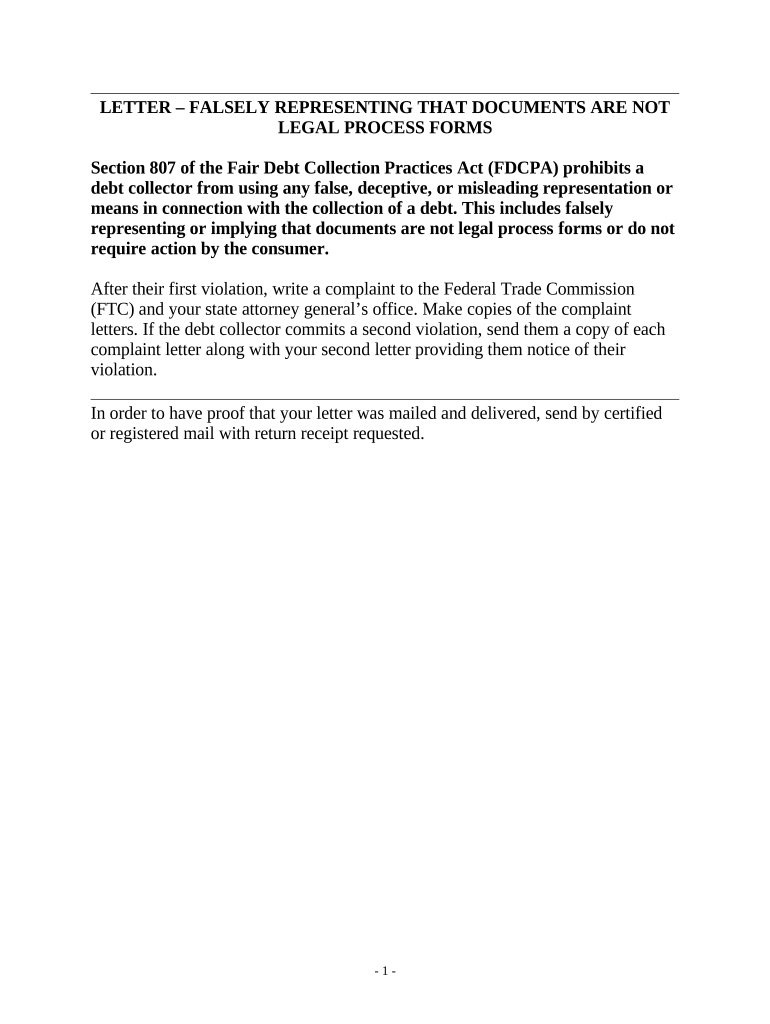
Debt Collector Action
What a Debt Collector Action Is and when it’s used
Why a clear Debt Collector Action matters
A precise, compliant Debt Collector Action protects procedural rights, supports enforceability in court, and documents the creditor’s attempts to collect while demonstrating adherence to statutory notice and validation requirements under federal and state law.
Who prepares and signs Debt Collector Actions
Typical users include creditors, internal collections teams, third‑party collection agencies, and attorneys who handle consumer or commercial debt recovery.
- In‑house collections teams managing receivables and account reconciliations for businesses
- Third‑party debt collectors acting under assignment or agency agreements
- Attorneys filing suit or preparing statutory validation and settlement correspondence
Use appropriate signatory authority and retain supporting records to show chain of assignment, authorization, and the method and date of delivery.
Step-by-step: prepare and issue a Debt Collector Action
-
01Gather records: Collect contracts, statements, ledgers, and assignment paperwork.
-
02Draft notice: Include amount, account details, and validation language.
-
03Select delivery: Choose certified mail, personal service, or permitted electronic methods.
-
04Record evidence: Keep proof of delivery, timestamps, and copies of the signed document.
Configuring a digital workflow for Debt Collector Actions
| Field | Configuration |
|---|---|
| Signature | Required, signer name and date fields |
| Authentication | Email link or SMS code for primary signer |
| Attachments | Attach account statements and assignment docs |
| Audit settings | Enable IP, timestamp, and action logs |
Where to file or send a Debt Collector Action
-
Pre‑litigation demand: Send by certified mail or permitted e‑service with return receipt.
-
Court filing: File in the jurisdiction where debtor resides or contract was performed.
-
Third‑party service: Use licensed process servers for personal service where required.
-
Electronic delivery: Use consented e‑delivery methods where state law allows.
Digital delivery and eSubmission considerations
Ensure the signing platform supports required authentication, audit trails, and permitted document formats for your jurisdiction.
- Authentication: Email + SMS codes or KBA as required
- Integrations: CRM and storage connectors for records
- Formats: PDF, DOCX supported for court copies
Retain completed documents and metadata in secure storage with export options for printing, e‑filing, or discovery; confirm platform meets any industry compliance needed for health or financial data.
Key timelines and consumer response windows
Validation dispute window:
Consumer has 30 days to dispute under 15 U.S.C. §1692g.
Response to dispute:
Collector must cease collection until verification is provided.
Court filing timing:
File suit before the applicable state statute of limitations expires.
Notice delivery proof:
Retain return receipt or electronic delivery logs.
Retention start date:
Dates on notices determine retention and discovery ranges.
Penalties and risks from improper Debt Collector Actions
Common preparation errors to avoid
- Failing to attach or preserve account histories that substantiate the amount claimed results in disputes and higher legal costs.
- Using imprecise validation language that omits required consumer notices can trigger FDCPA claims and delay collection efforts.
- Serving notices without signed proof of delivery or reliable electronic audit trails weakens court filings and collection leverage.
- Mismatching creditor names, assignments, or chain‑of‑title documents leads to jurisdictional challenges and dismissal risks.
eSignature vendor comparison for Debt Collector Actions
| signNow | DocuSign | Adobe Sign | PandaDoc | HelloSign | |
|---|---|---|---|---|---|
| Starting Price | $8/user/mo | $15/user/mo | $14/user/mo | $19/user/mo | $15/user/mo |
| Free Trial | 7-day trial | Varies | Varies | Varies | Varies |
| Bulk Send | Yes | Yes | Yes | Yes | Yes |
| Audit Trail | Yes | Yes | Yes | Yes | Yes |
| HIPAA Compliant | Yes (BAA) | Yes (BAA) | Yes (BAA) | No | No |
Real-world examples applying Debt Collector Actions
Optica Ventures LLC
A small portfolio manager standardized demand letters and attachments to reduce disputes and improve clarity.
- Implementation used templated account ledgers and validation notices to preempt consumer challenges.
- The result improved internal processing and customer response times without increasing legal escalations, while preserving documentation for potential litigation.
Martin Properties
A regional landlord deployed digital demand workflows for unpaid rent and fees.
- They included precise ledger attachments and signature blocks.
- This allowed faster resolution of accounts, easier tracking of service dates, and reduced the need for in‑person signings while maintaining compliance with notice requirements.
Practical tips for efficient, defensible Debt Collector Actions
Who is authorized to sign and their roles
Collections Manager
Typically an employee with delegated authority to send notices and negotiate settlements; must be listed in internal delegation policies and match signature block authority for enforceability.
Authorized Agent
Law firm or third‑party collector acting under written assignment or power of attorney; include proof of agency or assignment when filing or serving.
Frequently asked questions about Debt Collector Actions
-
What if the consumer disputes the debt?
If a consumer disputes within 30 days of a validation notice, cease collection efforts until you provide verification. Retain all validation documents and correspondence as evidence.
-
Is electronic delivery acceptable?
Electronic delivery is acceptable where the consumer consented and state law permits. Preserve evidence of consent and delivery per ESIGN (15 U.S.C. §7001) and UETA.
-
When is notarization required?
Notarization is rarely required for demand letters but may be needed for affidavits, assignments, or court filings; check local court rules before relying on notarization.
-
How long must I keep records?
Retain account records for at least three years for tax purposes and longer if litigation is likely; HIPAA or other industry rules may require extended retention.
-
What authentication level is recommended?
Use at least email+SMS or KBA for consumer‑facing debt notices; stronger authentication reduces fraud risk and improves evidentiary value.
-
Can I use a third‑party eSignature provider?
Yes, choose a provider that supports ESIGN/UETA, audit trails, and a BAA if handling protected health information.