Establishing secure connection…Loading editor…Preparing document…

Declaratory Judgment

This template is fully customizable. Edit the text, fill out the fields, and send it for signature. Give it a try!
Declaratory Judgment

What a Declaratory Judgment Is and When It’s Used

A declaratory judgment is a court determination that resolves legal uncertainty by declaring the rights, duties, or legal relations of parties without ordering affirmative relief like damages or injunctions. Courts issue declaratory relief when there is a justiciable controversy requiring clarification—for example, contract interpretation, statutory construction, or patent scope. Parties often seek declaratory judgments to prevent harm, obtain legal certainty before acting, or remove the threat of litigation. Procedures, filing requirements, and available relief vary by jurisdiction and by whether the action proceeds in federal or state court.

Why Parties Use a Declaratory Judgment

A declaratory judgment provides legal certainty without waiting for the other party to sue, can stop threatened enforcement, and clarifies ambiguous rights before costly performance or compliance decisions are made.

Why Parties Use a Declaratory Judgment

Who Typically Prepares or Files This Document

Filers should confirm local court rules and standing requirements before initiating a declaratory action.

  • Plaintiff attorneys and litigants seeking interpretation or validation of rights.
  • Corporate or in-house counsel resolving contract, IP, or regulatory ambiguity.
  • Regulated parties (manufacturers, healthcare providers) facing enforcement threats.

Who Signs and Who Files

Plaintiff Attorney

An attorney for the party seeking relief signs the filing papers and verifies facts under penalty of perjury. The attorney typically certifies compliance with service and local court rules and provides the court with a proposed order when requested.

Corporate Counsel

In corporate matters, an authorized officer may execute verification or corporate certification. Corporate counsel often drafts the complaint, confirms authority to sue, and ensures internal approvals and board resolutions are in place when required.

Core Components of a Professional Declaratory Judgment Filing

A clear, well-organized complaint improves the chance of proceeding and reduces jurisdictional challenges.

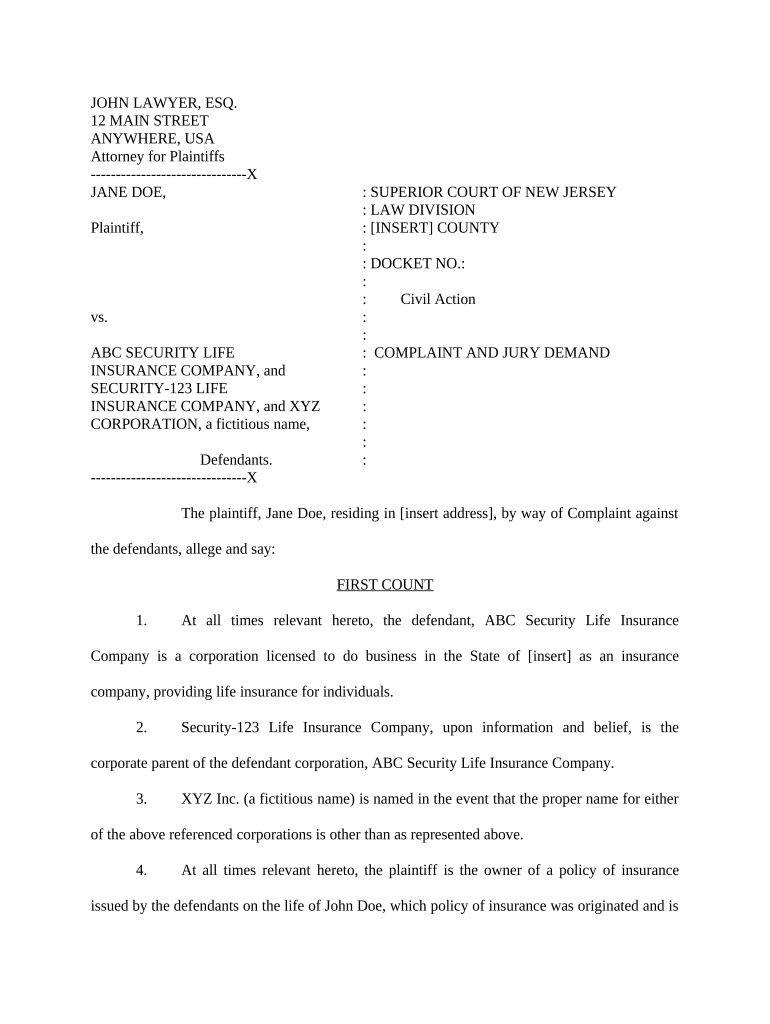
Caption

Court name, docket block, party names and addresses presented exactly as required by local rules.
Jurisdiction

Statement of subject-matter and personal jurisdiction, plus venue basis and statutory authority for declaratory relief.

Parties

Full legal names and capacities (e.g., 'ABC Corp., a Delaware corporation') with service addresses and registered agent if applicable.

Statement of Facts

Concise factual background establishing an actual controversy and the conduct giving rise to dispute.

Cause of Action

Count asserting entitlement to a declaratory judgment and any related claims (e.g., breach, non-infringement).

Relief Requested

Specific declarations sought, any ancillary declarations (e.g., interpretation), and request for costs or attorney fees if authorized.

Step-by-Step: Preparing and Filing a Declaratory Complaint

Follow a consistent sequence to prepare, verify, serve, and file to reduce procedural risk.

  • 01
    Draft Complaint: Prepare facts, claims, and declarations succinctly.
  • 02
    Confirm Jurisdiction: Verify venue and standing requirements.
  • 03
    Verify & Sign: Signer executes verified complaint and any accompanying affidavits.
  • 04
    File and Serve: Submit to court and complete service per rules.

Setting Up an Online Review and Signature Workflow

Digital workflows reduce turnaround time but must respect judicial filing and service rules.

Field Configuration
Document Upload PDF/A preferred with searchable text
Signature Fields Place signer name, signature, and date fields
Authentication Method Email or SMS code; stronger authentication for counsel
Audit Trail Enable IP, timestamp, and action logs

Where to File and How the Case Proceeds

Filing and post-filing steps vary by court; the following describes the typical routing from filing to initial disposition.

  • File Complaint: Clerk accepts electronic or paper original
  • Service: Serve defendants per state or federal rules
  • Response: Defendant files answer or motion
  • Court Decision: Judge issues declaratory ruling or dismisses

Digital Signing and eSubmission: Platform Considerations

Confirm court e-filing rules; save notarizations and sealed exhibits according to local requirements.

  • File Formats: PDF and DOCX accepted
  • Authentication: Email/SMS or advanced options
  • Audit Trail: IP, timestamp, event log

eSignature Vendor Pricing Snapshot for Court Filings and Execution

Compare common eSignature pricing and compliance features relevant to preparing and executing legal filings. Confirm plan details with each vendor before purchase.

signNow DocuSign Adobe Sign PandaDoc HelloSign
Starting Price $8/user/mo $15/user/mo $14/user/mo $19/user/mo $15/user/mo
Free Trial 7-day free trial No No No No
Bulk Send Yes Yes Yes Yes No
Audit Trail Yes Yes Yes Yes Yes
Envelope Cap No cap 100 envelopes/user/year Varies Varies Varies

Security and Compliance Essentials for Legal Filings

Encryption: TLS 1.2/1.3 in transit, AES-256 at rest
Certifications: SOC 2 Type II and ISO 27001
HIPAA Support: HIPAA compliant; BAA required
ESIGN & UETA: Compliant with ESIGN and UETA frameworks
21 CFR Part 11: Supports FDA-regulated record requirements
Accessibility: WCAG 2.0 Level AA accessibility support

Consequences of Errors in Declaratory Filings

Dismissal Risk: Lack of jurisdiction
Service Defect: Improper service invalidates proceedings
Statute Problems: Expired limitations bar relief
Sanctions: Frivolous filings may trigger sanctions
Evidentiary Loss: Poor records harm appeals
Unenforceable: Overbroad declarations may be denied

Common Preparation Mistakes to Avoid

  • Filing before confirming a ripe, justiciable controversy; courts dismiss cases that present abstract or hypothetical disputes.
  • Using vague relief language; unspecific or overly broad declarations are frequently narrowed or denied by judges.
  • Failing to verify party identities and capacities; wrong-party pleadings cause service and jurisdictional complications.
  • Neglecting to follow local formatting or e-filing rules; clerks often reject or return nonconforming submissions.

Real-World Examples of Digital Signature Use in Legal Workflows

Signatures and compliance controls help legal teams prepare and execute filings while preserving audit trails and security.

BIS (Dan Rotelli, CEO)

Law and compliance workflows needed secure e-signatures to meet regulatory standards.

  • We required SOC 2-level assurance and ESIGN/UETA compliance.
  • The team emphasized audit trails and certification when preparing verified filings to courts and regulators, improving internal confidence in digital execution while preserving admissibility.

Fertility Centers of Illinois (John Butler)

Healthcare provider needed secure, compliant signing for patient and institutional consents.

  • HIPAA concerns required careful handling of PHI.
  • Using audited digital signatures and BAAs enabled remote execution of consent forms and institutional certifications while retaining required retention and audit records for regulatory review.

Practical Tips for Accurate and Efficient Completion

Implement quality controls and a consistent checklist to reduce rejections and procedural delays.

Use a Filing Checklist
Create a jurisdiction-specific checklist covering caption, service methods, required exhibits, and local formatting to ensure every required element is included before submission.
Validate Party Information
Confirm legal names, capacities, and service addresses against corporate records or registrations to prevent service defects and subsequent motions to dismiss.
Preserve Audit Trails
When using electronic signatures, enable full audit logging (IP, timestamp, authentication) and retain originals in searchable PDF/A format for evidentiary purposes.
Coordinate Counsel and Clients
Obtain internal approvals, board resolutions, or authority letters before filing; document signer authority to avoid later challenges to standing or capacity.

Time-Sensitive Considerations and Typical Deadlines

Be aware of statute-of-limitations, service timelines, and local scheduling orders that affect case progression and potential relief.

Statute of Limitations:

Varies by claim type and state; commonly 2–6 years depending on the underlying cause

Service Deadline:

Follow state or federal rules for timely service after filing

Response Period:

Defendants typically have 20–30 days to respond in many jurisdictions

Motion Deadlines:

Local rules set briefing and motion scheduling intervals

Appeal Timeframe:

Post-judgment appeal windows vary by court and should be monitored

Frequently Asked Questions About Declaratory Judgments

Answers to common procedural and practical questions when preparing or filing a declaratory complaint.


Need help? Contact support

be ready to get more
Join over 28 million airSlate SignNow users