Establishing secure connection…Loading editor…Preparing document…

Deed of Gift of Property

This template is fully customizable. Edit the text, fill out the fields, and send it for signature. Give it a try!
Deed of Gift of Property

What a Deed of Gift of Property Is and why it matters

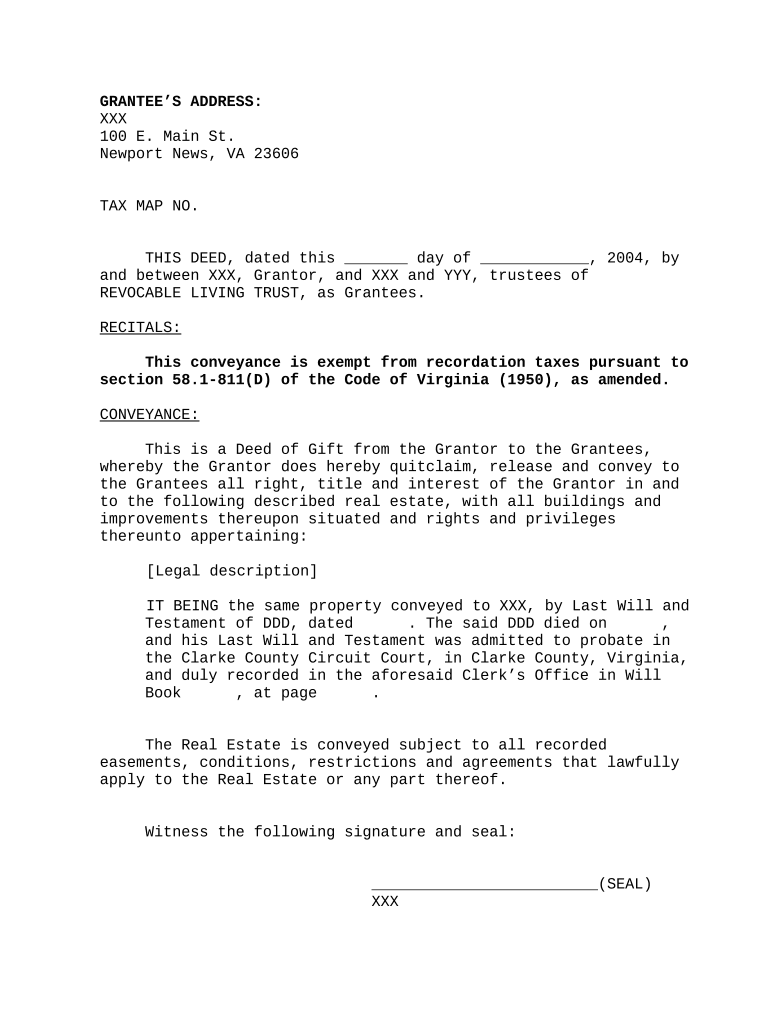
A Deed of Gift of Property is a legal instrument used to transfer ownership of real property from a donor (grantor) to a donee (recipient) without monetary consideration. The document identifies the parties, contains the property's full legal description, states the grantor's intent to give ownership, and includes an acknowledgement suitable for recording. Proper execution, notarization, and county recording are typically required to protect title, establish public notice, and avoid later disputes about ownership or conveyance history.

When this deed is the right tool

Use a Deed of Gift when you intend to transfer real property voluntarily and without a sale, for example transferring a family home to a relative or donating land to a nonprofit. It documents the donor's clear intent and creates an official record once recorded with the county.

When this deed is the right tool

Who commonly prepares and signs a Deed of Gift

Several parties typically interact with a Deed of Gift: the donor, the recipient, real estate attorneys, and the county recorder's office.

  • Donors and donees: Individuals transferring or receiving property, ensuring identity and intent are documented and recorded.
  • Real estate attorneys: Draft and review legal description, tax, and title implications to reduce future disputes.
  • County recorders / title companies: Review, accept recording, and update public title records after proper acknowledgement.

Each participant has specific responsibilities—donor for accurate statements and signatures, attorney for legal sufficiency, and recorder for acceptance—so coordinate early to avoid recording delays.

Core sections you should include in a professional deed

A complete Deed of Gift of Property includes several standard clauses that create a clear, recordable transfer and protect all parties' interests.

Grantor Identity

Full legal name and capacity of the person making the gift; include marital status if community property issues may apply.
Grantee Identity

Full legal name of the recipient and their contact or mailing address for future notices and tax correspondence.

Legal Description

Complete legal description of the parcel (lot, block, subdivision, or metes and bounds) as used by the county assessor and recorder.

Consideration Clause

Statement that the conveyance is by gift, often phrased as 'for no monetary consideration' or 'for natural love and affection.'

Habendum/Warranty

Defines estate granted (fee simple, etc.) and any limited warranties; warranty language affects future title insurance and liability.

Acknowledgement

Notary block and witness lines as required by state law so the deed can be recorded with the county recorder.

Step-by-step: executing and recording a Deed of Gift

Follow these steps in order to complete a valid deed transfer and provide clear public notice through county recording.

  • 01
    Draft the deed: Prepare deed with full legal description and gift language.
  • 02
    Review title: Obtain title report to confirm ownership and any encumbrances.
  • 03
    Sign before notary: Grantor signs in notary presence and any required witnesses sign.
  • 04
    Record the deed: Submit to county recorder with applicable fees and transfer tax forms.

Where the deed goes after signing

After execution, the deed typically follows a short routing path to become effective and visible in public records.

  • Notary acknowledgement: Notary completes certificate and affixes seal and signature.
  • County recorder: Recorder accepts and stamps the deed, assigns instrument number.
  • Title company update: Title insurer or company updates the title file and issues new reports.
  • Deliver original: Original recorded deed returned to grantee or as directed by parties.

Configuring a digital workflow for the Deed of Gift

Set up an online signing workflow that enforces required fields, identity checks, and final delivery to the recorder or title company.

Field Configuration
Signature field Require signer's signature and date with attachment option for ID.
Notary block Add a fixed notary acknowledgement block to preserve formatting.
Conditional witness fields Show witness signature lines only if state requires them.
Delivery Set final recipient as grantee and title company or recorder email.

Digital signing considerations and technical compatibility

Use an eSigning platform that supports PDF/Word, audit trails, and integrations with storage or title systems.

  • Integrations: Salesforce, NetSuite, Google Workspace supported
  • File formats: PDF and DOCX are supported formats
  • Authentication: Email, SMS code, or advanced signer authentication

Ensure the platform can deliver a tamper-evident final PDF, store the audit trail, and provide a copy for recorder or title insurers.

Timing to expect during execution and filing

Different actions have different practical timelines—factor these into closing or transfer schedules to avoid delays.

Signing appointment:

Schedule notary and any required witnesses in advance.

Recording submission:

Submit to county recorder promptly; same-day recording possible in many counties.

Recorder processing:

Processing varies from same-day to several weeks depending on county workload.

Gift tax return:

If required, Form 709 is due with your annual tax return (April 15).

Title update:

Title reports typically reflect recording within 1–4 weeks.

Notarization and witness flow for recording

Follow this authentication sequence to meet most state recording requirements for deeds.

01

Identify signers

Verify the grantor's identity with government ID.

02

Prepare document

Document must include notary block and witness lines if required.

03

Sign in presence

Grantor signs before the notary and witnesses, when required.

04

Notary completes certificate

Notary records date, seal, and confirmation of identity.

05

Witness attestations

Witnesses sign and provide printed names and addresses as required.

06

Optional RON

If permitted, remote online notarization may be used following state RON rules.

07

County acceptance

Submit original executed deed to recorder with fee.

08

Return

Recorded deed returned to grantee or designated recipient.

Common mistakes that lead to rejections or disputes

  • Incorrect legal description leads to recording rejection and title issues.
  • Mismatched names between ID and deed delay notarization or acceptance.
  • Missing notary seal or incomplete acknowledgement invalidates the recording.
  • Failure to record creates risk of competing claims and unclear title.

Risks and legal consequences of an incorrect deed

Unrecorded transfer: Title disputes and priority problems
Gift tax exposure: May require Form 709 filing
Title defects: Cloud on title and difficulty selling
Invalid notarization: Recording refusal or later challenge
Improperly described property: Ambiguity and boundary disputes
Missing signatures: Deed can be voided or set aside

Practical examples of Deed of Gift use

These scenarios illustrate common, lawful uses of a Deed of Gift and the steps typically followed.

Family transfer

A parent transfers a vacation home to an adult child to simplify estate planning

  • gift avoids sale and closing costs
  • the deed was drafted with precise legal description, notarized, recorded at the county, and the donor filed Form 709 where required to report the gift.

Charitable donation

An owner conveys a parcel to a nonprofit for conservation purposes

  • transfer documented by Deed of Gift with acceptance clause
  • the nonprofit requested a title report, accepted the recorded deed, and recorded conservation easement documentation to preserve the gift's purpose.

eSignature vendor comparison for executing and delivering deeds

Platform pricing and feature availability affect cost and workflow. The table compares common criteria for deed execution and secure delivery; signNow is listed first as the baseline.

signNow DocuSign Adobe Sign PandaDoc HelloSign
Starting Price $8/user/mo $15/user/mo $14/user/mo $19/user/mo $15/user/mo
Free Trial 7-day free trial Varies Varies Varies Varies
Bulk Send Yes (Business Premium) Yes Yes Yes Limited
Audit Trail Yes Yes Yes Yes Yes
HIPAA Compliant Yes Yes Yes No No

Frequently asked questions about Deed of Gift of Property

Answers to common practical and legal questions when preparing, signing, and recording a Deed of Gift of Property.


Need help? Contact support

be ready to get more
Join over 28 million airSlate SignNow users