Establishing secure connection…Loading editor…Preparing document…

Defamation Notice

This template is fully customizable. Edit the text, fill out the fields, and send it for signature. Give it a try!
Defamation Notice

What a Defamation Notice Is and When it’s Used

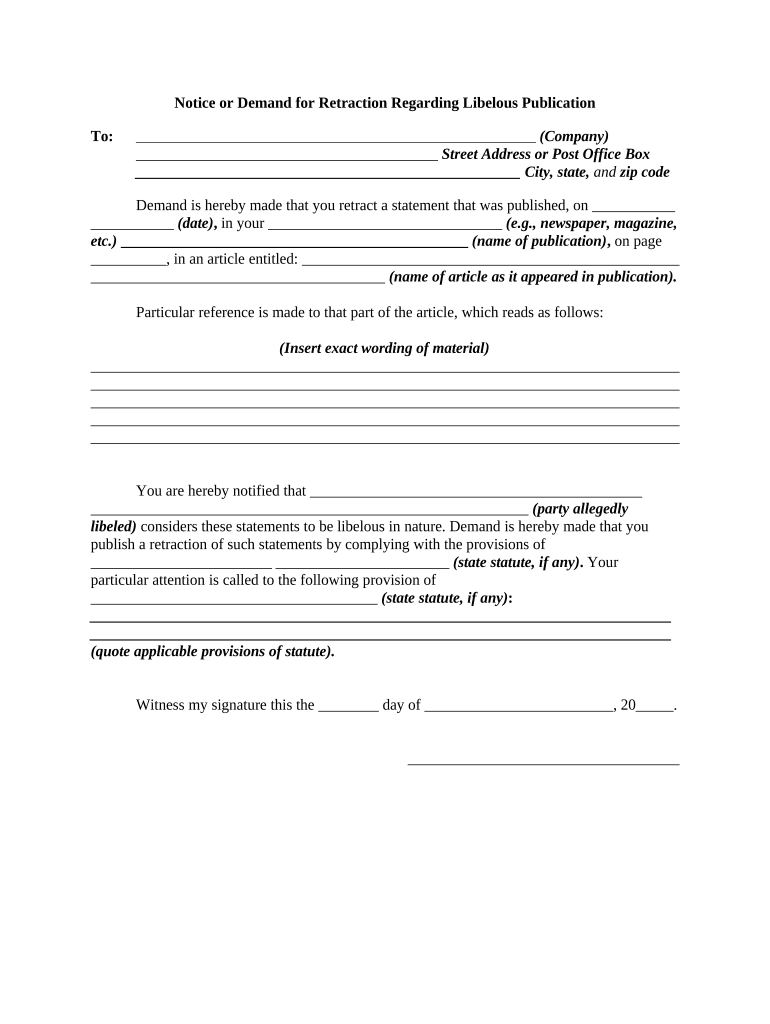
A Defamation Notice is a written demand sent to a person or organization that has published false or injurious statements about an individual or business. The notice identifies the specific statements, explains why they are false or harmful, requests correction or retraction, and often sets a reasonable deadline for response. It preserves a factual record, gives the recipient an opportunity to correct the record before litigation, and documents the claimant’s position. A Defamation Notice is not a complaint filed in court but is commonly used as a pre‑suit step in civil defamation matters.

Why sending a Defamation Notice matters

A clear Defamation Notice narrows disputes, documents the alleged harm, and can reduce damages if the recipient promptly corrects the record. It creates a formal record of your demand without immediately initiating litigation.

Why sending a Defamation Notice matters

Who typically sends or receives a Defamation Notice

Common senders include individuals, business owners, and counsel seeking corrective action or preserving remedies.

  • Private individuals asserting reputational harm, often seeking retraction or apology.
  • Small and medium businesses protecting brand reputation and customer trust.
  • Attorneys representing claimants or advising on pre‑suit strategy and mitigation.

Step-by-step: preparing and sending a Defamation Notice

Follow a concise, documented workflow to preserve evidence and maximize the notice’s effectiveness.

  • 01
    Identify statements: List exact quotations, URLs, dates, and publication channels.
  • 02
    Gather evidence: Capture screenshots, metadata, and witness contact details.
  • 03
    Draft notice: State falsity, requested remedy, and a clear deadline.
  • 04
    Deliver and confirm: Send by verifiable method and retain proof of delivery.

How to set up an online workflow for a Defamation Notice

Configure a digital workflow that captures evidence, automates delivery, and stores a verifiable audit trail.

Field Configuration
Delivery method Certified mail, email with read receipt, or registered platform delivery
Authentication Attach ID when needed; use multi‑factor for sensitive claims
Retention Retain copies and audit logs for statutory retention period
Attachments Include screenshots, export metadata, and witness statements

Digital signing and delivery requirements

Choose a platform that preserves an immutable audit trail, supports common file formats, and meets applicable compliance needs.

  • File formats: PDF, DOCX accepted
  • Authentication: Email link, SMS code, or ID verification
  • Audit trail: Timestamp, IP, and action log

Where to send a Defamation Notice

Select recipients and delivery channels that create verifiable proof of receipt and target parties with control over the content.

  • Author contact: Send notice to the individual who authored the statement.
  • Publisher or host: Address the owner or moderator of the website or publication.
  • Platform compliance: Use platform takedown or report channels when available.
  • Legal counsel: Copy your attorney for recordkeeping and escalation.

Key timelines and response expectations

Timing matters: preserve evidence immediately, set a reasonable response deadline, and be mindful of state statutes of limitation.

Preserve evidence promptly:

Capture screenshots and metadata immediately after discovery.

Response deadline:

Commonly set 10–30 days for recipient to respond.

Platform windows:

Content hosts may take 7–30 days to review notices.

Statute of limitations:

Varies by state; commonly one to three years.

Counsel engagement:

Seek legal advice within 30–60 days of discovery.

Typical milestone timeline for a Defamation Notice

Sequential milestones clarify actions and deadlines from discovery through possible filing.

01

Draft and document

Prepare notice and assemble supporting evidence for accuracy.

02

Deliver and confirm

Serve the notice using a verifiable method and retain proof.

03

Await response

Monitor for retraction, correction, or denial; document communications.

04

Escalate if needed

If unresolved, consult counsel about pre‑suit or filing options.

Information security and compliance when handling notices

Encryption in transit: TLS 1.2/1.3
Encryption at rest: AES‑256
Privacy frameworks: HIPAA BAA where PHI exists
Audit trail: Tamper‑evident time stamps
Access controls: Role‑based permissions
Certifications: SOC 2 Type II, ISO 27001 compliant

Risks and consequences of incorrect or premature notices

Monetary damages: Potential compensatory damages
Punitive awards: Possible in malicious cases
Attorney fees: Significant legal costs may follow
Counterclaims: Risk of countersuit for false allegations
Anti‑SLAPP impact: State anti‑SLAPP laws can affect remedies
Spoliation sanctions: Obliterating evidence can lead to sanctions

Common mistakes to avoid when preparing a Defamation Notice

  • Alleging falsity without specifics: vague or conclusory language makes the claim hard to verify or enforce and weakens credibility.
  • Sending to the wrong recipient: address the publisher or host with control over the content to improve chances of correction.
  • Failing to preserve metadata: screenshots without metadata can be challenged; capture timestamps and URL details when possible.
  • Using inflammatory language: escalatory tone can provoke countersuits and reduce the chance of an amicable resolution.

Realistic examples of Defamation Notice use

These examples show how a notice is used in different settings and what outcomes are commonly sought.

Individual claimant

A professional discovers false allegations online about business conduct

  • Seeks retraction and correction
  • The notice documents the falsity, requests removal within 14 days, and preserves evidence for possible civil action if not corrected.

Small business

A local business faces false online reviews alleging criminal behavior

  • Requests correction and identification of poster
  • The notice demands evidence, retraction, and a public correction to mitigate reputational harm while reserving legal remedies.

Practical tips for a clear and effective Defamation Notice

Following best practices increases the chance of correction and reduces legal exposure.

Be precise and factual
Cite exact language, dates, and sources. Avoid hyperbole; include verifiable facts and supporting documents.
Set a reasonable deadline
Offer a clear response period (commonly 10–30 days) to encourage compliance without appearing coercive.
Preserve all communications
Keep copies of delivery receipts, emails, and any platform correspondence for potential court use.
Avoid aggressive demands
Request correction or retraction calmly; overreaching demands can provoke counterclaims or delay resolution.

eSignature platform comparison for preparing and delivering Defamation Notices

Compare basic pricing and capability signals for common eSignature vendors when choosing a platform to create, sign, and deliver legally verifiable notices.

signNow DocuSign Adobe Sign PandaDoc HelloSign
Starting Price $8/user/mo $15/user/mo $14/user/mo $19/user/mo $15/user/mo
Free Trial 7-day free trial Varies by vendor Varies by vendor Varies by vendor Varies by vendor
Bulk Send Yes Yes Yes Yes No
Audit Trail Yes Yes Yes Yes Yes
HIPAA Compliant Yes Yes Yes No No

Frequently asked questions about Defamation Notices

Answers to common procedural and legal questions when preparing or delivering a Defamation Notice.


Need help? Contact support

be ready to get more
Join over 28 million airSlate SignNow users