Establishing secure connection…Loading editor…Preparing document…

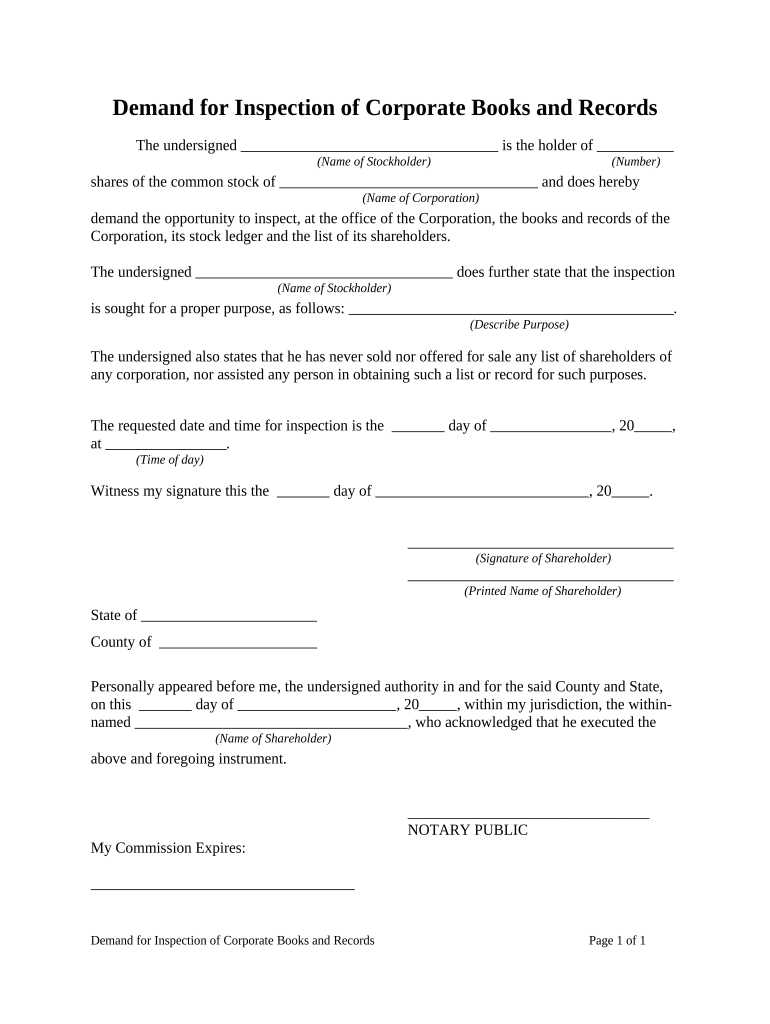
Demand for Inspection of Corporate Books and Records

This template is fully customizable. Edit the text, fill out the fields, and send it for signature. Give it a try!
Demand for Inspection of Corporate Books and Records

What the Demand for Inspection of Corporate Books and Records Is

A Demand for Inspection of Corporate Books and Records is a formal written request by a shareholder, member, or authorized representative seeking access to a corporation’s books, records, and supporting documents. It typically specifies the records requested, the statutory or contractual basis for the request, the purpose for inspection, and a proposed timeframe and location for review. The demand can be a prelude to litigation if the corporation refuses; many U.S. jurisdictions provide statutory inspection rights and procedures for enforcement in court.

Why a Shareholder Might Serve This Demand

A properly drafted demand clarifies the legal basis for inspection, focuses the company on producing relevant records, and creates a documented timeline that supports enforcement if needed.

Why a Shareholder Might Serve This Demand

Who Typically Issues and Responds to These Demands

Common parties include individual shareholders, institutional investors, company secretaries, and outside counsel initiating or responding to inspection requests.

  • Individual shareholder seeking transparency about distributions or related-party transactions.
  • Institutional investor conducting due diligence before litigation or major corporate action.
  • Corporate counsel or company officer preparing a compliance response or redaction plan.

Who Signs and Submits the Demand

Shareholder — Requesting Party

A shareholder or authorized agent signs to attest to ownership or standing; include ownership evidence and contact details. Counsel often signs on behalf of institutional holders when authorized.

Corporate Secretary — Responding Party

The corporate secretary or in-house counsel typically certifies receipt and coordinates production; responses should note any statutory objections and propose inspection logistics.

Essential Components of a Professional Demand

A formal demand should be concise, legally grounded, and specific about the records, purpose, and logistics to avoid ambiguity and speed resolution.

Cover Statement

Identify the requesting party, shareholder status, and statutory or bylaw authority for the inspection demand in a clear opening paragraph.
Scope of Records

List specific books, records, minutes, contracts, account ledgers, correspondence, and electronic files with date ranges and document types to narrow the request.

Proper Purpose

State a lawful purpose for inspection (e.g., investigating mismanagement, examining financial transactions) to meet statutory 'proper purpose' tests.

Proof of Ownership

Attach share certificates, broker statements, or a sworn affidavit proving share ownership or proxy authority at the relevant record date.

Logistics and Timing

Specify dates, times, location (on-site or electronic delivery), and the format requested (PDF, native files) for inspection or copying.

Reservation of Rights

Include a reservation that the requester may seek court enforcement, and identify confidentiality or nondisclosure expectations if sensitive materials are produced.

Step-by-Step: Preparing and Sending the Demand

Follow these sequential steps to create a clear, enforceable demand that preserves rights and reduces back-and-forth with the company.

  • 01
    Verify Standing: Confirm share ownership or proxy authority before drafting.
  • 02
    Define Scope: List specific records and date ranges to request.
  • 03
    Attach Proof: Include ownership documentation and identity verification.
  • 04
    Send and Track: Deliver via registered mail or secure eDelivery and retain proof of transmission.

Customizing an Online Demand Workflow

Set up an electronic workflow to collect evidence, signatures, and delivery receipts while maintaining an audit trail for enforcement.

Field Configuration
Ownership Upload Required PDF upload with file validation
Signature Block Signer name, title, date fields required
Delivery Method Email with read-receipt or registered mail
Audit Trail Capture IP, timestamp, and access log

Typical Route From Demand to Production

Understanding the common flow helps set expectations for timelines and potential escalation steps if access is denied or incomplete.

  • Draft: Requester prepares demand with supporting proof.
  • Deliver: Send to corporate secretary or counsel.
  • Review: Company evaluates scope and prepares records.
  • Produce: Documents delivered for inspection or copying.

eDelivery and eSignature Considerations

Use secure delivery and an auditable e-signature process to record consent, transmission, and receipt when serving or acknowledging a demand.

  • Authentication: Use email verification or multi-factor authentication.
  • Audit Trail: Retain timestamps, IP addresses, and event logs.
  • File Types: Support PDF, DOCX, and native spreadsheets.

Maintain a complete, tamper-evident record of the demand and any acknowledgements; electronic records should be exportable for court filings.

Timelines and Expected Response Windows

Response timelines vary by jurisdiction and corporate bylaws; specify requested inspection dates while allowing statutory cure periods for production.

Statutory Notice Window:

Often requires 10–30 business days for production

Company Acknowledgement:

Request acknowledgement within 7 days

Production Dates:

Propose 1–2 mutually agreeable inspection dates

Court Enforcement:

File motion if no response within statutory window

Document Preservation:

Notify parties to preserve relevant records immediately

Common Mistakes to Avoid

  • Requesting overly broad categories without date limits, which invites objections and delays due to ambiguity or disproportionate burden.
  • Failing to attach proof of ownership or authority, causing the company to reject the demand for lack of standing.
  • Neglecting to state a lawful 'proper purpose', which many jurisdictions require before compelling production.
  • Not preserving electronic metadata or failing to request native-file formats, potentially losing discoverable evidence.

Risks and Consequences of an Incorrect or Deficient Demand

Denial of Request: Court refusal
Sanctions: Possible cost awards
Delay: Extended discovery timeline
Inadmissible Evidence: Lost metadata
Privacy Breach: Unauthorized data exposure
Increased Costs: Attorney and motion expenses

eSignature Vendor Comparison for Serving and Acknowledging Demands

Platforms differ on price, bulk send, audit trails, and HIPAA support; signNow is listed first for straightforward comparison.

signNow DocuSign Adobe Sign PandaDoc HelloSign
Starting Price $8/user/mo $15/user/mo $14/user/mo $19/user/mo $15/user/mo
Free Trial Yes, 7-day trial Varies by plan Varies by plan Varies by plan Varies by plan
Bulk Send Yes Yes Yes Yes No
Audit Trail Yes Yes Yes Yes Yes
HIPAA Compliant Yes Yes Yes No No
Envelope Cap No cap 100 envelopes/user/year Varies by plan Varies by plan Varies by plan

Practical Examples of How Demands Are Used

Two common scenarios illustrate how a focused demand resolves questions or leads to court-enforced production when necessary.

Private Investor Inquiry

An investor requests ledgers for a two-year period to verify distributions

  • Narrow scope to financial ledgers
  • Company produced redacted copies after three weeks, avoiding motion practice by agreeing to a limited onsite review and confidentiality agreement.

Institutional Due Diligence

A funds manager seeks contracts and related-party transaction records before a vote

  • Supplies ownership proof and purpose
  • Company initially objected, then a negotiated protocol produced electronic copies and metadata under counsel supervision.

Frequently Asked Questions

Answers to common procedural and legal questions about serving, responding to, and enforcing a Demand for Inspection of Corporate Books and Records.


Need help? Contact support

be ready to get more
Join over 28 million airSlate SignNow users