Establishing secure connection…Loading editor…Preparing document…

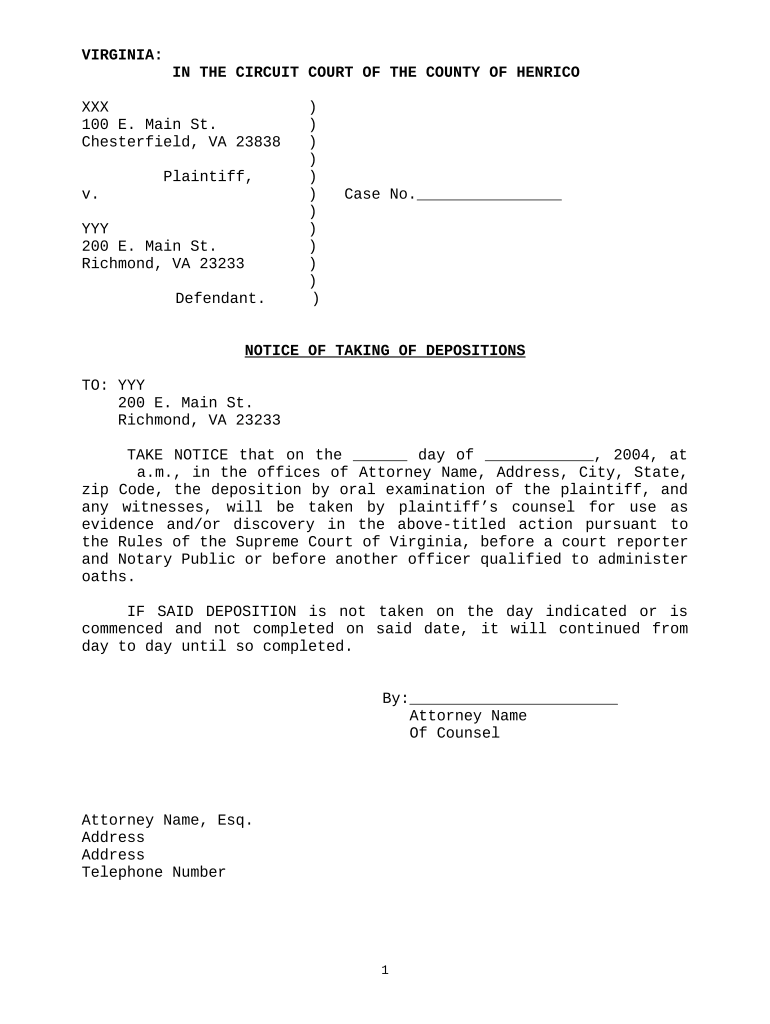
Virginia Notice of Taking of Depositions

This template is fully customizable. Edit the text, fill out the fields, and send it for signature. Give it a try!
Virginia Notice of Taking of Depositions

What a Virginia Notice of Taking of Depositions Is

A Virginia Notice of Taking of Depositions is a formal written notice used in civil litigation to inform a party or witness that their deposition will be taken. It identifies the case caption, name of the deponent, date, time, location or remote method, and the scope or topics to be covered during examination. The notice may also request production of documents or electronically stored information and must be served in accordance with court rules and applicable discovery procedures.

Why a Clear, Compliant Deposition Notice Matters

A properly drafted notice reduces scheduling disputes, supports enforceability, and clarifies the scope of testimony and document requests for all parties and the court.

Why a Clear, Compliant Deposition Notice Matters

Who Typically Prepares and Receives This Notice

The notice is prepared by litigating parties or their counsel and addressed to opposing parties, witnesses, and court reporters.

  • Plaintiffs and defendants in civil litigation, through counsel, to schedule depositions and document production.
  • Litigation paralegals and discovery coordinators who manage scheduling, service, and exhibit lists for depositions.
  • Third-party witnesses and corporate representatives subpoenaed to testify or to produce documents at a deposition.

Serve and file the notice per local rules and preserve proof of service to support later enforcement if required.

Core Elements to Include in a Professional Notice

A complete notice states the case identifier, identifies the deponent, sets date/time/place or remote method, defines topics, lists requested documents, and includes a signature and certificate of service.

Case Caption

Full court name, case number, and party captions as they appear on pleadings to ensure proper identification and filing consistency.
Deponent Identity

Full legal name, role or corporate position if applicable, and any contact details needed for scheduling or serving subpoenas.

Date, Time, Location

Specify MM/DD/YYYY and exact time, physical address or videoconference link, and timezone if participants are in different jurisdictions.

Scope / Topics

List subjects or topics for examination with sufficient detail to allow preparation and to limit later scope disputes during the deposition.

Document Requests

Identify categories of documents or specific exhibits to be produced at deposition or by subpoena, with format instructions if electronic.

Signature & Service

Attorney signature block, contact information, and a certificate of service showing how and when the notice was served.

Step-by-step: Preparing and Serving the Notice

Follow a predictable sequence to prepare, serve, and document the deposition notice to reduce disputes and preserve enforcement options.

  • 01
    Draft Notice: Populate caption, deponent, date/time, scope, and document requests with precise language.
  • 02
    Check Local Rules: Confirm service methods, required lead time, and remote deposition procedures under court rules.
  • 03
    Serve the Notice: Serve opposing counsel, deponent, and court reporter via required methods and retain proof of service.
  • 04
    File or Lodge If Required: File a copy with the court or include with related motion practice when local rules demand.

Overview: Digital and Paper Notice Workflow

A typical workflow moves from document preparation to service, production management, and recordkeeping—each step documented for discovery compliance.

  • Prepare Template: Create a reusable notice template with required fields and production checklists.
  • Populate Case Data: Insert case caption, deponent details, date/time, and topics.
  • Serve and Record: Send via accepted service methods and save delivery receipts.
  • Manage Productions: Track documents produced, designation of confidential material, and exhibit numbering.

Configuring an Online Notice Template

Set template fields and validations to reduce errors when generating notices for new cases and deponents.

Field Configuration
Case Caption Auto-fill from case record; required field validation
Deponent Details Text fields for name, role, and contact; dropdown for corporate rep
Date/Time Fields Use MM/DD/YYYY and separate time field with timezone
Production List Repeatable item list with file-type instructions

Accepted Formats and Authentication for Electronic Notices

Electronic notices are commonly drafted in PDF or Word and may be served by e-mail, e-filing, or court e-service portals depending on jurisdiction.

  • Accepted Formats: PDF, DOCX, and printable formats
  • Integrations: Court e-filing and case management systems
  • Authentication: Email delivery receipts, verified e-service, and e-sign audit trails

Confirm the receiving court and opposing counsel accept electronic service and preserve certificates of transmission to support any later enforcement or sanctions motion.

Timing and Notice Considerations

Timing requirements vary by court and forum; always confirm minimum lead times for serving a deposition notice or related subpoena.

Reasonable Notice:

Provide sufficient advance notice per local or federal rule; 'reasonable' varies by case complexity and travel needs.

Subpoena Lead Time:

Allow extra time when serving third-party subpoenas for document production.

Remote Depositions:

Confirm platform, authentication, and scheduling windows in advance.

Response and Objections:

Parties typically object promptly; follow meet-and-confer requirements to resolve disputes.

Court Holidays:

Adjust scheduling for local court closures and recognized holidays.

Common Preparation Errors to Avoid

  • Vague topic listings that invite scope disputes and motion practice during or after the deposition.
  • Failing to confirm the deponent’s availability before serving a notice, which can lead to duplicative service attempts.
  • Omitting a certificate of service or failing to retain proof of electronic delivery, undermining enforcement efforts.
  • Not specifying the format requested for electronic documents, causing delays or confusion during production.

Consequences of a Defective or Untimely Notice

Motion Practice: Opposing party may move to quash or limit deposition
Sanctions: Court may award costs or sanctions under discovery rules
Excluded Testimony: Evidence or testimony may be excluded for noncompliance
Delay: Scheduling disputes increase litigation time and expense
Additional Costs: Need for re-notice, travel, or additional subpoenas increases expenses
Enforcement Risk: Weak service proof can impede enforcement of subpoenas

Practical Examples: Typical Notice Scenarios

Two concise scenarios illustrate how notices are used when scheduling deponent testimony and document production.

Out-of-State Deponent

A lawyer serves a notice to depose an out-of-state corporate rep by written notice and subpoena for production

  • Remote deposition scheduled due to travel constraints
  • Proper service, remote platform instructions, and a production list avoided later disputes by documenting scope and delivery methods.

Document-Focused Deposition

Counsel serves a notice with a targeted production request for electronic records and specific date ranges

  • The deponent produced native spreadsheets and PDFs
  • Requiring format instructions and Bates ranges at notice stage streamlined the exhibit process and reduced follow-up motions.

Representative eSignature Vendor Comparison for Notice & Discovery Workflows

Pricing and core capabilities vary across vendors; the table below lists starting prices and common feature availability to guide platform selection for discovery and notice processes.

signNow DocuSign Adobe Sign PandaDoc HelloSign
Starting Price $8/user/mo $15/user/mo $14/user/mo $19/user/mo $15/user/mo
Free Trial 7-day free trial Varies by vendor Varies by vendor Varies by vendor Varies by vendor
Bulk Send Yes Yes Yes Yes Limited
Audit Trail Yes Yes Yes Yes Yes
HIPAA Compliant Yes Yes Yes No No
Envelope Cap No cap 100 envelopes/user/year Varies by plan Varies by plan Varies by plan

Frequently Asked Questions About Notices of Deposition

Answers to common procedural and electronic-service questions when preparing or serving a Virginia Notice of Taking of Depositions.


Need help? Contact support

be ready to get more
Join over 28 million airSlate SignNow users