Establishing secure connection…Loading editor…Preparing document…

Iowa Renunciation and Disclaimer of Property

This template is fully customizable. Edit the text, fill out the fields, and send it for signature. Give it a try!
Iowa Renunciation and Disclaimer of Property

What the Iowa Renunciation and Disclaimer of Property Is

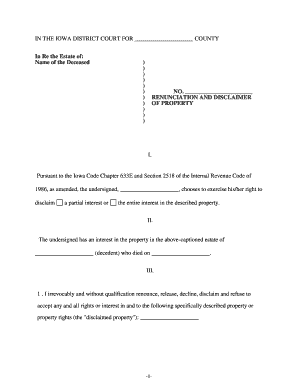
An Iowa Renunciation and Disclaimer of Property is a written, signed statement by which a person formally declines to accept an interest in real or personal property under a will, trust, intestacy distribution, or other transfer. The document records the disclaimant's intent to refuse the property interest, describes the specific interest disclaimed, and identifies the transfer or estate involved. When properly executed it reallocates the interest according to the instrument or state law rather than to the disclaimant, and it can affect tax and estate-administration outcomes.

Why a Formal Renunciation or Disclaimer Matters

A written disclaimer clarifies that the intended recipient refuses the property interest, which can simplify estate administration, prevent unwanted tax consequences, and ensure the transfer follows the decedent’s or settlor’s fallback provisions under Iowa law or the governing instrument.

Why a Formal Renunciation or Disclaimer Matters

Who Typically Prepares or Signs This Document

Parties should confirm signatory authority and document timing with counsel because the legal and tax consequences of a disclaimer depend on when and how it is executed.

  • Estate beneficiaries who elect to refuse an inheritance to allow an alternate distribution or for tax planning reasons.
  • Personal representatives or executors who accept and record a disclaimer to reflect the disclaimant’s intent in probate files.
  • Trustees or trust counsel who process disclaimers affecting trust distributions and reallocation among remainder beneficiaries.

Core Elements of a Professional Iowa Disclaimer

A complete renunciation or disclaimer includes identity, a precise description of the interest, a clear declination statement, effective date, delivery instructions, and any required notarization or witness statements to match state or instrument rules.

Parties

Full legal names and roles of the disclaimant and the original transferor or decedent, plus contact information for the estate's representative.
Property Description

Exact identification of the disclaimed interest: asset type, account numbers, legal description for real estate, or trust/will clause reference.

Statement

An explicit, unambiguous declaration that the disclaimant refuses the specified interest, including whether refusal is total or partial.

Effective Date

The date the disclaimer is executed and delivered; this timing can affect whether the disclaimer is treated as qualified under tax rules.

Delivery

Direction for how and to whom the signed disclaimer must be delivered, and whether filing with probate or the trustee is required.

Authentication

Notary acknowledgment or witness signatures when required by the instrument or state law; note any RON or recording requirements.

Essential Information to Include

Disclaimant Name: Full legal name
Decedent or Settlor: Name of original owner
Asset Details: Specific asset ID
Declination Text: Clear refusal language
Execution Date: MM/DD/YYYY format
Notary/Witness: As required

Potential Risks and Consequences

Tax Consequences: Loss of step-up or other tax relief
Irrevocability: Most disclaimers are final once effective
Estate Impact: May change distributions for heirs
Mistimed Filing: Can disqualify tax qualification
Invalid Form: Improper execution can void disclaimer
Record Gaps: Failure to deliver may leave uncertainty

Common Preparation Mistakes to Avoid

  • Using vague language that fails to specify the precise interest being disclaimed, which can create ambiguity in probate or trust administration.
  • Signing before confirming whether the disclaimer must be delivered to an executor, trustee, or recorded in county records to be effective.
  • Failing to obtain required notarization or witness signatures when the instrument or state law requires them, risking invalidation.
  • Assuming tax benefits without counsel; a mistimed or nonqualified disclaimer can carry unintended federal or state tax liabilities.

Step-by-Step: Completing an Iowa Renunciation or Disclaimer

Follow these core steps to prepare and execute a clear, enforceable disclaimer under Iowa practice and general U.S. e‑signature rules.

  • 01
    Identify the interest: Confirm exact asset or clause being disclaimed.
  • 02
    Draft clear language: Use unambiguous refusal phrasing referencing instrument clauses.
  • 03
    Determine execution rules: Check if notarization or witnesses are required.
  • 04
    Deliver and record: Send signed copy to executor/trustee and file if necessary.

How to Configure an Online Disclaimer Workflow

Set up a digital signing workflow that captures identity, timestamps, and delivery confirmation while matching any notarization or witness requirements.

Field Configuration
Disclaimant Identity Require full name and email
Signature Block Signature + date fields
Notary Step Enable remote notarization if permitted
Delivery Receipt Auto-send signed PDF to executor

Digital Execution Workflow Overview

An efficient e-sign workflow ensures intent, attribution, and retention while providing the audit trail required by ESIGN and UETA.

  • Upload Document: Prepare PDF with fillable fields
  • Assign Signers: Add disclaimant and estate rep emails
  • Authenticate: Use email, SMS, or stronger checks
  • Complete & Deliver: Signed copy and certificate issued

Technical and Authentication Considerations

Confirm the platform meets ESIGN/UETA compliance and any sector-specific security controls before relying on electronic execution for legally significant disclaimers.

  • File Formats: PDF and DOCX supported
  • Authentication: Email, SMS, or multi-factor
  • Integrations: Connect to cloud storage

Practical Examples of How Disclaimers Are Used

These short case sketches show real-world scenarios where a formal disclaimer resolved estate or administrative issues.

Tim Martin — Real Estate

A property investor declined a fractional interest to simplify title transfer

  • He executed a written disclaimer and delivered it to the executor
  • As a result the property passed to the alternate beneficiary per the will, avoiding a partition action and streamlining closing.

John Butler — Medical Practice

A clinic founder refused a bequeathed interest to prevent tax complications for his estate

  • He signed an irrevocable disclaimer witnessed and notarized according to estate counsel advice
  • The trust accepted the disclaimer and allocated the interest to contingent beneficiaries without delaying operations.

Best Practices for Clear and Enforceable Disclaimers

Follow these practical tips to minimize risk and ensure the disclaimer has the intended legal effect.

Use precise, unambiguous language
Draft the disclaimer to identify the interest exactly, reference the instrument clause or account, and state an irrevocable refusal to avoid interpretive disputes later in probate or trust proceedings.
Confirm execution formalities
Check whether the governing instrument, state law, or custodian requires notarization, witnesses, filing, or recording; obtain these at execution to reduce invalidation risk.
Coordinate with estate representatives
Deliver the signed disclaimer to the executor or trustee promptly and request written acknowledgement to document receipt and ensure proper reallocation of the interest.
Seek tax and legal review when needed
Consult counsel if the disclaimer could affect federal or state tax treatment, creditors’ rights, or beneficiary entitlements to ensure it qualifies where tax or statutory benefits are intended.

Timing and Delivery Considerations

Timely execution and delivery determine the disclaimer’s legal effect and whether it meets any statutory or tax qualification requirements.

Execution Date:

Date the disclaimer at signing in MM/DD/YYYY to show when declination occurred

Delivery to Executor:

Provide the signed document to the estate representative without delay

Recording When Required:

Record disclaimers affecting recorded real estate if county rules require

Trustee Notification:

Send to trustee and request confirmation of receipt

Tax Timing:

Consult counsel about any statutory timing that affects tax treatment

Frequently Asked Questions About Iowa Disclaimers

Answers to common questions that arise when preparing or accepting a renunciation or disclaimer of property in Iowa.


Need help? Contact support

be ready to get more
Join over 28 million airSlate SignNow users