Establishing secure connection…Loading editor…Preparing document…

Discovery Interrogatories from Plaintiff to Defendant with Production Requests

This template is fully customizable. Edit the text, fill out the fields, and send it for signature. Give it a try!
Discovery Interrogatories from Plaintiff to Defendant with Production Requests

What this combined interrogatory and production request form is

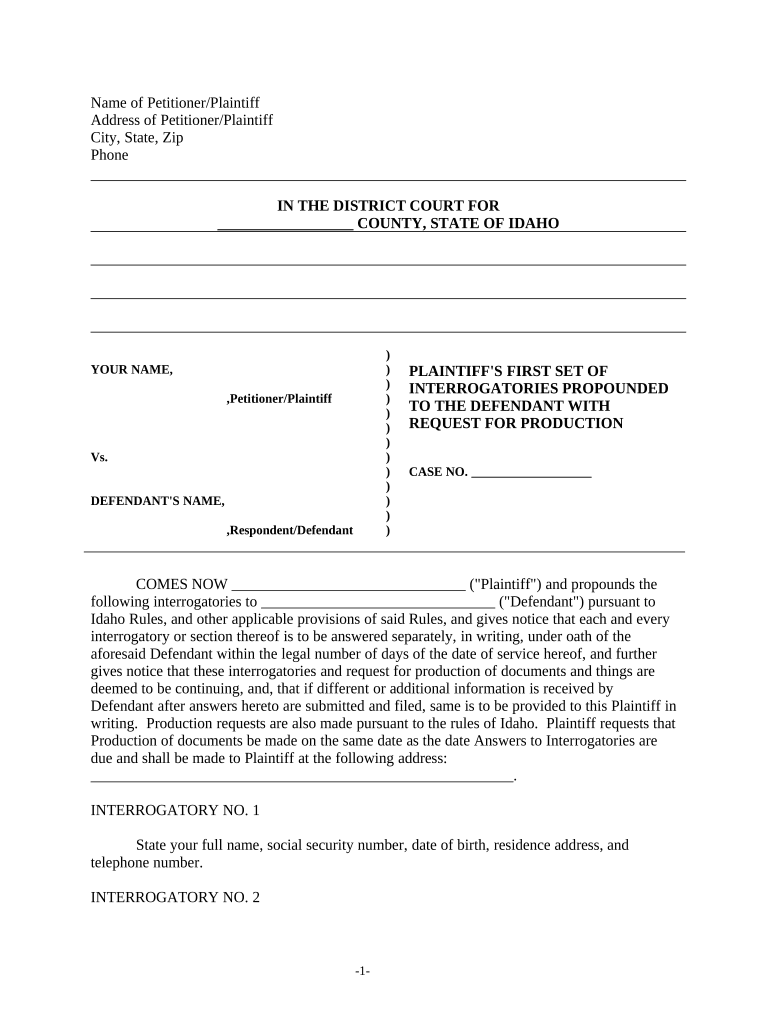
A Discovery Interrogatories from Plaintiff to Defendant with Production Requests is a combined civil discovery document used by a plaintiff to obtain written answers and documents from a defendant. It pairs numbered interrogatories asking for facts, contentions, and calculations with specific production requests for documents and electronically stored information. The form is governed by procedural rules for timing, scope, and objections, and it frequently requires verification under oath and a privilege log for withheld materials. Properly drafted requests are specific, proportional, and narrowly tailored to permissible discovery.

Why serve combined interrogatories with production requests

Combining interrogatories and production requests organizes fact-finding, reduces duplication, and creates a coordinated written record that supports later motions or settlement analysis. This consolidated approach helps counsel identify document gaps and quantify damages earlier in litigation.

Why serve combined interrogatories with production requests

Who prepares and responds to these discovery requests

Each party must follow applicable procedural rules, meet service and timing requirements, and maintain records of production and privilege assertions.

  • Plaintiff counsel and paralegals coordinating factual inquiries and drafting specific document requests for discovery.
  • Defense counsel and litigation support managing collections, privilege review, and preparing verified answers and production sets.
  • In-house legal, records custodians, and eDiscovery vendors who locate, preserve, and transmit responsive electronically stored information.

Essential parts of an effective interrogatory and production packet

A professional packet includes clear definitions, concise interrogatory questions, specific document requests, defined custodians and date ranges, instructions for format and metadata, and a verification or signature block attesting to accuracy.

Definitions

Concise defined terms reduce ambiguity and narrow scope; definitions cover persons, documents, dates, and key events for consistent responses.
Interrogatory Items

Numbered questions targeted to facts, calculations, and contentions; avoid compound or ambiguous phrasing to elicit precise answers.

Production Requests

Specific requests identifying document types, custodians, and date ranges and stating preferred electronic formats and metadata fields to be preserved and produced.

Instructions

Direction on how to search, de-duplicate, and produce electronically stored information, including search terms, custodial scope, and privilege procedures.

Verification

A signed, sworn verification by the responding party or corporate representative confirming the completeness and truth of responses under penalty of perjury.

Objections & Privilege

A clear objection section and requirement to provide a privilege log identifying withheld documents by category and date.

Sensitive data and handling notes

Protected Health Info: Treat as HIPAA-covered
Confidential Business Data: Use confidentiality order
Privileged Communications: Log and withhold
Metadata: Preserve and produce
ESI Custodians: Identify custodial sources
Chain of Custody: Document collection steps

Stepwise process for serving and responding

Follow a documented sequence to draft, serve, collect, and verify discovery while preserving ESI and tracking deadlines.

  • 01
    Draft: Tailor questions and requests to case issues.
  • 02
    Serve: Use authorized service methods and proof of service.
  • 03
    Collect: Preserve ESI and gather responsive documents.
  • 04
    Respond: Produce documents, answer interrogatories, and verify responses.

Configuring an online workflow for requests and production

Set up a repeatable workflow for serving requests, collecting responses, and ingesting produced files to maintain chain of custody and auditability.

Field Configuration
Service Method Email, mail, or court e-filing; include proof
Response Deadline Standard 30 days or court-ordered timeframe
Authentication Email link, SMS code, or account login
Production Format Searchable PDF with metadata fields

Typical flow from request to produced file

A clear end-to-end sequence reduces disputes and supports motion practice; document each step and the person responsible.

  • Prepare Request: Draft interrogatories and production items
  • Serve Opposing Party: Issue by authorized service, document proof
  • Collect Materials: Custodial search and privilege review
  • Produce Files: Deliver files with load files and metadata

Technical considerations for eSubmission and eDiscovery

Ensure chosen platforms meet security and compliance needs for confidential materials and retain a verifiable chain of custody for produced ESI.

  • File Formats: PDF, DOCX, native files
  • Audit Trail: Timestamp and user actions
  • Integrations: Link to review platforms

Common timelines and response expectations

Timelines vary by jurisdiction and court order but follow standardized periods; track service dates to compute response obligations accurately.

Standard Response Period:

Typically 30 days to answer interrogatories and produce documents.

Court-Ordered Deadlines:

Shorter or longer deadlines may be imposed by scheduling orders.

Extension Requests:

Parties may agree to extend or seek court permission.

Motion to Compel Timing:

Allow time for meet-and-confer efforts before filing a motion.

Preservation Hold:

Issue immediately to prevent spoliation of ESI and paper records.

Common drafting and response pitfalls to avoid

  • Overly broad or vague requests provoke objections and increase dispute risk, often leading to motion practice and costs that could have been avoided.
  • Failing to include clear date ranges, custodians, or formats forces additional meet-and-confers and can produce incomplete ESI collections.
  • Improper privilege assertions without a detailed log may waive privilege or lead a court to order in camera review of withheld materials.
  • Neglecting to preserve metadata or to specify metadata fields results in incomplete productions and potential sanctions for spoliation.

Consequences of deficient responses or failures

Court Sanctions: Monetary or evidentiary penalties
Waiver: Loss of privilege claim
Exclusion: Evidence may be excluded
Adverse Inference: Jury may be instructed adversely
Contempt: Potential contempt proceedings
Increased Costs: Expanded discovery and attorney fees

Typical eSignature vendor pricing and compliance snapshot

Comparing eSignature providers helps teams choose platforms that support discovery production, secure transfers, and compliance; signNow appears first in the vendor comparison below.

signNow DocuSign Adobe Sign PandaDoc HelloSign
Starting Price $8/user/mo $15/user/mo $14/user/mo $19/user/mo $15/user/mo
Free Trial 7-day free trial, no credit card Varies by vendor Varies by vendor Varies by vendor Varies by vendor
Bulk Send Yes Yes Yes Yes No
Audit Trail Yes Yes Yes Yes Yes
HIPAA Compliant Yes Yes Yes No No

Representative examples showing practical use

These examples illustrate how combined interrogatories and production requests resolve factual disputes efficiently and create documentary records.

Commercial Contract Dispute

A plaintiff used targeted interrogatories to identify transaction dates and counterparties and paired production requests for invoices and communications to locate key evidence.

  • The focused approach reduced overbroad responses and narrowed custodial searches.
  • As a result, counsel resolved issues faster, limited motion practice, and presented coherent proof at mediation using organized produced exhibits and verified answers.

Employment Litigation

In an employment matter the plaintiff requested personnel files, disciplinary records, and email chains while asking interrogatories about decision-makers and timelines.

  • Narrow date ranges and named custodians limited scope.
  • The combined package produced clear timelines and decision-maker testimony that supported summary judgment preparation and streamlined settlement negotiations without extensive discovery disputes.

Frequently asked questions about preparing and responding

Practical answers to common procedural and technical questions help parties avoid defective service, preserve privileges, and produce usable records.


Need help? Contact support

be ready to get more
Join over 28 million airSlate SignNow users