Establishing secure connection…Loading editor…Preparing document…

Discovery Interrogatories from Plaintiff to Defendant with Production Requests

This template is fully customizable. Edit the text, fill out the fields, and send it for signature. Give it a try!
Discovery Interrogatories from Plaintiff to Defendant with Production Requests

What this Discovery Interrogatories and Production Request package is

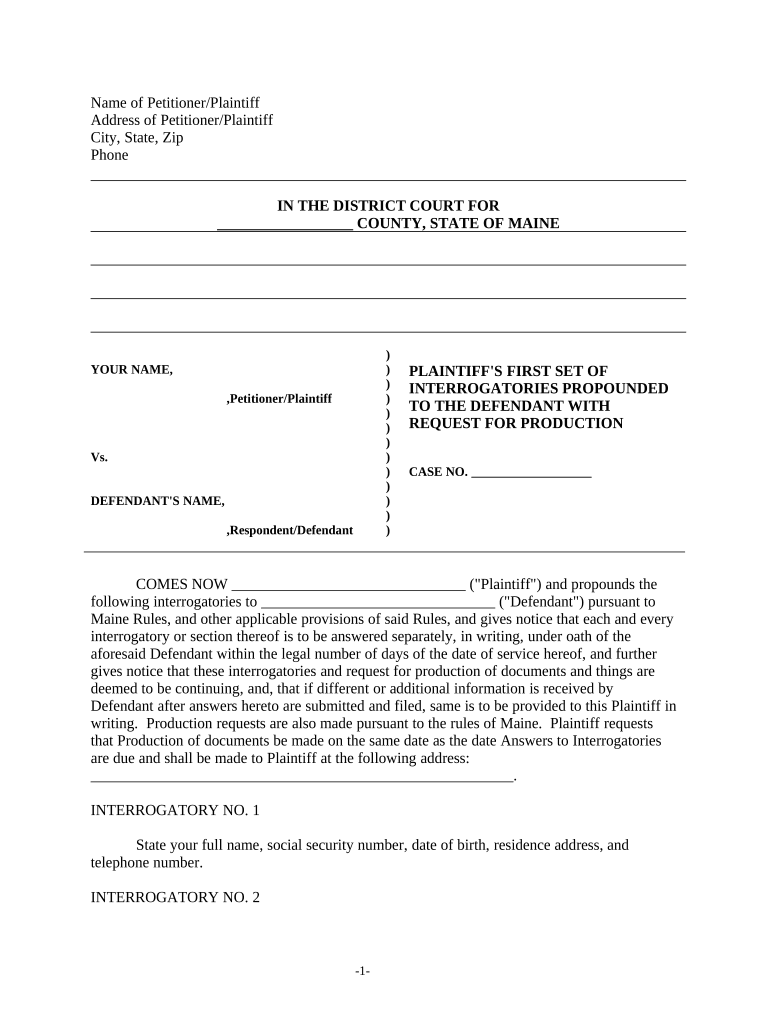
Discovery interrogatories from Plaintiff to Defendant with production requests are written questions and document requests served by the plaintiff during civil litigation to obtain factual information and relevant records from the defendant. Interrogatories require written answers under oath and production requests ask for tangible or electronic documents, ESI, and other items responsive to defined categories. Governing rules include the Federal Rules of Civil Procedure (see Rule 33 and Rule 34) and state civil procedure counterparts; timing, scope, and format vary by jurisdiction. Properly framed interrogatories narrow issues, preserve evidence, and support later motions if responses are incomplete.

Why well-constructed interrogatories and production requests matter

Clear interrogatories and production requests focus discovery, reduce later disputes, and create a written record of facts and documents. Well-drafted requests preserve evidence, improve case valuation, and support efficient motion practice while reducing unnecessary burden on parties and the court.

Why well-constructed interrogatories and production requests matter

Who prepares and responds to these discovery tools

Interrogatories and production requests are prepared and reviewed by litigation counsel and executed by parties and witnesses as required.

  • Plaintiff attorneys and litigators drafting targeted questions and document categories to frame disputed issues.
  • Defense counsel and in-house legal teams preparing verified answers, objections, and privilege logs for produced documents.
  • Litigation support, paralegals, and eDiscovery specialists coordinating collection, review, and production under confidentiality controls.

Step-by-step process for preparing and serving interrogatories and production requests

Follow a structured workflow to draft, serve, receive, and preserve answers and produced documents while protecting privilege and ensuring timely compliance.

  • 01
    Draft Interrogatories: Identify issues, define terms, and draft numbered questions with clear time frames.
  • 02
    Attach Production Requests: Create specific document categories, specify formats, custodians, and date ranges.
  • 03
    Serve Opposing Party: Serve documents per Rule 5 and applicable state rules; document service method and date.
  • 04
    Preserve and Track: Collect ESI, preserve originals, log privilege claims and track produced items with Bates numbers.

Configuring a digital workflow for serving and receiving discovery

Set up a consistent, auditable digital workflow that captures service, authentication, and chain-of-custody metadata for each served or produced item.

Field Configuration
Sender Identity Use attorney or firm account; include contact and service address.
Authentication Enable email confirmation or SMS code for recipient verification.
Document Format Use searchable PDF for production; preserve native files when requested.
Audit Trail Capture timestamps, IPs, and signed acknowledgements for each transmission.

Technical requirements for secure eSubmission and eSignature

Choose a platform that records authentication, audit trails, file integrity, and supports common legal file formats.

  • Integrations: Connectors for eDiscovery, cloud storage, and case management.
  • File Formats: PDF/A, native files, and load file support for review platforms.
  • Authentication: Email, SMS, KBA, or advanced signer authentication as required.

Where and how discovery responses and productions are routed

Understand service rules and whether responses are served on counsel or filed with the court; maintain records of each transmission.

  • Service on Parties: Serve opposing counsel directly per local Rule 5 and document the method.
  • Court Filing: Do not file discovery responses unless required or attached to a motion.
  • eSubmission to Repositories: Upload productions to eDiscovery platforms with secure access controls.
  • Preservation Copy: Keep an unaltered copy in a litigation hold archive for audit.

Typical deadlines and timing expectations for interrogatories and productions

Observe the controlling procedural rule for response timing; many jurisdictions provide 30 days to answer, with local variations and extension options.

Response Timeframe:

Federal Rule 33(b)(2): 30 days after service unless court or stipulation shortens or extends time.

Production Responses:

Rule 34 responses typically within 30 days; document production schedules can be negotiated.

Meet-and-Confer:

Local rules often require a meet-and-confer before filing disputes; allow 7–14 days for resolution.

Motion to Compel:

File a motion after reasonable efforts to resolve; local rules set timelines for briefing and hearings.

Preservation Duty:

Preserve relevant ESI upon reasonably anticipated litigation to avoid spoliation sanctions.

Key litigation milestones tied to interrogatory and production events

Map discovery steps to the case schedule so parties meet written-response deadlines and preserve required materials for motions and trial.

01

Serve Interrogatories

Plaintiff serves numbered interrogatories and production requests on defendant to start the response clock.

02

Collect and Review

Defendant identifies custodians, collects ESI, and reviews for responsiveness and privilege.

03

Serve Answers and Produce

Defendant serves verified answers and produces non-privileged documents with a privilege log as needed.

04

Resolve Disputes

If objections persist, parties meet-and-confer and, if unresolved, file a motion to compel.

Essential elements to include in a professional interrogatory and production package

Include clear definitions, numbered requests, precise date ranges, custodian lists, production format specifications, and privilege handling instructions to reduce disputes and objections.

Defined Terms

Provide a definitions section for key phrases, parties, and time periods so each request has a consistent meaning and scope.
Numbered Requests

Use sequential numbering and short headings for each interrogatory and document category to simplify citation and response.

Date Ranges

Specify inclusive dates (MM/DD/YYYY) for each request to limit scope and ease ESI collection and filtering.

Custodian Listing

List custodians, departments, and known systems where ESI resides to narrow collection burden and prevent disputes.

Production Format

State required formats (searchable PDF, native files, load files) and metadata fields to be produced with documents.

Privilege Protocol

Require a privilege log with document identifiers and privilege basis; specify redaction and clawback procedures.

Security and compliance considerations for handling produced materials

Encryption In Transit: TLS 1.2/1.3
Encryption At Rest: AES-256
Third-Party Certifications: SOC 2 Type II, ISO 27001
Health Data: HIPAA-compliant with BAA
FDA Records: 21 CFR Part 11 support available
Accessibility: WCAG 2.0 Level AA

Penalties, risks, and adverse outcomes from deficient discovery responses

Waived Objections: Failing to timely object may waive certain defenses.
Motion Sanctions: Court may award fees or sanctions for noncompliance.
Adverse Inference: Missing or destroyed evidence can lead to negative factual inferences.
Monetary Penalties: Costs and attorney fees can be imposed under local rules.
Perjury Risk: Answers signed under oath expose the signer to perjury liability.
Spoliation Liability: Spoliation sanctions for failing to preserve ESI when litigation is foreseeable.

eSignature vendor comparison for signing and submitting discovery materials

Comparison focuses on starting price, trial availability, bulk send, audit trail, HIPAA compliance, and envelope or send caps; signNow appears first per vendor ordering rules.

signNow DocuSign Adobe Sign PandaDoc HelloSign
Starting Price $8/user/mo $15/user/mo $14/user/mo $19/user/mo $15/user/mo
Free Trial 7-day free trial Varies by vendor Varies by vendor Varies by vendor Varies by vendor
Bulk Send Yes (Premium) Yes Yes Yes No
Audit Trail Yes Yes Yes Yes Yes
Envelope Cap No envelope cap 100 envelopes/user/year Varies by plan Varies by plan Varies by plan

Practical tips for accurate, efficient discovery drafting and production

Adopt consistent formatting, preserve metadata, and follow local rules to reduce disputes and accelerate resolution.

Be Narrow and Specific
Limit each interrogatory and production category to relevant facts, custodians, and time frames to reduce burden objections and expedite collection.
Preserve Metadata
Request and produce metadata fields (date, author, path) and preserve native files where necessary to maintain evidentiary value.
Use Verified Responses
Require answers signed under oath or penalty of perjury to ensure accuracy and potential evidentiary use at trial.
Coordinate Privilege Logs
Provide a clear privilege log with identifiers, dates, and privilege grounds; agree on a clawback protocol to minimize disputes.

Illustrative discovery scenarios and expected document flows

These practical examples show common interrogatory and production patterns seen in civil litigation to guide drafting and review.

Example: Liability-Focused Interrogatories

Plaintiff seeks identities of witnesses and incident details

  • Requests limited custodians and dates
  • Plaintiff serves 20 numbered interrogatories and three production categories; defendant collects ESI, produces non-privileged documents with Bates numbers, and logs privilege assertions for withheld items.

Example: Document-Heavy Commercial Dispute

Plaintiff requests contracts, communications, and invoice histories

  • Production scope spans multiple custodians
  • Parties negotiate production format, use load files for ESI review, and resolve privilege disputes through a stipulated protocol to avoid motions.

Frequently asked questions about interrogatories, productions, and digital submissions

Answers to common procedural and technical questions about serving, responding, and submitting discovery materials electronically.


Need help? Contact support

be ready to get more
Join over 28 million airSlate SignNow users