Establishing secure connection…Loading editor…Preparing document…

Discovery Interrogatories from Plaintiff to Defendant with Production Requests

This template is fully customizable. Edit the text, fill out the fields, and send it for signature. Give it a try!
Discovery Interrogatories from Plaintiff to Defendant with Production Requests

What this set of interrogatories and production requests is

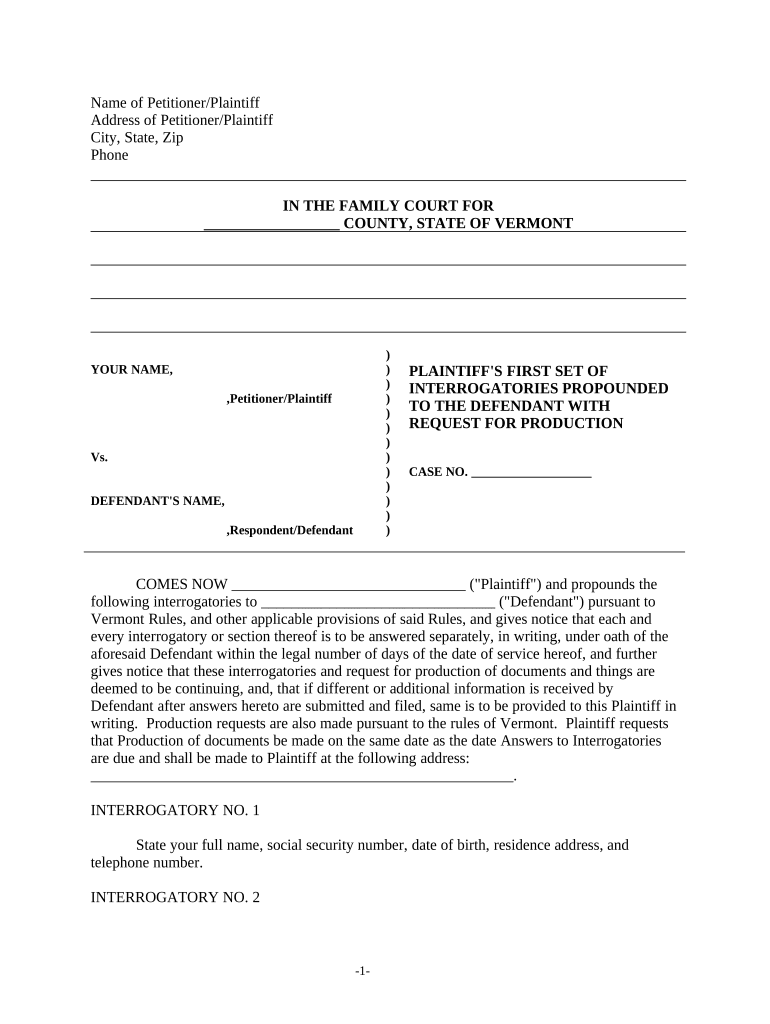
The Discovery Interrogatories from Plaintiff to Defendant with Production Requests is a combined discovery instrument used in civil litigation to obtain written answers and documents from an opposing party. It typically includes numbered interrogatories seeking factual information, definitions and instructions, and requests for production that require the defendant to produce relevant documents, electronically stored information, or tangible items. Responses are sworn under oath where required, and objections must be stated with specificity. The form is tailored to the claim theory and jurisdictional discovery rules that govern timing and scope.

Why these discovery requests matter in litigation

This combined set clarifies facts, narrows disputed issues, and preserves evidence by forcing early document production and sworn answers. Properly drafted interrogatories and production requests reduce surprise at trial, guide depositions, and create a record for motions to compel or for sanctions when responses are deficient.

Why these discovery requests matter in litigation

Who prepares and responds to these discovery requests

Typical users include litigators, in-house counsel, paralegals, and parties representing themselves who need to collect or compel facts and documents.

  • Plaintiff counsel seeking facts and documents to support claims or settlement positions.
  • Defendant counsel preparing detailed, timely answers and privilege logs where necessary.
  • Pro se litigants who must follow local rules when serving or responding to discovery.

Stepwise process to complete and serve the requests

Follow a clear sequence to draft, review, serve, and track responses under applicable rules.

  • 01
    Draft: Prepare numbered interrogatories and document requests tied to claim elements.
  • 02
    Review: Confirm definitions, time frames, and relevant custodians before service.
  • 03
    Serve: Serve per local civil rules and record the service date for deadlines.
  • 04
    Track: Log responses, objections, privilege claims, and produced items for the record.

Common questions and practical answers about these discovery requests

Answers address typical procedural problems, objections, timing issues, and production mechanics encountered in responding to interrogatories and document requests.


Need help? Contact support

Essential parts of a professional interrogatory and production set

A rigorous set is organized, legally grounded, and calibrated to proportionality and the jurisdiction’s discovery rules.

Caption block

Includes court, case number, title, and service details so documents are properly identified and accepted by the clerk and opposing counsel.
Definitions

Precise definitions for terms like 'document', 'communication', and time periods minimize interpretive disputes and reduce boilerplate objections.

Interrogatories

Numbered, focused fact questions tied to claim elements and damages; avoid compound or argumentative phrasing that invites objections.

Requests for Production

Clear lists of document categories, custodians, and date ranges; specify preferred ESI formats for efficient processing and review.

Privilege and Confidentiality

Instructions on privileged materials, protective order reference, and how to mark confidential documents maintain evidentiary protections.

Verification and Signature

A verification clause or signature block that satisfies local rule requirements and, if electronic, meets ESIGN/UETA standards for attribution and retention.

Security and compliance considerations for produced materials

Encryption in transit: TLS 1.2/1.3
Encryption at rest: AES-256
Access controls: Role-based permissions
Audit trails: Detailed action logging
Regulatory compliance: ESIGN, UETA
Health data: HIPAA BAA required

Risks and sanctions for deficient discovery responses

Court Sanctions: Monetary or evidentiary sanctions
Adverse Inference: May affect jury instructions
Motion Costs: Fee-shifting orders
Spoliation Liability: Possible default judgment exposure
Privilege Waiver: Overbroad logs risk waiver
Timing Penalties: Late responses trigger relief motions

Common drafting and response pitfalls to avoid

  • Overbroad time frames that sweep in irrelevant materials and invite proportionality objections from the responding party.
  • Vague definitions or ambiguous instructions that permit evasive answers and create disputes over scope and intent.
  • Requesting privileged communications without a privilege log, risking waiver or unnecessary briefing before a judge.
  • Failing to specify ESI format or production method, leading to delays, reformatting costs, and motion practice.

How electronic service and e-submission usually work

Electronic workflows speed service, track delivery, and create an audit trail when properly authenticated and preserved.

  • Upload: Upload the interrogatories and production requests in PDF or Word format.
  • Set fields: Add signature, verification, and production format instructions for ESI.
  • Serve: Send to opposing counsel via approved service method or agreed electronic means.
  • Record: Preserve timestamps, delivery receipts, and audit logs for proof of service.

Configuring an online workflow for serving and collecting responses

Standardize an eWorkflow to ensure consistent service, authentication, and preservation of discovery materials.

Field Configuration
Document format PDF/A for preservation; Word for editing
Signer authentication Email plus optional SMS or KBA
Production format Native ESI or PDF images with load files
Audit preservation Retain IP, timestamps, and action logs

Technical and integration essentials for e-submission

Use a platform that supports required file types, audit trails, and strong signer authentication for a defensible record.

  • File types: PDF, DOCX, native ESI
  • Integrations: eDiscovery and cloud storage
  • Authentication: Email, SMS, or KBA

Key deadlines and timing expectations

Observe federal and local rules for response periods, production schedules, and motions to compel to avoid prejudice and sanctions.

Federal response period:

30 days after service for interrogatories (FRCP 33(b)).

Requests for production:

Typically 30 days, subject to a court or stipulation variance.

Privilege log delivery:

Provide contemporaneously with responses or within a reasonable time.

Meet-and-confer:

Schedule promptly after disputed responses to avoid motion practice.

Motions to compel:

File after meet-and-confer; follow local court filing deadlines.

How interrogatories differ from other discovery tools

Compare purpose, response format, and enforcement between interrogatories and a common alternative: requests for production.

Document Type Interrogatories Requests for Production
Purpose written factual answers document and esi production
Format answers under oath document lists or files
Response time 30 days typical 30 days typical
Enforcement motion to compel motion to compel

Representative eSignature vendor pricing and capabilities for discovery workflows

Typical vendor pricing and capabilities relevant to serving, authenticating, and preserving discovery paperwork. Pricing reflects common per-user annual plans where available.

signNow DocuSign Adobe Sign PandaDoc HelloSign
Starting Price $8/user/mo $15/user/mo $14/user/mo $19/user/mo $15/user/mo
Free Trial 7-day free trial Varies Varies Varies Varies
Bulk Send Yes Yes Yes Yes Yes
Audit Trail Yes Yes Yes Yes Yes
be ready to get more
Join over 28 million airSlate SignNow users