Establishing secure connection…Loading editor…Preparing document…

Divorce Settlement

This template is fully customizable. Edit the text, fill out the fields, and send it for signature. Give it a try!
Divorce Settlement

What a Divorce Settlement Covers and How it Works

A Divorce Settlement (also called a marital settlement agreement or separation agreement) is a legally binding contract between spouses that sets out the division of assets and debts, spousal support, child custody and visitation, child support, retirement and tax treatment, and any other terms the parties agree on. Private settlement agreements can be signed by the parties and later submitted to the family court for incorporation into a final judgment. Electronic signatures are generally recognized under federal and state law for private agreements, though court procedures and enforceability may vary.

Why a Written Divorce Settlement Matters

A clear written settlement reduces uncertainty and future disputes by documenting each party’s rights and obligations. When properly signed and, if required, notarized or incorporated into a court order, it becomes enforceable and helps avoid repeated litigation or modification hearings.

Why a Written Divorce Settlement Matters

Who Typically Prepares and Signs a Divorce Settlement

The Divorce Settlement is used by divorcing parties, their attorneys, mediators, financial advisors, and court clerks when finalizing or filing agreements.

  • Family law attorneys and mediators who draft and negotiate settlement terms on behalf of clients.
  • Divorcing spouses and their financial advisors for asset division, support, and tax planning.
  • Court clerks and judges who review agreements when parties ask to incorporate terms into a final decree.

In most cases both parties should review the document with counsel and sign the final version; some courts additionally require notarization or original signatures for filings.

Step-by-Step: Completing a Divorce Settlement

Follow an ordered process to draft, review, sign, and, if needed, file the settlement with the family court.

  • 01
    Draft agreement: Outline terms for assets, support, custody, and debts in plain, specific language.
  • 02
    Review with counsel: Each party should have independent legal or financial review to confirm rights and tax implications.
  • 03
    Sign and notarize: Execute signatures; obtain notarization if required by court or state law.
  • 04
    File or present to court: Submit the agreement for incorporation into the final judgment if you want court enforceability.

Essential Sections Every Professional Divorce Settlement Should Include

A complete settlement covers legal, financial, custodial, and enforcement provisions so parties and courts can implement the terms without ambiguity.

Parties and Recitals

Identify each party, the date of separation, jurisdiction, and the purpose of the agreement; clear recitals reduce later factual disputes and support court review.
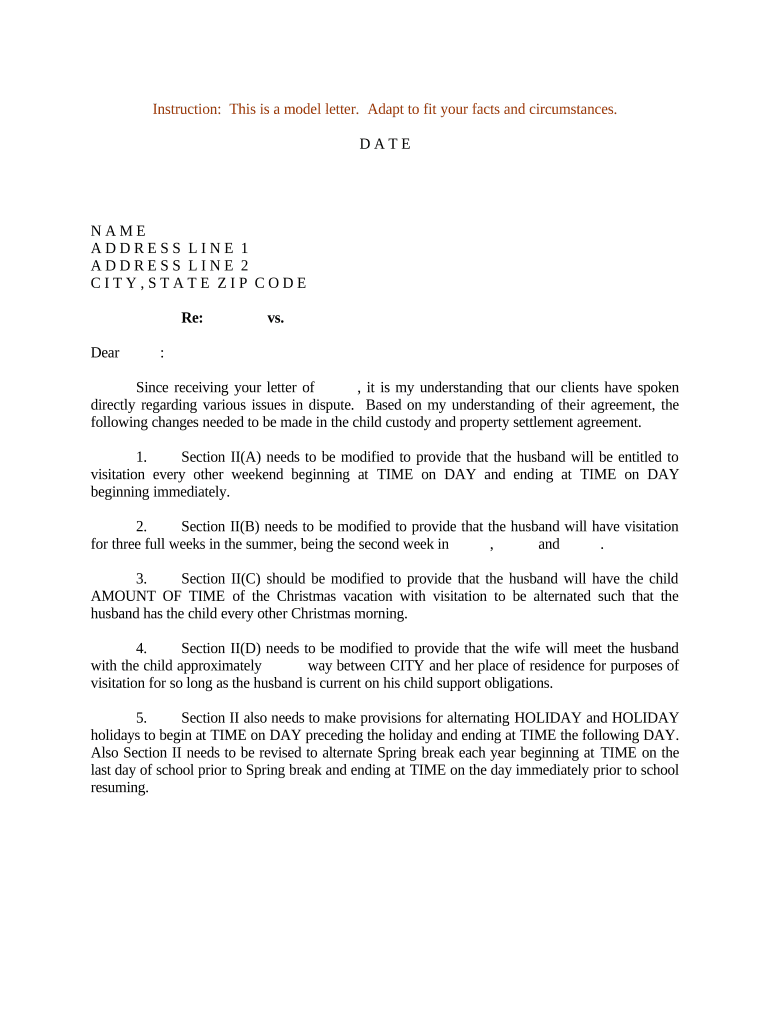
Division of Property

Describe real property, bank accounts, investments, retirement plans, and personal property with specifics to ensure transfers and title changes are administrable.

Child Custody and Visitation

Set a custody schedule, decision-making authority, holiday allocations, and a dispute-resolution process tailored to the child’s best interests.

Child Support and Spousal Support

State amounts, payment intervals, duration, tax treatment, and triggers for modification or termination with objective calculation methods where possible.

Debts and Liabilities

Allocate responsibility for mortgages, loans, and tax liabilities; include indemnity language to protect the other party from third-party claims.

Enforcement and Dispute Resolution

Include choice of law, venue, arbitration or mediation clauses, attorney fee provisions, and terms for seeking court enforcement of settled obligations.

Security and Compliance Considerations

Encryption: TLS 1.2/1.3 and AES-256
Audit Trail: Timestamped actions and IP
HIPAA Support: BAA available if needed
ESIGN & UETA: Meets electronic signature standards
Access Controls: Role-based permissions
Document Export: PDF/A and full history

Risks if the Settlement Is Incomplete or Incorrect

Invalid Signature: May be unenforceable
Missing Consent: ESIGN consent defects
Incorrect Dates: Affects obligations timing
Undisclosed Assets: Can lead to rescission
Improper Notarization: Court may reject
Late Filing: Delays judgment entry

Common Preparation Mistakes to Avoid

  • Using vague asset descriptions that make transfers and title changes impracticable or disputed at enforcement time.
  • Failing to match legal names or including nicknames, which can complicate enforcement and bank or title transfers.
  • Assuming verbal modifications are effective without executing written amendments; oral changes are difficult to prove.
  • Not addressing tax consequences for retirement or property transfers, which can create unexpected liabilities after settlement.

Typical Digital Signing Workflow for a Settlement Agreement

Digital workflows let parties sign remotely while preserving a complete audit trail; follow authentication and consent steps for legal validity.

  • Upload document: Prepare the final PDF and place signature fields.
  • Set signer order: Determine sequential or parallel signing for parties.
  • Authenticate signers: Use email, SMS code, or higher-level authentication.
  • Complete audit trail: Capture timestamps, IP addresses, and signed copies.

Recommended eSigning Settings for Settlements

Configuring authentication, field behavior, and template settings ensures consistent execution and easier court presentation.

Field Configuration
Signature order Sequential signing to ensure each party reviews prior signatures
Authentication Email + optional SMS code for added identity assurance
Conditional fields Reveal asset sections only when selected by party
Template save Save as template for multi-case law firm use

Technical Considerations for Digital Execution

Choose a platform that supports secure signatures, audit trails, and the integrations you need for document delivery and storage.

  • Integrations: Salesforce, NetSuite, Google Workspace
  • Supported formats: PDF, DOCX, HTML
  • Authentication options: Email, SMS, KBA

Confirm the provider supports any required compliance (for example a BAA for protected health information) and can produce an immutable audit trail suitable for court review.

Timing Considerations During Settlement and Filing

Timelines depend on negotiation complexity and local court rules; allow time for review, notarization, and any required court procedures.

Negotiation period:

Allow several weeks for asset valuation and agreement drafting.

Execution window:

Signatures should be gathered promptly to reflect current financial facts.

Court filing:

Check local rules for filing deadlines and required supporting documents.

Incorporation:

Agree whether terms will be incorporated into the final judgment.

Post-judgment changes:

Modifications often require court approval and show changed circumstances.

Real-world Examples of Digital Document Use in Legal Workflows

Firms and companies use digital signing to speed execution and reduce the burden of in-person signatures when appropriate for the document type.

Optica Ventures LLC

A small legal-services team moved routine settlement signings online to reduce in-person meetings

  • Reduced turnaround times for client approvals
  • "The interface is simple and easy-to-use for our team; more importantly, it is just as easy for our customers."

Xerox (NetSuite Operations)

An enterprise team standardized templates and integrated signing into NetSuite to avoid manual processing

  • Centralized template management and audit trails improved compliance
  • "airSlate SignNow provides us with the flexibility needed to get the right signatures on the right documents, in the right formats, based on our integration with NetSuite."

Comparing eSignature Pricing and Core Features

Pricing and feature availability vary by vendor and plan; signNow is listed first for direct comparison across common criteria.

signNow DocuSign Adobe Sign PandaDoc HelloSign
Starting Price $8/user/mo $15/user/mo $14/user/mo $19/user/mo $15/user/mo
Free Trial 7-day free trial Varies by vendor Varies by vendor Varies by vendor Varies by vendor
Bulk Send Yes Yes Yes Yes No
Audit Trail Yes Yes Yes Yes Yes
HIPAA Compliant Yes Yes Yes No No
Envelope Cap No envelope cap 100 envelopes/user/year Varies Varies Varies

Frequently Asked Questions About Divorce Settlements

Answers to common questions about execution, enforceability, and electronic signing of settlement agreements.


Need help? Contact support

be ready to get more
Join over 28 million airSlate SignNow users