Establishing secure connection…Loading editor…Preparing document…

Release of Owner of Drag Racing Car by Driver from Responsibility for Injuries or Death

This template is fully customizable. Edit the text, fill out the fields, and send it for signature. Give it a try!
Release of Owner of Drag Racing Car by Driver from Responsibility for Injuries or Death

What this release is and where it applies

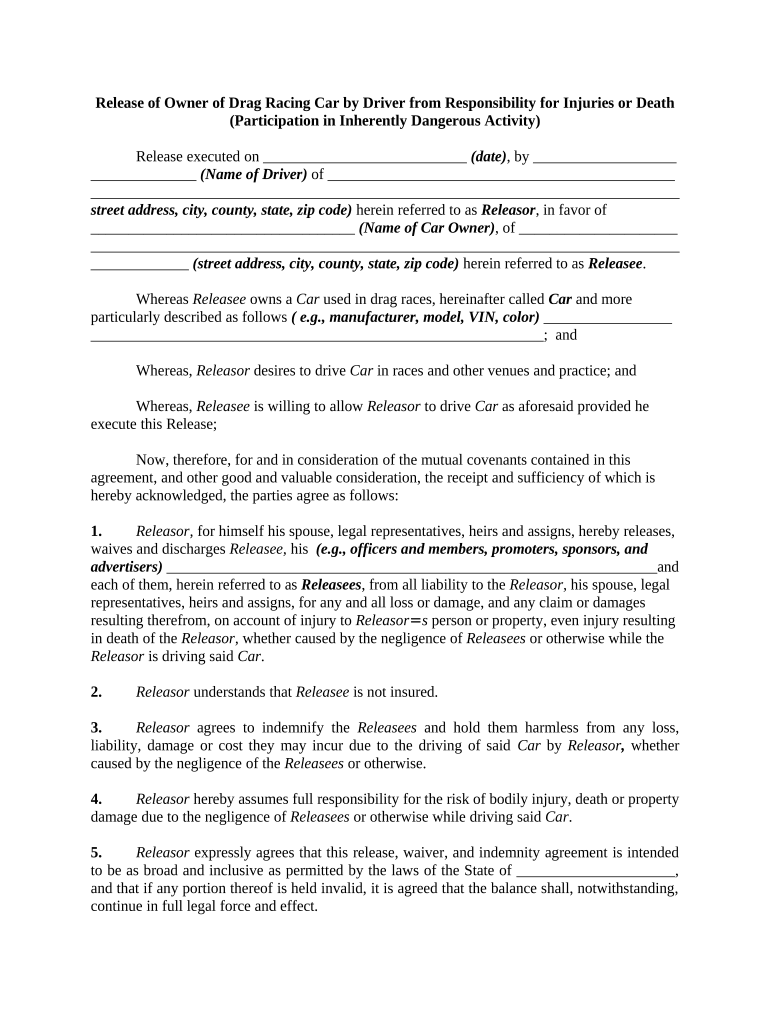
A Release of Owner of Drag Racing Car by Driver from Responsibility for Injuries or Death is a written waiver and indemnity where a driver agrees to release the vehicle owner from liability for injury or death arising from drag racing activities. It typically identifies the parties, vehicle, event or private use conditions, assumptions of risk, indemnification language and signature blocks. These releases are used for private track events, informal competitions, and vehicle testing; they do not eliminate liability for gross negligence or criminal acts and must be drafted with clear, specific language to increase enforceability under U.S. contract and tort law.

Why this release matters for owners and organizers

A clear release allocates risk between driver and owner, documents consent to hazardous activity, and records compensation or consideration. Properly drafted releases reduce litigation exposure and clarify insurance responsibilities.

Why this release matters for owners and organizers

Who typically completes and signs this release

Common users include private car owners, drivers participating in high-risk events, and event hosts who collect waivers.

  • Vehicle owners and lenders who loan or rent cars for drag events.
  • Drivers and participants engaging in informal or sanctioned drag racing.
  • Event organizers, track operators, and promoters collecting participant waivers.

Each signatory should understand rights waived, insurance implications, and whether the document will be notarized or retained for claims and audits.

Step-by-step: completing the release

Follow these sequential actions to complete a legally sound release.

  • 01
    Review Terms: Read the scope, risk, and indemnity clauses before signing.
  • 02
    Provide Information: Enter accurate names, vehicle VIN, event date and consideration.
  • 03
    Initial and Sign: Initial key sections if requested, then sign and date the document.
  • 04
    Authenticate: Notarize or use electronic authentication if required by venue or insurer.

Where to file, submit, and who should keep copies

After signing, route copies to all relevant parties and retain an accessible record for claims or audits.

  • Owner Copy: Owner retains original release for defense and insurance notices.
  • Driver Copy: Driver keeps a signed copy to confirm agreed allocation of risk.
  • Event Organizer: Organizer retains copies for participant records and incident investigation.
  • Insurer: Provide copy to relevant insurers when requested for claims handling.

Configuring an online signing workflow

Set up a simple digital workflow to collect, authenticate, and store signed releases.

Field Configuration
Signer Order Owner then driver, or parallel signing as appropriate
Authentication Email link; optionally add SMS or ID verification
Notary Option Include remote notary step when legally required
Storage Save signed PDF with audit trail in secure repository

Technical requirements for digital execution

Choose a platform that provides secure e-signing, tamper-evident PDFs, and audit trails for each signature event.

  • File Formats: PDF, DOCX supported
  • Integrations: CRM and storage integrations available
  • Authentication: Email, SMS, or advanced ID options

Ensure the platform supports ESIGN/UETA legal requirements, offers retention and export options, and allows delivery of copies to owner, driver, event organizer and insurer without adding data exposure risk.

Essential clauses every release should include

A well-drafted release contains specific, unambiguous sections so courts and insurers can determine intent and scope.

Parties

Clearly identify owner, driver, and any additional releasees with legal names and capacities to avoid ambiguity in enforcement and claim administration.
Activity Description

Specify the drag racing event, location, dates and permitted activities so the release covers the intended hazardous conduct without overbroad language.

Assumption of Risk

State that the driver understands and accepts inherent risks, using clear phrases rather than boilerplate to improve enforceability.

Indemnification

Include mutual or one-way indemnity terms allocating defense costs, damages, and attorney fees for third-party claims resulting from the activity.

Limitations

Specify whether the release excludes gross negligence or willful misconduct and confirm applicable insurance coverage requirements or waivers.

Signatures and Date

Provide signature blocks for driver and owner, space for witness or notary acknowledgment, and a clear effective date for the document.

Required information elements

Driver DOB: DOB for identity
Driver License: State and number
Vehicle VIN: VIN for vehicle ID
Event Date: MM/DD/YYYY
Insurance Info: Carrier and policy number
Emergency Contact: Name and phone

Key legal risks and enforcement limits

Unenforceability: Overbroad waivers risk being void
Gross Negligence: May remain actionable despite release
Criminal Acts: Cannot release criminal liability
Insurance Denial: Improper wording can trigger coverage disputes
Minor Signers: Releases by minors often voidable
Ambiguous Scope: Leads to litigation and added costs

Common drafting and execution mistakes

  • Using vague terms such as 'any injuries' without tying the language to defined activities increases the chance a court will limit the waiver's scope.
  • Failing to identify the vehicle by VIN or failing to date the release creates factual disputes during claims or litigation.
  • Relying on cursory verbal consent or unsigned forms; without documented intent and signature, an electronic or paper release may be unenforceable.
  • Ignoring witness or notarization requirements where state law or event rules require them, which can invalidate the acknowledgment or complicate probate or insurance review.

eSignature vendor pricing and capability snapshot

Compare starting price and core capabilities for common eSignature vendors when collecting releases and waivers; signNow is listed first per vendor order conventions.

signNow DocuSign Adobe Sign PandaDoc HelloSign
Starting Price $8/user/mo $15/user/mo $14/user/mo $19/user/mo $15/user/mo
Free Trial Yes, 7-day trial Verify Verify Verify Verify
Bulk Send Yes (Business Premium) Verify Verify Verify Verify
Audit Trail Yes Yes Yes Yes Yes

How other organizations manage high-risk releases

Real customers highlight practical benefits of secure digital signatures and centralized records management.

Optica Ventures — Brian Fitzgibbons

The interface is simple and easy-to-use for our team; more importantly, it is just as easy for our customers.

  • Practical adoption across dispersed signers.
  • Centralized signed copies and audit trails reduced follow-up time and improved record reliability for event operators.

Martin Properties — Tim Martin

I can process and execute all of these documents online with 100% compliance and built-in security.

  • Mobile and offline signing helpful on-site.
  • Faster turnaround and consistent signature records made incident follow-up and insurance submissions more efficient for property managers.

Practical tips to increase enforceability and clarity

Use precise phrasing, confirm signer identity, and align releases with insurance and event rules.

Use Plain Language
Draft the release in clear, specific terms describing activities covered, avoiding broad catch-all phrases that courts may construe narrowly.
Require ID Verification
Authenticate signers with government ID or multi-factor electronic verification to strengthen attribution and defend against fraud claims.
Tailor to State Law
Address notarization or witness rules for the relevant state and avoid relying on a one-size-fits-all form across jurisdictions.
Coordinate with Insurers
Confirm that release language and insurance certificates align so coverage is not inadvertently voided when an incident occurs.

Frequently asked questions and practical answers

Answers to common legal and procedural questions about releases, signatures, and recordkeeping.


Need help? Contact support

be ready to get more
Join over 28 million airSlate SignNow users