Establishing secure connection…Loading editor…Preparing document…

Grant of Easement to Advertise

This template is fully customizable. Edit the text, fill out the fields, and send it for signature. Give it a try!
Grant of Easement to Advertise

What a Grant of Easement to Advertise Is

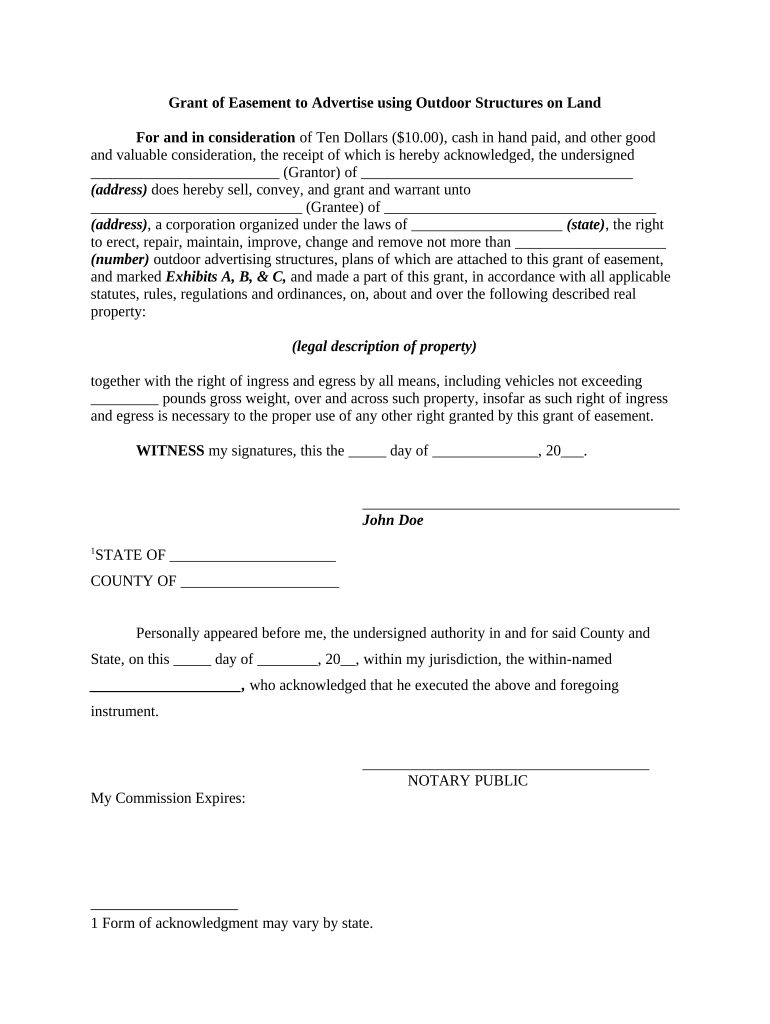
A Grant of Easement to Advertise is a legal instrument in which a property owner grants another party the right to place, maintain, and operate advertising structures or signage on a defined portion of the owner's land. The agreement defines location, dimensions, access rights, term, compensation or consideration, maintenance responsibilities, insurance and indemnity, and any restrictions such as illumination or size limits. It may be recorded in the land records to provide notice to future owners. Drafting should be specific to property lines and local ordinances to prevent disputes and ensure enforceability.

Why a Clear Easement Matters

Provides a clear legal framework for signage placement, protecting both property rights and advertiser interests. It allocates responsibility for installation, maintenance, liability, and compensation, and can be recorded to bind successors. Precise terms reduce dispute risk and help comply with local zoning and sign codes.

Why a Clear Easement Matters

Who Typically Drafts or Signs This Document

Typical users include property owners, outdoor advertisers, commercial landlords, and site managers who need clear legal rights for sign placement and access.

  • Property owners — grant or restrict outdoor advertising rights and receive compensation or conditions.
  • Advertisers / media companies — secure location, term, and maintenance obligations for signage.
  • Local governments and zoning officials — review easements for code compliance and public safety concerns.

Core Elements to Include for Enforceability

A professionally drafted Grant of Easement to Advertise should balance clarity and enforceability by specifying location, scope, term, liabilities, compensation, and recording instructions.

Location

Define the easement area with metes and bounds or survey references, include setbacks and coordinates, and attach a survey exhibit to avoid ambiguity during enforcement.
Scope

List permitted sign types, maximum dimensions, allowable illumination, mounting methods, and restrictions such as advertising content or tenant exclusivity and duration limits to prevent disputes.

Term

Specify commencement date, fixed or renewable term length, notice procedures for termination, abandonment clauses, and formal procedures for renewal, extension, or assignment upon sale.

Maintenance

Allocate responsibilities for installation, routine maintenance, repairs, and removal; state who bears costs and timelines for corrective action to address damage or code violations.

Insurance

Require liability insurance minimums, naming the property owner as additional insured, include certificate delivery deadlines, and specify deductible and subrogation waiver terms.

Recording

State intent to record, identify the county recorder, note required acknowledgements, and set procedures for recording costs and subsequent amendments or assignments.

Step-by-Step: Completing the Easement

Follow these steps to complete a Grant of Easement to Advertise, ensuring clarity on parties, property, rights, term, compensation, and recording.

  • 01
    Identify Parties: Enter full legal names and contact details for each party.
  • 02
    Describe Property: Specify parcel, address, and recorded legal description.
  • 03
    Define Rights: State permitted sign types, dimensions, and placement limits.
  • 04
    Term & Compensation: Record the easement term, renewal options, and payment details.

How the Grant Is Typically Executed and Recorded

Typical process for granting advertising easement from negotiation through execution and recording, highlighting key steps and responsible parties.

  • Negotiate Terms: Agree on scope, term, and compensation.
  • Draft Document: Prepare legal description and exhibits.
  • Execute & Notarize: Sign, notarize, and obtain witness signatures if required.
  • Record Instrument: Submit to county recorder and pay fees.

Recommended Digital Workflow Settings

Configure a digital workflow to collect signatures, attach exhibits, and record execution metadata for the easement document.

Field Configuration
Upload Document PDF with survey exhibit attached
Signer Order Specify party sequence or parallel signing
Auth Method Email link or SMS code; consider stronger id
Storage Save signed copy with audit trail

Platform Capabilities to Support Easement Execution

Choose platforms that support PDF, Word, RON notarization, secure storage, and audit trails to meet recording and compliance needs.

  • File Formats: PDF, DOCX, and image support
  • Integrations: Link to CRM and cloud storage
  • Notarization: Support for eNotary or RON sessions

Security and Compliance Considerations

Encryption: TLS 1.2/1.3 in transit; AES-256 at rest
Certifications: SOC 2 Type II; ISO 27001; PCI DSS
HIPAA: BAA required for protected health information
Regulatory Compliance: ESIGN and UETA recognized for enforceability
Audit Trail: Comprehensive logs with timestamps and IP
Accessibility: WCAG 2.0 Level AA support

Common Risks and Consequences

Recording Rejection: Omitted notary or incorrect description
Loss of Rights: Vague terms may forfeit easement
Zoning Fines: Noncompliant signs can incur fines
Liability Exposure: Insufficient insurance increases risk
Title Clouding: Undisclosed easements complicate sales
Assignment Disputes: Missing consent triggers litigation

Practical Tips to Reduce Disputes and Delays

Practical tips to reduce disputes and speed enforcement when drafting, executing, and recording advertising easements in compliance with local rules.

Use precise legal descriptions
Attach a certified survey or metes-and-bounds description. Avoid vague references to 'front yard' or 'near driveway.' Accurate descriptions ensure the recorder accepts the instrument and prevent encroachments or title disputes during resale.
Coordinate permits and zoning
Confirm local sign ordinances, obtain necessary permits, and align easement terms with municipal restrictions on size, illumination, and placement. Require evidence of permits and include permit-contingent clauses to protect parties from enforcement actions.
Require insurance and indemnity
Specify minimum liability insurance limits, name the owner as additional insured, and include indemnity language allocating responsibility for third-party claims, damage, and indemnification procedures, reducing litigation risk and clarifying claim handling.
Record promptly and clearly
Record the executed easement with the county recorder, include acknowledgements, and pay recording fees. Provide recorded copies to lenders and tenants to prevent title surprises and ensure enforceability against subsequent purchasers.

Typical Timeline Milestones

Typical timelines for completing and recording an advertising easement depend on negotiation complexity, local recording schedules, and any permit requirements.

Negotiation Period:

1–8 weeks depending on complexity and stakeholder review.

Document Drafting:

1–2 weeks for counsel to prepare and review drafts.

Execution & Notarization:

Immediate to one week depending on signer availability and RON.

Recording Time:

County recorder processing varies — typically 1–4 business days.

Insurance & Permits:

Certificates and permits often required before signage installation.

Real-World Examples

Two examples illustrate how organizations use digital workflows to execute and manage advertising easements.

Optica Ventures

Optica Ventures used a digital signature workflow to execute advertising easements across multiple properties efficiently.

  • Reduced turnaround and simplified customer interactions.
  • Brian Fitzgibbons, COO, observed that the interface is simple and easy to use for staff and customers, enabling faster execution and fewer follow-ups when securing sign locations and recording easements.

Martin Properties

Martin Properties processes and executes property-related documents online, including advertising easements for commercial listings.

  • Mobile and offline signing improved completion rates.
  • Tim Martin, Founder, said he can process and execute documents online with full compliance and built-in security, enabling on-the-go approvals, reliable recordkeeping, and faster revenue realization when granting or modifying sign easements.

eSignature Pricing and Feature Snapshot

Compare common eSignature vendor plans and capabilities relevant to executing and storing signed advertising easements.

signNow DocuSign Adobe Sign PandaDoc HelloSign
Starting Price $8/user/mo $15/user/mo $14/user/mo $19/user/mo $15/user/mo
Free Trial 7-day free trial (no credit card) Varies by plan Varies by plan Varies by plan Varies by plan
Bulk Send Yes (Business Premium) Varies by plan Varies by plan Varies by plan Varies by plan
Audit Trail Yes Yes Yes Yes Yes
HIPAA Compliant Yes Yes Yes No No

FAQs and Troubleshooting

Answers to common questions about drafting, signing, recording, and enforcing a Grant of Easement to Advertise in the United States.


Need help? Contact support

be ready to get more
Join over 28 million airSlate SignNow users