Establishing secure connection…Loading editor…Preparing document…

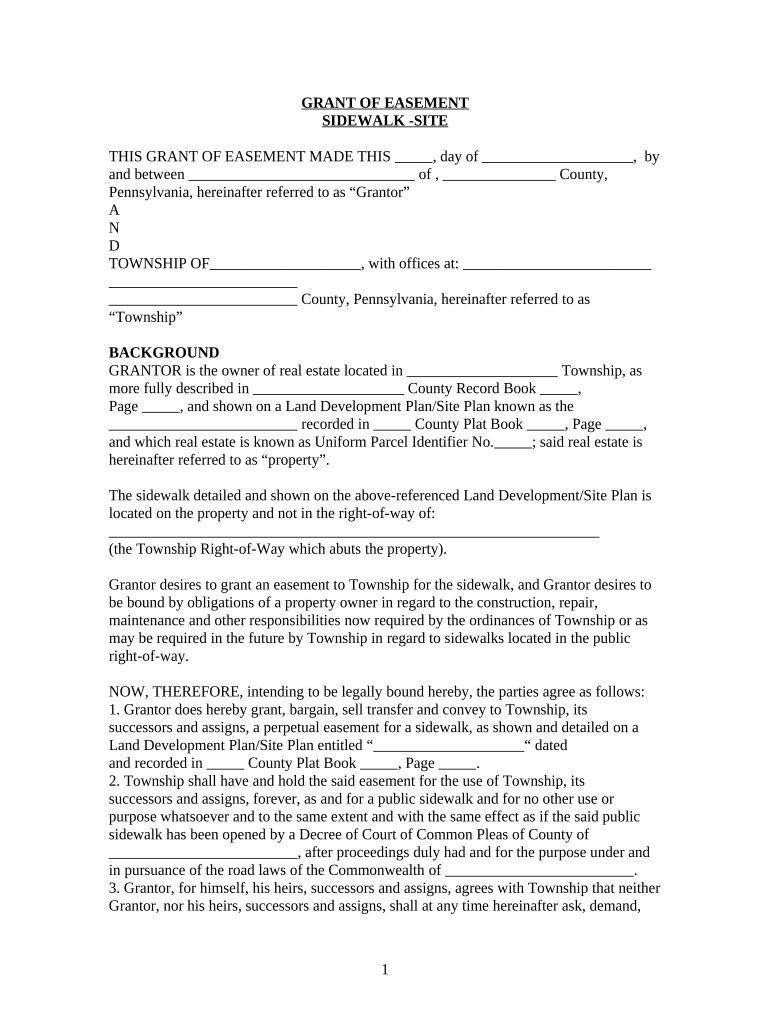
Easement Agreement

This template is fully customizable. Edit the text, fill out the fields, and send it for signature. Give it a try!
Easement Agreement

What an Easement Agreement Is and when it’s used

An Easement Agreement is a written contract granting a right to use another person’s real property for a specific purpose while preserving ownership. It identifies the grantor (property owner) and grantee (beneficiary), describes the easement location and scope with a legal description, and sets duration, maintenance obligations, and any compensation. Easements can be perpetual, term-limited, exclusive or non-exclusive, and may be appurtenant (tied to land) or in gross (tied to a person or entity). Proper execution and recording place notice on the public record and protect priority.

Why a clear Easement Agreement matters

A professionally drafted Easement Agreement clarifies rights and responsibilities, reduces future disputes over access and maintenance, preserves property value, and creates a public record that protects both parties and subsequent owners.

Why a clear Easement Agreement matters

Who commonly prepares and signs easement agreements

The document is used by parties who need legal access or use rights across another’s land, as well as by professionals who manage or record those rights.

  • Property owners granting access for utilities, driveways, or drainage easements.
  • Utility companies, municipalities, and contractors needing legal access for installation and maintenance.
  • Title companies, surveyors, and attorneys who prepare or review legal descriptions and recording language.

Typical signers and their roles

Property Owner

Individual or entity that owns the servient estate and executes the easement grant; should provide clear legal name, authority documentation if entity, and notarized signature to support recording and title clearance.

Grantee / Holder

Person, company, or public entity that receives the easement right; should confirm scope, maintenance obligations, insurance responsibilities, and deliver corporate authorization or power-of-attorney when signing for organizations.

Core components to include in a professional Easement Agreement

A complete agreement reduces ambiguity and increases enforceability; include precise definitions, survey-based descriptions, term limits, obligations, remedies, and recording instructions.

Parties

Full legal names of grantor and grantee with entity type and contact addresses, plus signatory titles when signed by an organization.
Legal Description

Survey metes-and-bounds or recorded-plat reference describing the servient parcel and the exact easement area or centerline.

Scope of Use

Specific permitted activities (access, utilities, maintenance), exclusive or non-exclusive rights, and any prohibitions or limitations.

Duration

Specify start date, termination date or perpetuity, renewal mechanics, and conditions for automatic cessation if applicable.

Maintenance & Liability

Allocate maintenance duties, repair standards, indemnity, insurance requirements, and restoration obligations following work.

Recording & Remedies

Instruction to record in county land records, remedies for breach, and how disputes will be resolved including governing law.

Step-by-step: preparing and executing an Easement Agreement

Follow a clear sequence from drafting to recording to ensure enforceability and public notice.

  • 01
    Draft: Prepare full terms and attach survey or exhibit for location details.
  • 02
    Review: Have title company or attorney confirm legal description and title impact.
  • 03
    Execute: Sign before a notary and obtain any required witness signatures.
  • 04
    Record: File the executed document with the county recorder for public notice.

Typical workflow for creating and finalizing an Easement Agreement

A predictable workflow reduces errors and speeds recording; coordinate drafting, approvals, signature, and filing steps.

  • Request Setup: Collect survey, parcel ID, and party information before drafting.
  • Internal Approval: Obtain board or owner approvals if the grantor or grantee is an entity.
  • Authentication: Execute with notarization and witnesses per state requirements.
  • County Recording: Submit original executed instrument to county recorder for indexing.

Digital signing and authentication settings to use

Configure signer identity and field rules to align with local notarization and recording requirements when using electronic workflows.

Field Configuration
Signature Field Require signer signature and date on signature block
Notary Block Include acknowledgement block formatted per county template
Authentication Use email + SMS code or ID verification for identity proofing
Attachments Attach survey exhibits as referenced numbered exhibits

Technical delivery and integration considerations

Choose platforms that support PDF, DOCX uploads, audit trails, and the authentication level required by the jurisdiction.

  • File Formats: PDF and DOCX are widely accepted for upload and storage
  • Integrations: Connectors to Salesforce, NetSuite, and Google Workspace streamline workflows
  • Authentication: Support for SMS codes, ID analysis, and SSO increases signer confidence

Verify that the chosen platform retains a tamper-evident audit trail and supports export of an executed PDF suitable for county recording.

Timing considerations and recommended filing practices

Easement priority depends on timely recordation and clear execution; local rules vary so act promptly after execution.

Record Promptly:

Record executed instrument with the county recorder as soon as possible to protect priority.

Notary Timing:

Execute before the notary; notarization date should match signature date for recording clarity.

Survey Before Filing:

Obtain a survey or exhibit prior to recording to avoid rejection or reindexing.

Entity Approvals:

Allow time for corporate sign-off and resolutions when entities are grantor or grantee.

Title Company Review:

Coordinate title insurance or escrow review to confirm recording instructions and fees.

Key milestones from draft to recorded easement

Track each milestone so document execution and recording proceed without gaps that could affect priority.

01

Draft Complete

Finalize legal description, exhibits, and parties before circulating for signature.

02

Approval Obtained

Secure internal authorizations and any municipal or HOA approvals required.

03

Execution & Notarization

All parties sign before a notary and any required witnesses observe and sign.

04

County Recording

File the original executed instrument and pay applicable recording fees.

Common preparation and execution pitfalls to avoid

  • Using a street address instead of a survey-based legal description can render the instrument unrecordable and cause title issues down the road.
  • Failing to confirm corporate signing authority or attaching a corporate resolution can create grounds to challenge the easement.
  • Omitting clear maintenance or indemnity obligations leads to recurring disputes between the servient owner and easement holder.
  • Not recording promptly risks subsequent liens or conveyances taking priority over the unrecorded easement right.

Risks and legal consequences of a deficient Easement Agreement

Title Disputes: Clouds on title
Recording Rejection: Instrument returned
Loss of Priority: Subsequent liens prevail
Enforcement Issues: Ambiguous scope limits remedies
Financial Exposure: Unexpected maintenance costs
Liability Claims: Personal injury exposure

Representative eSignature pricing and feature comparison

Basic pricing and features for common eSignature providers. Verify plan specifics and enterprise terms directly with each vendor before purchase.

signNow DocuSign Adobe Sign PandaDoc HelloSign
Starting Price $8/user/mo $15/user/mo $14/user/mo $19/user/mo $15/user/mo
Free Trial 7-day free trial, no credit card required Varies Varies Varies Varies
Bulk Send Yes (Business Premium) Yes Yes Yes Varies
Audit Trail Yes Yes Yes Yes Yes
HIPAA Compliant Yes Yes Yes No No

Practical easement scenarios

Real-world scenarios show how easement agreements solve recurring access and utility needs while highlighting documentation best practices.

Developer Access Easement

A developer granted a non-exclusive construction access easement to reach a rear parcel while minimizing disturbance to neighbors.

  • The easement required a restoration clause.
  • Proper survey exhibits, clear start and end dates, and recorded notice avoided later title objections and clarified contractor responsibilities.

Utility Maintenance Easement

A utility company secured an easement in gross to maintain underground lines across private lots.

  • It included indemnity language.
  • Including insurance requirements, periodic inspection rights, and a recorded maintenance schedule reduced service interruptions and clarified cost allocation for repairs.

Frequently asked questions about Easement Agreements

Answers to common legal and process questions about drafting, signing, notarizing, and recording easement agreements in the United States.


Need help? Contact support

be ready to get more
Join over 28 million airSlate SignNow users