Establishing secure connection…Loading editor…Preparing document…

Underground Easement

This template is fully customizable. Edit the text, fill out the fields, and send it for signature. Give it a try!
Underground Easement

What an Underground Easement Is and when it's used

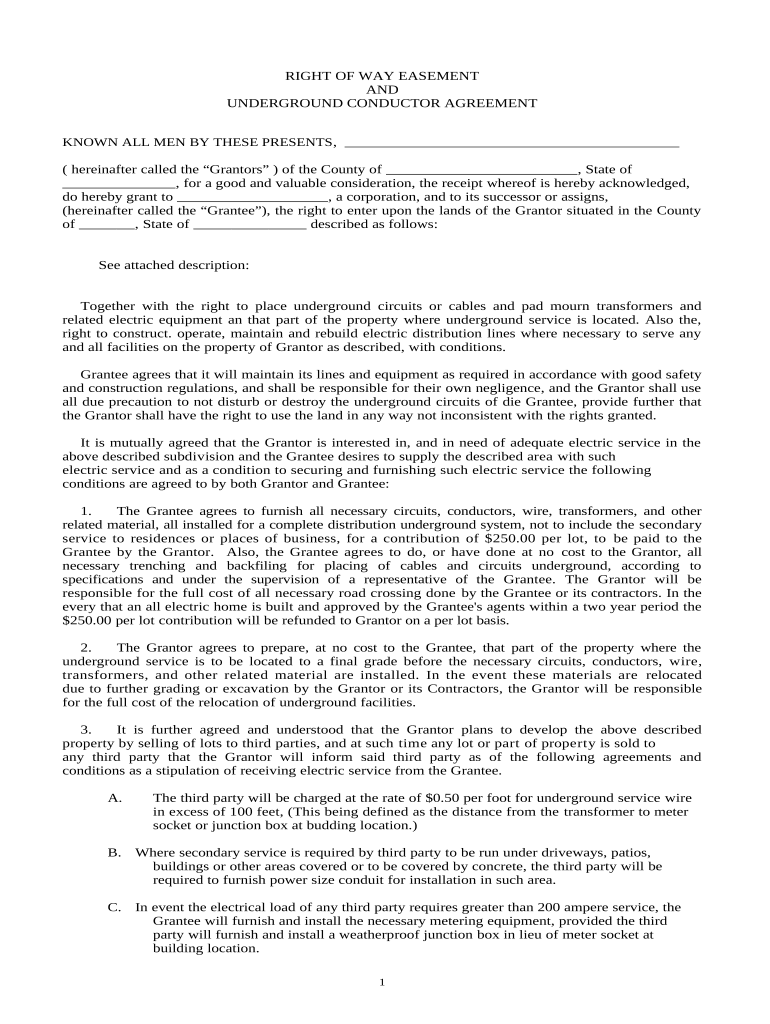
An Underground Easement is a recorded legal instrument that grants a person or utility company the right to install, access, maintain, repair, or replace infrastructure located below the surface of private property. Typical uses include water, sewer, storm drainage, gas, electrical conduits, fiber optic lines, and other buried utilities. The easement describes the exact area affected by bearings, distances, or metes and bounds and usually includes permitted uses, access rights, maintenance obligations, indemnities, term or perpetuity, and any compensation or consideration. Recording the easement provides notice to future owners and attaches to the property title.

Why a clear Underground Easement matters

A precise Underground Easement clarifies who may use the subsurface area, prevents disputes, preserves title marketability, and allocates maintenance and liability. Recording the easement creates public notice and protects both grantor and grantee by defining access, limits, and compensation.

Why a clear Underground Easement matters

Who commonly prepares and signs Underground Easements

Typical parties include property owners granting rights, utilities or developers receiving rights, and title or escrow agents facilitating recording.

  • Property owners transferring specified subsurface rights while retaining surface ownership and use.
  • Utility companies or municipal agencies needing permanent access to install and maintain subterranean lines.
  • Title companies, surveyors, and escrow officers who confirm legal descriptions and record the document.

The set of signers and reviewers varies by transaction size and public involvement; large projects often include municipal approvals or utility board resolutions.

Primary signers and their roles

Property Owner

The grantor must be the recorded owner with authority to convey or encumber the land. The owner should confirm the legal description, sign in the required format, and provide any corporate resolutions or trustee documentation if signing on behalf of an entity.

Utility/Grantee

The grantee (utility, municipality, or private company) accepts the defined rights and any operational limits. The grantee typically provides insurance, indemnity terms, and contact details for maintenance notices; corporate signatories must show signing authority.

Essential parts of a professional Underground Easement

A well-drafted Underground Easement combines precise location data, clear rights and obligations, and recording-ready language that integrates with title and surveying records.

Legal Description

Complete metes-and-bounds or tax-lot description tied to the county parcel; must match the deed and title records to avoid ambiguity or title objections.
Granting Clause

Language that conveys the specific subsurface rights being granted, including whether rights are exclusive or non-exclusive and any limits on use or depth.

Dimensions / Exhibit

A precise description of the easement area with surveyed coordinates, width, depths, and an attached exhibit map or plat showing the area to be recorded and indexed.

Term & Consideration

State whether the easement is perpetual or for a fixed term and state the consideration paid or other exchange to satisfy recorders and escrow requirements.

Access, Maintenance & Repair

Define rights to enter the property, procedures for notice, restoration obligations after work, and allocation of maintenance responsibilities and costs.

Recording & Notices

Required recording instructions, address for notices, title company requirements, and any requirements for lien waivers or insurance endorsements.

Step-by-step: preparing and executing an Underground Easement

Follow these sequential steps to produce a recordable easement with minimal delay and clear post-recording responsibilities.

  • 01
    Drafting: Prepare clear legal description and exhibit from surveyor.
  • 02
    Review and Approvals: Confirm title, insurance, and internal corporate authority.
  • 03
    Signatures and Notary: Obtain required signatures and notarization per state rules.
  • 04
    Recording: File with county recorder and circulate certified copies to stakeholders.

How to configure a digital completion workflow for this easement

Use this configuration checklist when building an online signing and recording workflow to ensure required approvals, exhibits, and authenticated signatures.

Field Configuration
Signature Authentication SMS code or email link for signer verification
Attach Exhibit Require uploaded survey plat before signing
Conditional Fields Show corporate resolution fields when entity signs
Final PDF for Recording Flatten PDF and include signature certificate

Digital flow: from draft to recorded easement

A reliable online flow reduces turnaround time while preserving evidentiary trails needed for title and recorder offices.

  • Upload Document: Import PDF and attach survey exhibit
  • Place Fields: Add signature, date, and initial fields
  • Send to Signers: Distribute by email link or bulk send
  • Notarize & Record: Perform notarization (in-person or RON) and submit recording copy

Digital signing and format considerations

Choose a platform that preserves an audit trail, supports standard file formats, and can produce a recording-ready PDF.

  • File Types: PDF/A or flattened PDF preferred
  • Integrations: Works with title and document management systems
  • Authentication: Supports email, SMS, or advanced signer checks

Verify platform outputs are accepted by your county recorder and that the final PDF includes the signature certificate and any required exhibits.

Key timing and recording expectations

Timelines vary by county and transaction; account for internal approvals, title clearing, and recorder office processing when planning the schedule.

Title Clearance Deadline:

Complete title review before closing or recording.

Recording Window:

Record immediately after execution to provide public notice.

Construction Start:

Begin excavation only after recorded easement and locate clearances.

Notice for Maintenance:

Observe advance notice periods specified in the easement.

Insurance Effective Date:

Match insurance start to easement operation date.

Authentication flow: notarization and witness steps

Notarization and witness requirements affect execution options; confirm state rules and whether Remote Online Notarization (RON) is permitted.

01

Confirm Authority

Verify who can sign on behalf of entities.

02

Determine Notarization

Decide between in-person or RON if allowed.

03

Witness Requirements

Add witness lines where state law demands them.

04

Record Notary Block

Include proper notary acknowledgment for recording.

05

Audio-Video Record (RON)

Retain session if RON rules require it.

06

Affidavit/Resolution

Attach corporate resolution when entity signs.

07

Certified Copies

Obtain certified copies for filing and stakeholders.

08

Title Endorsement

Request endorsement from insurer post-recording.

Common mistakes to avoid when preparing an Underground Easement

  • Using an imprecise legal description that doesn't match county records, creating ambiguity and potential title objections at recording.
  • Failing to attach or reference the survey exhibit or plat, which leaves contractors without a clear work area and invites disputes.
  • Omitting execution details for entities — missing corporate resolutions or notarized officer signatures can invalidate recording for corporations.
  • Neglecting to state maintenance, restoration, or indemnity obligations clearly, which can lead to costly disputes after installation or repair.

Risks and consequences of incorrect or incomplete easements

Unenforceable Interest: May be void for ambiguity
Title Defect: Insurer exceptions or claim risk
Construction Delay: Work stoppage or extra cost
Trespass Liability: Unauthorized work exposure
Regulatory Penalties: Local fines for improper work
Insurance Gaps: Coverage exclusions on projects

Illustrative scenarios where Underground Easements are used

Two representative project scenarios show common drafting priorities and post-recording steps.

Municipal Water Main Extension

A city obtains a perpetual easement to extend a water main across private parcels, including exact centerline coordinates and restoration obligations

  • Utility requires a 48-hour notice before entry
  • Recording included map exhibit, title endorsement, and an insurance clause naming the city as additional insured for construction risks and ongoing maintenance.

Private Fiber Installation

A telecom company negotiates non-exclusive 20-year subsurface rights with defined depth limits and conduit placement criteria

  • Contractor access limited to specified hours for surface restoration
  • The easement attaches a signed survey, includes indemnity for fiber installation, and requires the grantee to repair disturbance within 30 days after work.

Typical eSignature vendor pricing and feature snapshot for easement workflows

Compare cost and capabilities that affect high-volume, notarized, or recording-ready document processes; signNow is listed first per platform comparisons.

signNow DocuSign Adobe Sign PandaDoc HelloSign
Starting Price $8/user/mo $15/user/mo $14/user/mo $19/user/mo $15/user/mo
Free Trial 7-day free trial No No Yes, limited Yes, limited
Bulk Send Yes Yes Yes Yes No
Audit Trail Yes Yes Yes Yes Yes
HIPAA Compliant Yes Yes Yes No No
Envelope Cap No cap 100 envelopes/user/year Varies Varies Varies

Frequently asked questions about Underground Easements and digital execution

Answers to common execution, recording, and enforceability questions for Underground Easements in the United States.


Need help? Contact support

be ready to get more
Join over 28 million airSlate SignNow users